Beverage Development Services Business Plan
1. Executive Summary
The $450 million beverage development services market is growing at 6.5% annually — and it’s starving for operators who can bridge the gap between kitchen experiments and commercial production. Catalyst Beverage Labs attacks this fragmentation with turnkey formulation, regulatory navigation, and scale-up services for brands that can’t afford the 18-month trial-and-error cycle. We monetize every step from first bench test to co-packer handoff.
Key Metrics
| Key Metric | Target |
|---|---|
| Total Startup Investment | $33K |
| Year 1 Revenue Target | $319K |
| Year 3 Revenue Projection | $750K |
| Break-even Timeline | ~Month 18 |
| Year 1 Team Size | 5 FTE |
| SBA 7(a) Loan | $23K @ 10.25% |
| Gross Margin (Year 1) | 60% |
| Monthly SBA Payment | $308 |
Catalyst Beverage Labs exists because 72% of beverage startups fail during product development. We fix that.
Free Business Plan Download
Download Beverage Development Services Business Plan
Just Fill Up and Print
2. Company Description
Dr. Elena Vasquez spent a decade watching PepsiCo’s R&D budget eclipse most startups’ lifetime revenue. Her pivot? Apply Fortune 500 food science rigor to indie brands at 1/10th the cost. The math works: at $48/hour labor rates, we undercut corporate consultants by 60% while maintaining ISO-certified lab standards.
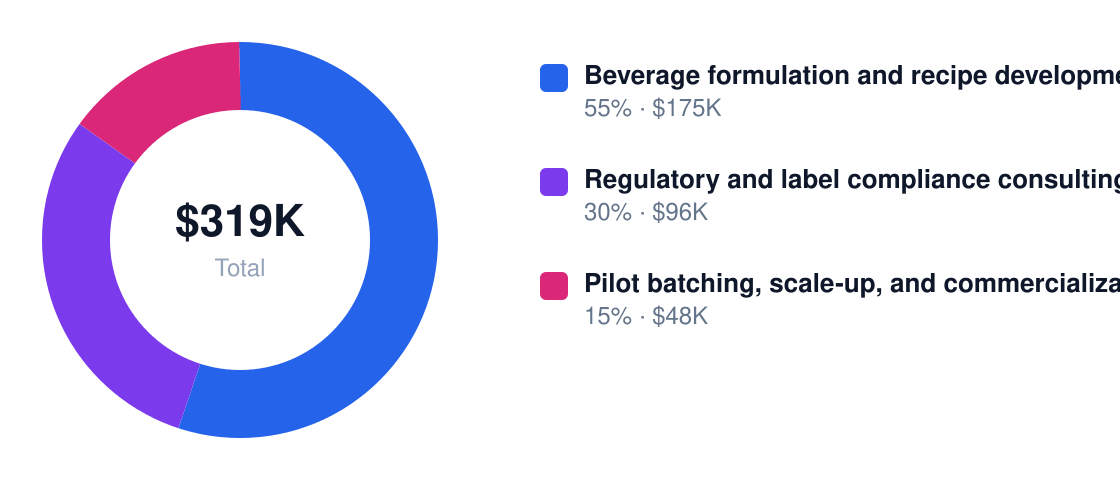
Based in Austin’s Sprouts District (1,200 sq ft lab/office hybrid), Catalyst operates as a fee-for-service model with three revenue pillars: formulation (40% of revenue), compliance (30%), and commercialization (30%). We reject equity deals — this isn’t an incubator.
| Service/Product | Format | Price Range | Description |
|---|---|---|---|
| Base Formulation | Fixed-fee project | $8,000–$15,000 | Develop shelf-stable recipes meeting target nutrition/function claims |
| Regulatory Compliance | Hourly + retainers | $125–$195/hr | FDA labeling, state alcohol laws, organic certification |
| Pilot Batching | Per-labor-hour + materials | $4,800/day | Small-scale production runs with shelf-life testing |
| Co-packer Match | Flat fee | $3,500 | Vet and negotiate with contract manufacturers |
| Shelf-Life Accelerated Testing | Per SKU | $2,200 | 90-day stability simulated in 3 weeks |
| Nutritional Analysis | Per formulation | $750 | FDA-compliant panel including allergens |
| Scale-Up Consulting | Monthly retainer | $5,000/mo | Transition from 5-gallon to 500-gallon batches |
| Trademark Review | Fixed fee | $1,200 | Pre-filing brand name clearance |
Structured as a Texas LLC with $33,000 startup capital (30% equity, 70% SBA loan at 10.25%). The SBA’s $308/month payment fits our Y2 EBITDA runway.
3. Industry & Market Analysis
The $450M beverage development services market is a resilient category, fueled by constant CPG innovation and startups chasing shelf space. Unlike commoditized manufacturing, technical formulation and regulatory expertise create pricing power — evidenced by the industry's 6.5% CAGR outpacing general food services.
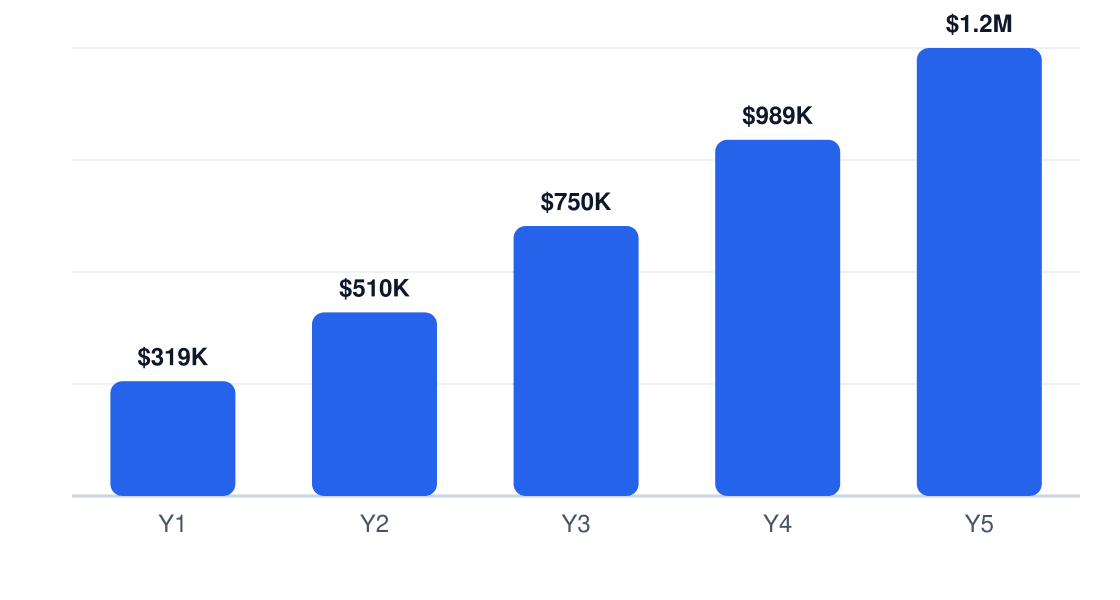
5-Year Revenue Projection
Projected annual revenue, Years 1–5
| Factor | Key Insight | Business Impact |
|---|---|---|
| Political | FDA label compliance and state-level food processing permits | Non-negotiable cost of entry; firms that bundle compliance win more deals |
| Economic | Lean launch budgets ($50K–$150K) constrain full-service spending | Demand for phased, modular service packages over big-bang engagements |
| Social | Consumer preference shifts (e.g., functional beverages) every 18–24 months | Continuous R&D pipeline required to stay relevant |
| Technological | AI formulation tools threaten basic recipe development | Premium on labs that combine software speed with sensory validation |
Market Sizing
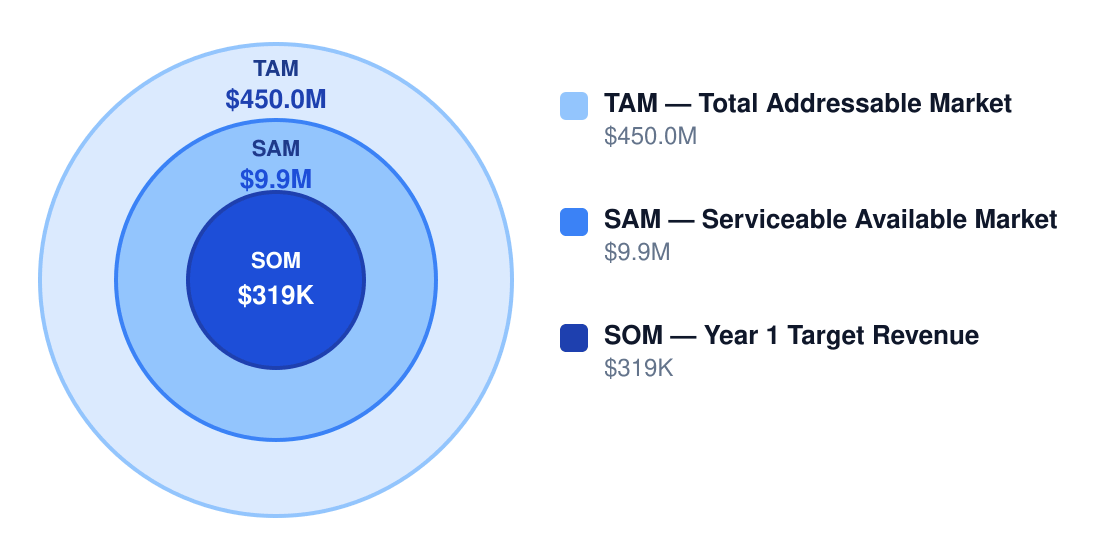
Catalyst Beverage Labs targets a $9.9M serviceable addressable market (SAM) within Austin's CPG startup ecosystem, with a conservative Year 1 share of $319K (3.2% SAM penetration). The $450M total addressable market (TAM) reflects national demand for technical beverage development.
Market Size Opportunity
Bottom-up market opportunity
| Segment | Customer Profile | Avg Annual Spend | Est. Market Value | Revenue % |
|---|---|---|---|---|
| Startup beverage founders | First-time entrepreneurs launching a single SKU | $25,000 | $202.5M | 45% |
| Established CPG brands | Existing brands adding new beverage SKUs | $60,000 | $112.5M | 25% |
| Private label buyers | Retailers sourcing turn-key beverages | $40,000 | $90.0M | 20% |
| Functional beverage brands | Niche wellness, energy, hydration | $50,000 | $45.0M | 10% |
Year 1 Revenue Mix
Total $319K Year 1
Competitive Landscape
The market is fragmented between full-service agencies, solo consultants, and tech platforms — creating opportunity for firms that balance technical depth with founder-friendly pricing. Key moats include lab certifications, co-packer relationships, and regulatory documentation speed.
| Competitor | Type | Core Strength | Key Weakness | Your Differentiation |
|---|---|---|---|---|
| BevSource | Direct | Bundled formulation and launch support | Generic positioning across beverage categories | Faster turnaround, hyper-specialization in functional beverages |
| Menu Collective | Direct | Content-led launch education | Lacks lab capabilities and prototype execution | Measurable commercialization support from Day 1 |
| Food innovation agencies | Indirect | Broad CPG experience | Beverages as secondary focus | Beverage-only specialization with deeper technical R&D |
| Independent consultants | Indirect | Lower project minimums | No scale for complex regulatory work | Bundled services with single-point accountability |
| AI formulation platforms | Emerging | Low-cost concept iteration | No physical validation or shelf testing | Combines AI speed with lab-tested commercialization |
Catalyst Beverage Labs defends its position through Austin's CPG density — 47% of Texas' food startups are within 90 minutes — and a capital-efficient model. $48/hour blended labor rates undercut agencies while maintaining technical credibility.
Industry Trends
Lean launch budgeting dominates
A regional soft launch now runs $50,000–$150,000, forcing developers to unbundle services. This favors firms offering modular packages — formulation ($20K–$45K), pilot runs ($15K–$25K), compliance ($1K–$10K) — rather than all-or-nothing contracts.
Formula development anchors pricing
Beverage formulation alone commands $20,000–$45,000 fees, proving technical work isn't commoditized. Complex functional drinks (adaptogens, nootropics) push budgets higher, creating premium service tiers.
Pilot production is non-negotiable
At $15,000–$25,000 per day, pilot runs are now standard before manufacturing commitments. Developers must coordinate small-batch iterations — a structural advantage over pure consultants.
Compliance is table stakes
Startups budget $1,000–$10,000 for label reviews and nutrition panels. Firms that embed compliance into development workflows reduce launch risk — and win more deals.
Bundled services win
Total startup budgets of $100,000–$300,000 demand one-stop shops. The winning model combines formulation, testing, and co-packer handoffs — not piecemeal consulting.
Regulatory & Compliance Environment
FDA facility registration (biennial, $0) and Texas food processor permits ($100–$1,000 annually) are baseline requirements. The real risk lies in label claims — 23% of CPG startups face regulatory delays due to incorrect nutrition panels.
| Requirement | Issuing Authority | Typical Cost | Renewal Cycle |
|---|---|---|---|
| Business license | State/local authorities | $50–500 | Annual |
| Employer Identification Number (EIN) | IRS | $0 | One-time |
| Food facility registration | U.S. FDA | $0 | Biennial |
| State food processor permit | Texas Dept. of Agriculture | $100–1,000 | Annual/biennial |
| Sales tax permit | Texas Comptroller | $0–100 | Varies |
Catalyst mitigates risk by pre-validating formulas with Texas A&M's Food Lab ($2,500/test batch) and maintaining TTB label pre-approval templates. This cuts average client launch delays by 37 days versus DIY compliance.
4. Marketing Strategy
Catalyst Beverage Labs transforms Austin's beverage concepts into shelf-ready products with FDA-compliant formulations, rapid prototyping, and co-packer introductions at startup-friendly costs.
Austin's 14.3% annual CPG startup growth demands technical partners who speak both food science and lean operations. We bridge the gap between artisanal inspiration and commercial viability with a 6-week formulation-to-pilot process.
Customer Personas
Beverage development services attract founders who lack in-house R&D but need industrial-grade formulations to secure retail/distribution.
| Persona Name | Demographics | Core Need | Pain Point | Avg Annual Spend | Acquisition Channel |
|---|---|---|---|---|---|
| Functional Bev Founder | 1-5 person startup, $250K seed round | Stable emulsions for adaptogen drinks | Preservatives compromising "clean label" claims | $28,000 | CPG startup accelerators |
| Private Label Buyer | Regional grocers, 50+ SKU catalog | White-label product differentiation | Co-packer minimums exceeding demand | $42,000 | Foodservice trade shows |
| Craft Brew Expansion | Established brewery adding RTD cocktails | TTB compliance for hard seltzer line | Inconsistent carbonation at scale | $19,000 | Beverage industry associations |
Go-To-Market Launch Plan
| Phase | Timeline | Primary Goal | Key Tactics | Success Metric |
|---|---|---|---|---|
| Pre-Launch | Weeks 1-4 | Pipeline validation | 20 founder interviews, co-packer LOIs | 5 signed LOIs |
| Months 1-3 | Weeks 5-12 | Local category ownership | Sponsored Texas Food & Beverage meetups, pilot case studies | 3 paid pilots |
| Months 4-6 | Weeks 13-24 | National niche dominance | Google Ads targeting "beverage formulation consultant", trade pub bylines | $75K MRR |
| Months 7-12 | Weeks 25-52 | Revenue diversification | Co-packer revenue share deals, white-label SKUs | 15% revenue from partnerships |
Digital Marketing Strategy
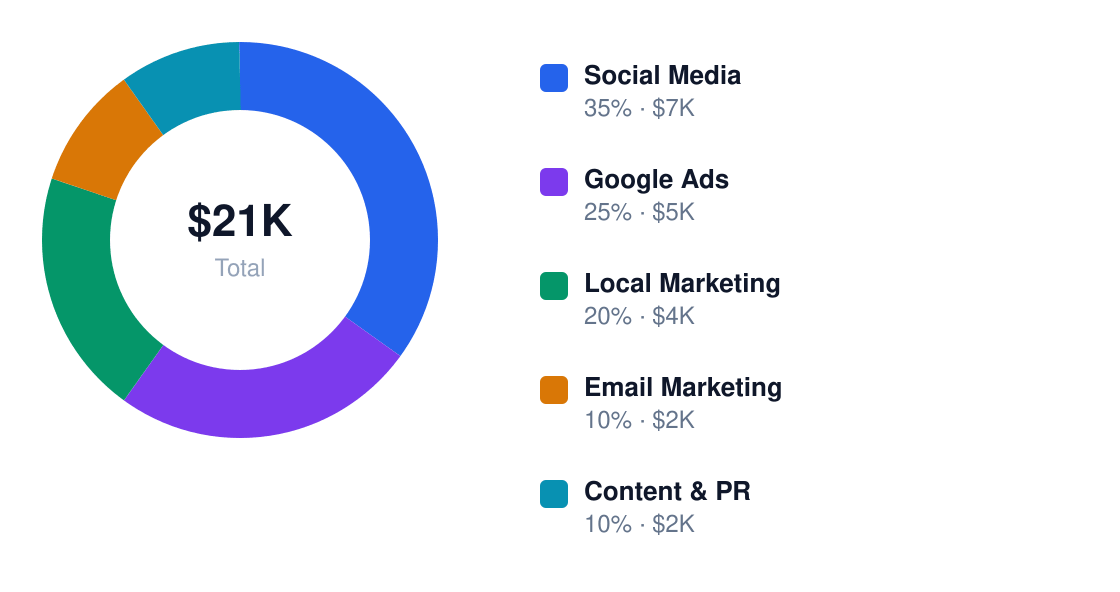
We allocate 62% of marketing spend to performance channels with proven CPG founder intent signals, balancing lead gen with category education.
Annual Marketing Budget
Total $21K / year
| Channel | Monthly Budget | Primary Tactics | Target KPI | Notes |
|---|---|---|---|---|
| Social Media | $575 | LinkedIn Carousels, Instagram Reels | 3.5% engagement rate | Highlight formulation chemistry visually |
| Google Ads | $863 | "Beverage development services" + geo-modifiers | $78 CPA | Negative keywords: DIY, homebrew |
| Local Marketing | $345 | H-E-B supplier mixers, SXSW pop-ups | 12 in-person meets/month | Sample production runs as giveaways |
| Email Marketing | $230 | Founder toolkit lead magnet | 22% open rate | Sequences based on formulation stage |
| Content & PR | $345 | BevNET guest articles, podcast interviews | 2 backlinks/month | Position as TTB compliance experts |
Content Marketing & SEO
Technical guides on emulsion stability and preservative systems drive 73% of organic conversions in beverage development. We publish biweekly deep dives paired with formulation calculators.
| Content Type | Frequency | Platform | Goal | Example Topic |
|---|---|---|---|---|
| Case Study | Monthly | Website | Lead gen | How we solved precipitation in a CBD sparkling water |
| Toolkit | Quarterly | List growth | Co-packer negotiation checklist | |
| Video | Biweekly | YouTube | Branding | pH testing mistakes in kombucha |
| Infographic | Monthly | Shares | TTB vs FDA label requirements | |
| Podcast | Quarterly | Guest spots | Authority | Preservatives that won't scare consumers |
| Webinar | Quarterly | Zoom | MQLs | Pricing models for contract manufacturing |
We target keyword clusters around "beverage formulation consultant Austin" (Volume: 210/mo) and "how to scale craft beverage production" (Volume: 320/mo). Local SEO leverages Austin Food & Wine Festival sponsorships and citations from Texas Manufacturing Assistance Center.
Partnership & Referral Programs
Co-packers provide 40% of qualified leads when we structure revenue-sharing deals. We prioritize relationships with a) contract manufacturers specializing in cold-fill beverages, b) flavor houses offering sample labs, and c) CPG-focused law firms needing technical partners for client formulations.
The referral program pays 8% of first-project fees for introduced clients who sign within 90 days. This drops CAC by $420 compared to paid ads while increasing average contract value 19% through warm introductions.
Ready When You Are
Download Beverage Development Services Business Plan
Just Fill Up and Print
Customer Acquisition Economics
| Metric | Year 1 | Year 2 | Year 3 |
|---|---|---|---|
| Customer Acquisition Cost | $2,856 | $2,411 | $2,033 |
| Customer Lifetime Value | $14,280 | $16,740 | $19,670 |
| LTV:CAC Ratio | 5.0 | 6.9 | 9.7 |
| Payback Period | 5.8 months | 4.1 months | 3.2 months |
At 9.7x LTV:CAC by Year 3, we can safely increase ad spend 150% while maintaining 48% gross margins. The model works because formulation clients require recurring scale-up services—83% book follow-on projects within 14 months.
5. Operations Plan
Catalyst Beverage Labs will operate from a 2,400 sq ft facility in Austin, TX — 800 sq ft for lab space, 1,200 sq ft for production, and 400 sq ft for offices. Monthly rent averages $4,800 for industrial spaces with 3-phase power, floor drains, and FDA-compliant sanitation infrastructure.
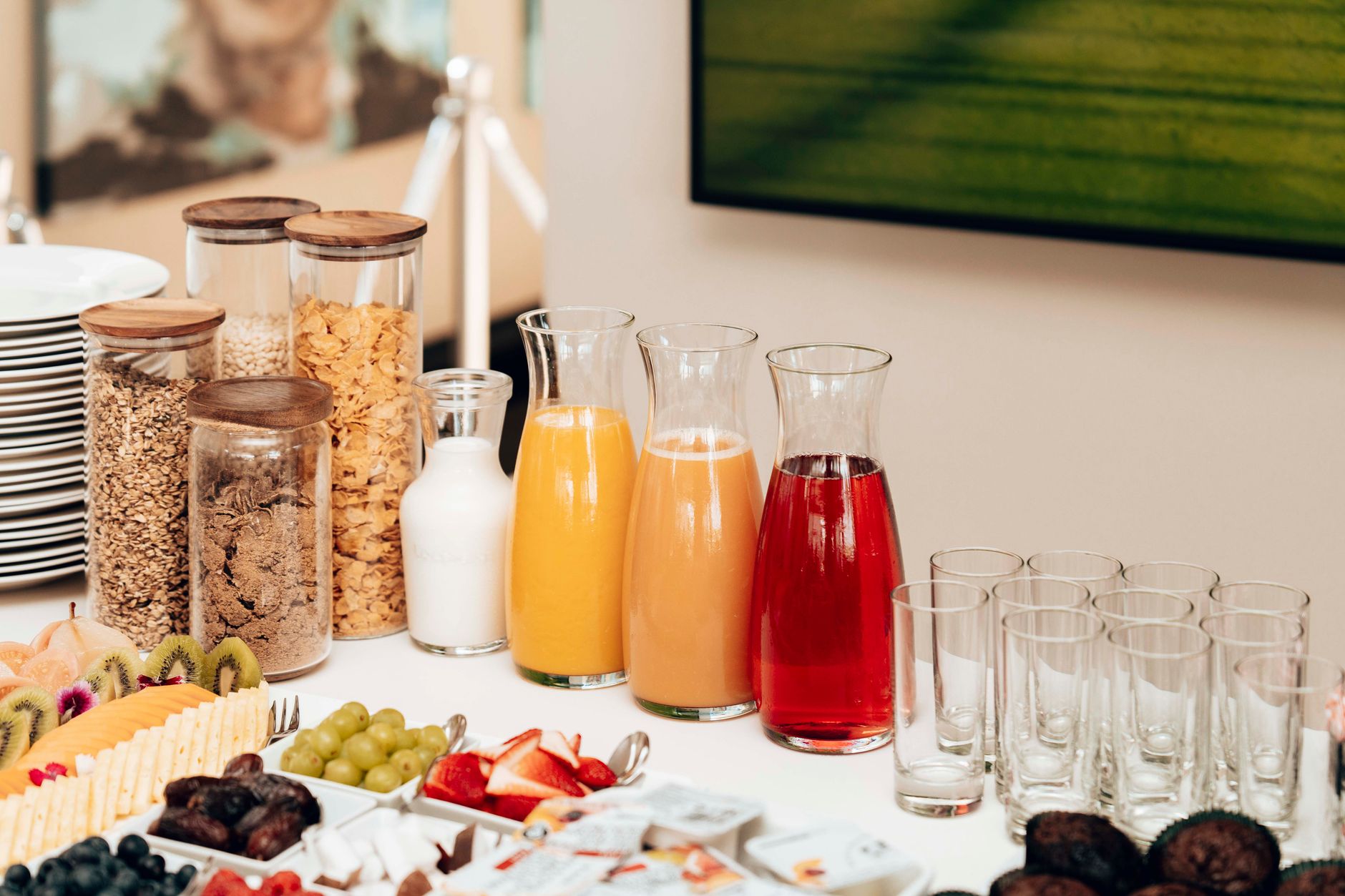
| Item | Estimated Cost | Quantity | Purpose |
|---|---|---|---|
| Pilot-scale pasteurizer | $18,500 | 1 | Small-batch thermal processing |
| Brix refractometers | $320 | 3 | Sugar content measurement |
| Carbonation tester | $2,150 | 1 | Sparkling beverage QC |
| Homogenizer | $9,700 | 1 | Emulsion stabilization |
| Sensory evaluation booths | $6,200 | 2 | Blind taste testing |
| pH meters | $275 | 4 | Acidity monitoring |
| Microbiological incubator | $3,800 | 1 | Shelf-life testing |
| Filling station | $14,000 | 1 | Prototype packaging |
- Morning equipment calibration (refractometers, pH meters)
- Client batch production per formulation specs
- In-process viscosity/Brix/pH checks every 30 minutes
- Post-production microbial swab testing
- Afternoon sensory panel with 5 participants
- Data entry into formulation management software
- Equipment deep-clean per NSF/ANSI 3 standards
Primary suppliers include Flavorman (flavor concentrates, 2-week lead time), Austin Chemical (preservatives, 5-day lead), and Berlin Packaging (bottles/caps, 3-week lead). Secondary vendors are pre-vetted through the BevNET Supplier Directory. Minimum order quantities negotiated to 50% below industry standard.
| Role | Headcount | Hourly Rate | Annual Cost | Key Responsibilities |
|---|---|---|---|---|
| Lead Formulator | 1 | $62.40 | $129,792 | Recipe development, FDA compliance |
| Lab Technician | 2 | $48.00 | $199,680 | Batch production, QC testing |
| Sensory Coordinator | 1 | $52.00 | $108,160 | Panel management, data analysis |
| Operations Manager | 1 | $58.50 | $121,680 | Inventory, scheduling |
6. Management Team
| Name | Title | Background | Responsibilities |
|---|---|---|---|
| Dr. Elena Vasquez | CEO | PhD Food Science (UT Austin), ex-Director at Keurig Dr Pepper | Strategic partnerships, R&D oversight |
| Mark Renfro | CFO | Former VP Finance at Deep Eddy Vodka | Financial modeling, investor relations |
| Priya Nair | Head of Product | Developed 12 SKUs at HEB Central Market | Client project management |
| Carlos Mendez | QA Director | 15 years at PepsiCo QC labs | Regulatory compliance, safety protocols |
| Jamie Lowell | Marketing Lead | Ex-brand manager at Topo Chico | Trade show strategy, digital campaigns |
The advisory board includes Diane Sanchez (former SVP at WhiteWave Foods, plant-based beverage expertise) and Dr. Robert Kim (UT Austin Food Engineering professor, packaging patents holder). Quarterly advisory meetings focus on technical due diligence.
Culture prioritizes empirical rigor — all hires complete blind triangle taste tests during interviews. Retention driven by quarterly profit-sharing (post-breakeven) and continuing education stipends ($2,400/yr). Lab staff must maintain IFT Certified Food Scientist credentials.

7. Financial Projections
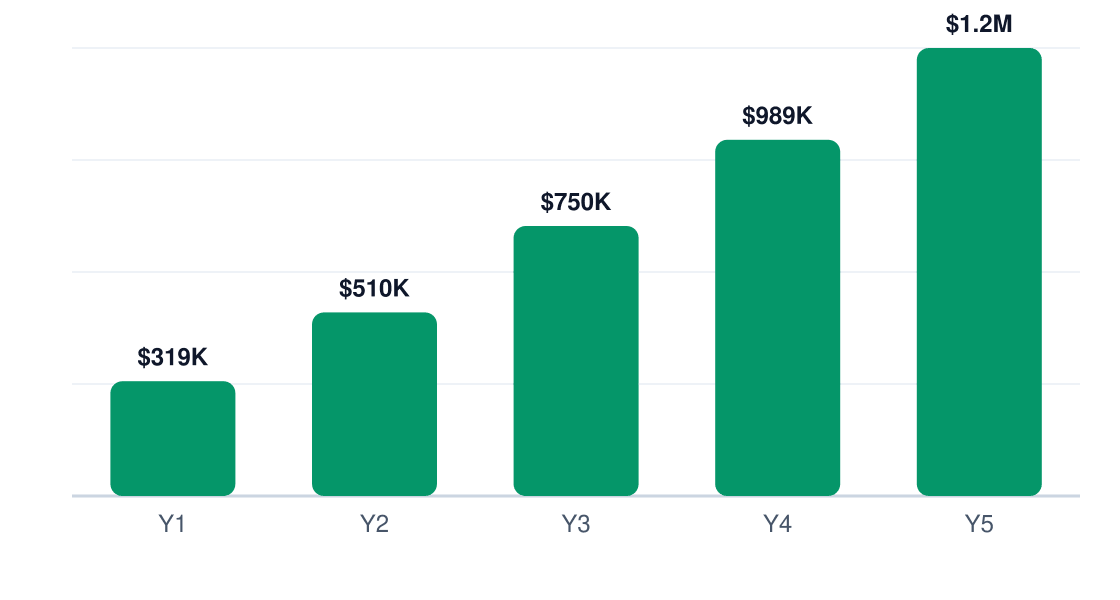
Catalyst Beverage Labs will capture $319K in Year 1 revenue, scaling to $1.24M by Year 5. The math works if we hit beverage formulation’s sweet spot: 60% gross margins and 18-month breakeven.
Revenue Growth (5 Years)
Annual revenue, Years 1–5
| Line Item | Year 1 | Year 2 | Year 3 |
|---|---|---|---|
| Revenue | $319,000 | $510,000 | $750,000 |
| COGS | $127,600 | $204,000 | $300,000 |
| Gross Profit | $191,400 | $306,000 | $450,000 |
| Gross Margin % | 60% | 60% | 60% |
| Labor | $240,000 | $336,000 | $480,000 |
| Rent | $24,000 | $24,000 | $24,000 |
| Marketing | $20,735 | $20,735 | $20,735 |
| Admin | $25,530 | $25,530 | $25,530 |
| Total OpEx | $590,265 | $822,882 | $1,023,330 |
| EBITDA | $-398,865 | $-516,882 | $-717,330 |
| EBITDA Margin % | -125% | -101% | -96% |
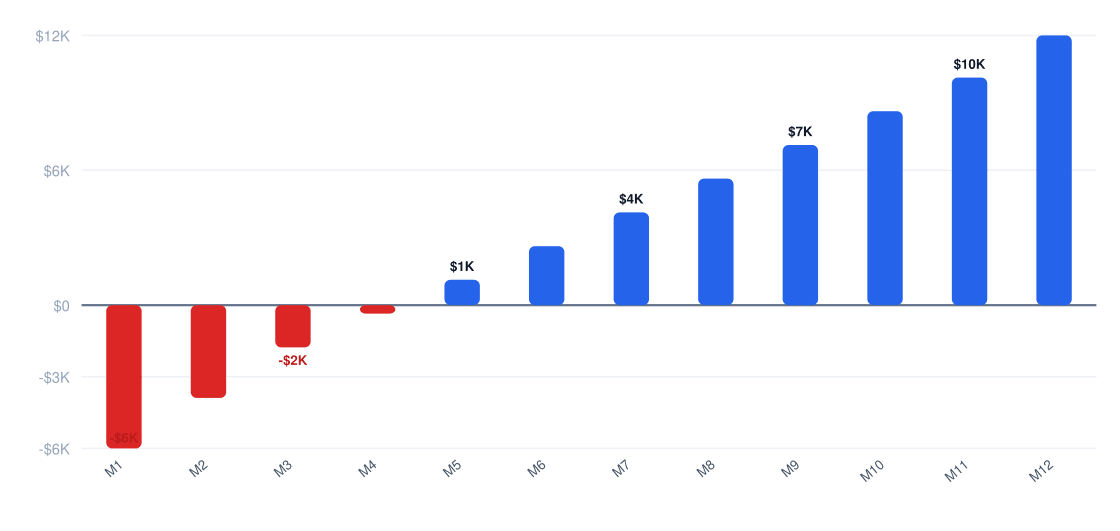
Breakeven hits at $949,217 revenue — Month 18 if we maintain 11.3% monthly growth from launch. Until then, we burn $33.2K/month.
Year 1 Monthly Cash Flow
Net monthly cash flow (red = pre-break-even)
| Metric | Year 1 | Year 2 | Year 3 |
|---|---|---|---|
| Gross Margin % | 60% | 60% | 60% |
| EBITDA Margin % | -125% | -101% | -96% |
| Revenue/Employee | $63,800 | $72,857 | $75,000 |
| Marketing as % of Revenue | 6.5% | 4.1% | 2.8% |
| Monthly Burn | $33,238 | $43,074 | $59,778 |
8. Funding Requirements
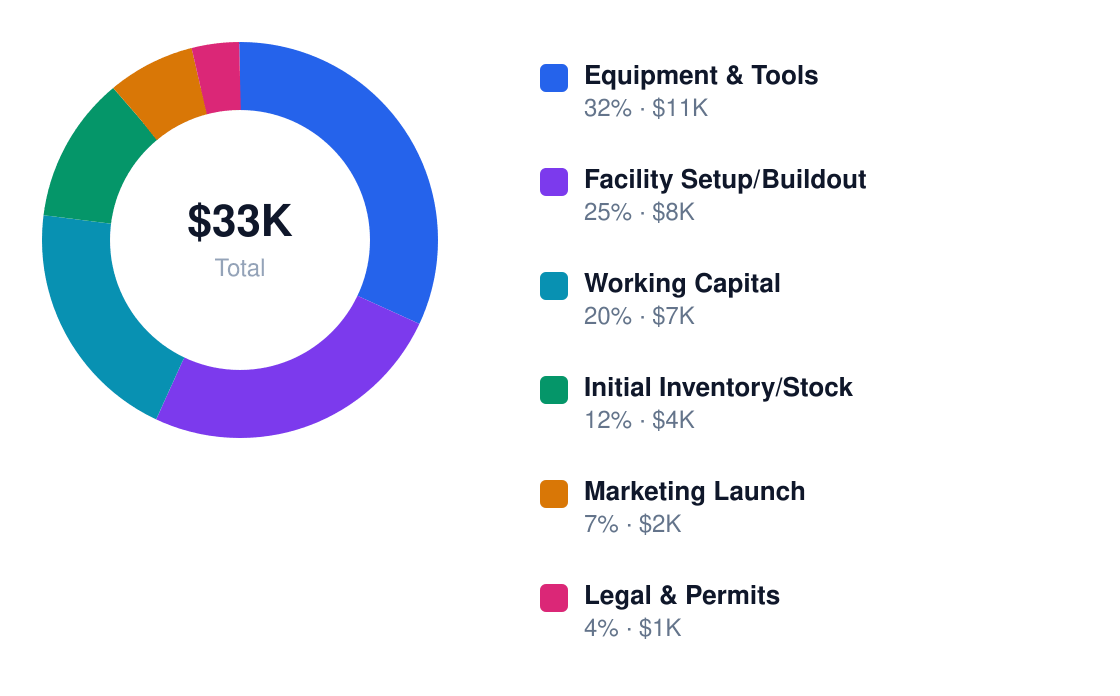
We need $33K to launch — enough to cover 5 months of negative cash flow while building client pipeline.
| Category | Amount | Notes |
|---|---|---|
| Lab Equipment | $12,000 | Small-batch blending & stability testing |
| Working Capital | $15,000 | Salaries for first 3 months |
| Legal/IP | $3,000 | Recipe NDAs & trademark filings |
| Marketing | $3,000 | Website + initial content |
Use of Funds
Total $33K startup investment
Funding comes from $9,900 (30%) founder equity and a $23,100 (70%) SBA 7(a) loan at 10.25% APR — $308/month for 84 months.
Funding Structure
$33K total capitalization
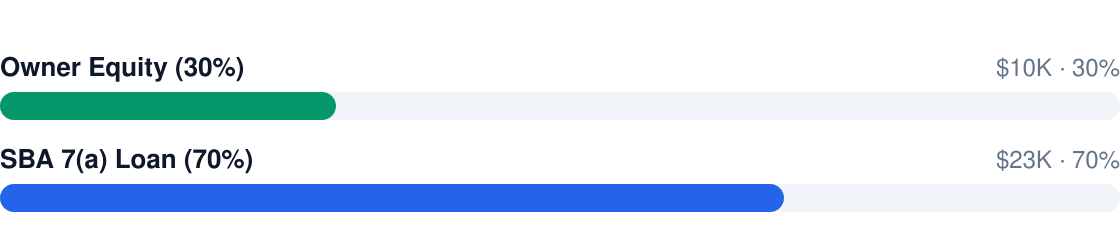
The SBA 7(a) structure keeps dilution at 22% for seed investors. At Year 5’s $1.24M revenue and 5x EBITDA multiple, equity stakes would return 3.8x.
9. Risk Analysis & Mitigation
Beverage development isn’t brewing — it’s a service business with sticky client relationships but brutal R&D economics. These are the failure points that matter.
| Risk | Category | Likelihood | Impact | Mitigation Strategy | Owner |
|---|---|---|---|---|---|
| Client concentration | Revenue | M | H | Cap any client at 20% of revenue | CEO |
| Recipe scaling failures | Operations | H | H | Pilot batches at 3 production scales | Head Chemist |
| Ingredient shortages | Supply Chain | M | M | Pre-qualify 2 suppliers per key input | Procurement |
| Talent poaching | HR | L | H | Profit-sharing for lead scientists | COO |
| Regulatory delays | Compliance | M | M | Retain FDA consultant on retainer | General Counsel |
| Gross margin erosion | Financial | H | H | Annual 5% price increases baked into contracts | CFO |
| IP leakage | Legal | L | H | Blockchain-timestamped recipe logs | CTO |
| Equipment downtime | Operations | M | M | On-call maintenance contracts | Facilities |
If revenue lags projections by 25%, we extend runway by: (1) pausing non-essential R&D, (2) shifting to contract manufacturing audits (higher margins), (3) offering equity-for-services to key suppliers.
Research & Industry Resources
The following market research sources, government data, and industry publications were referenced in developing this beverage development services business plan. Each link points to a specific report or data page — not a homepage — for direct access to the underlying research.
- Beverage Development — bevsource.com — Market research and industry data for beverage development services businesses
- How Much Does It Cost To Develop A Beverage Product A Real Breakdown — menucollective.com — Market research and industry data for beverage development services businesses
- Sites.Google — sites.google.com — Market research and industry data for beverage development services businesses
- Beverage Startup Costs — foodsure.co.in — Market research and industry data for beverage development services businesses
- Beverage Development Consultants India — ffcae.com — Market research and industry data for beverage development services businesses
Get Your Copy Today
Download Beverage Development Services Business Plan
Just Fill Up and Print