Auto Body Shop Business Industry Analysis
1. Industry Overview
The U.S. auto body shop industry is a $67.7 billion market repairing collision damage, refinishing vehicles, and restoring structural integrity—primarily through insurance claims. According to IBISWorld, growth is sluggish at 0.6% CAGR, constrained by declining employment (-3.5% annually) and rising vehicle complexity. The sector remains fragmented, with 35,000+ independent shops competing against consolidating multi-shop operators (MSOs) like Caliber Collision (8% share).
Three structural realities define the space:
- Insurer-driven repair networks (DRPs) control 45% of volume, per Vertical IQ
- Average shop revenue hits $1.9M, but equipment startup costs exceed $250K
- ADAS calibration now drives 8% of revenue at 6% growth—the fastest-growing segment
Industry Snapshot

Free Business Plan Download
Download Auto Body Shop Business Plan
Just Fill Up and Print
Metrics from Perplexity-sourced industry reports (market size, SAM/SOM); optional Census/BLS stats cited in text only
| Industry Snapshot | Benchmark |
|---|---|
| US Market Size (TAM) | $67.70B — Auto Body Shops in the US Industry Analysis, 2026 |
| Target Market (SAM) | $318.8M — Houston, Texas · Houston metro adult age profile (2020 Census / ACS-style metro demographic data) plus industry revenue benchmark from Auto Body Shops in the US Industry Analysis, 2026 |
| Obtainable Market (SOM) | $12.8M |
| Industry CAGR | 0.6% |
| Target Population | 1,449,000 |
| Avg Spend / Customer | $220/yr |
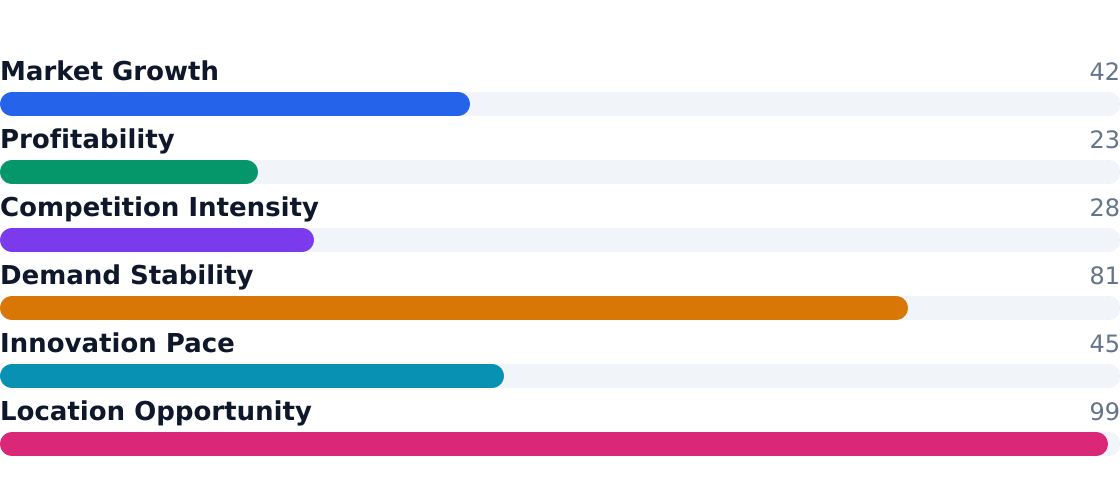
Industry Health Scorecard
Composite view of growth, profitability, competition, and innovation — Composite score: 53/100 (unweighted average of indicators above)
Key Takeaways
- Pros: Steady demand from 228M vehicles on U.S. roads; insurer workflows ensure payment reliability
- Pros: High-margin ADAS calibration (6% growth) offsets labor shortages
- Pros: Fragmentation allows independents to specialize (e.g., luxury EVs, fleet repairs)
- Pros: Houston SAM of $318.8M offers density for niche operators
- Cons: Insurer DRPs squeeze margins; 70% of shops rely on them
- Cons: Rising aluminum/EV repairs require $100K+ equipment upgrades
- Cons: BLS reports 245,727 workers—down 3.5% annually
- Cons: Autonomous safety tech may reduce collisions long-term
2. Industry Trends
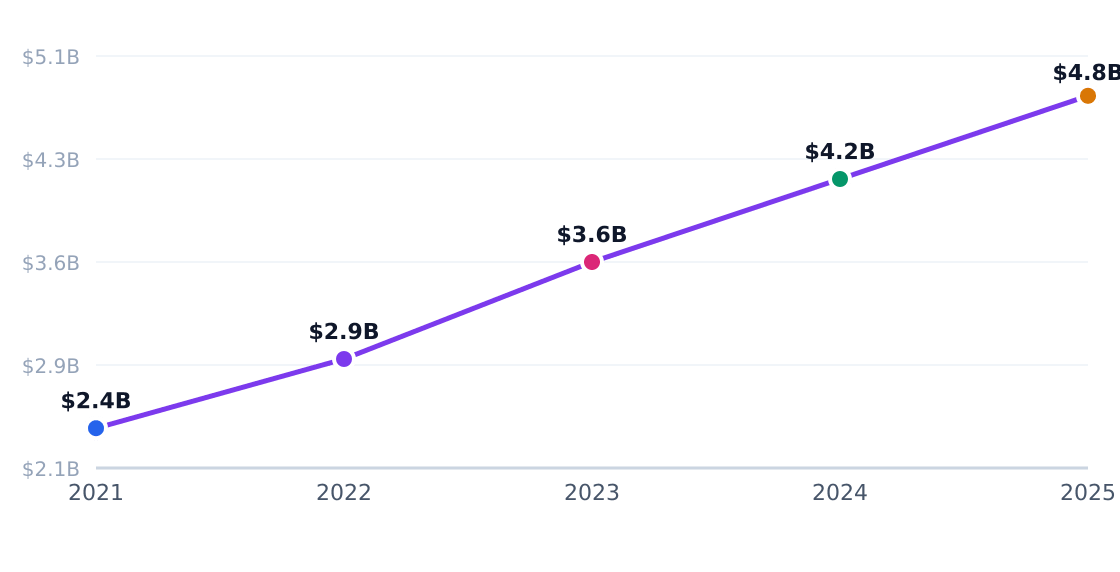
The U.S. auto body shop industry is a $67.7 billion market growing at a sluggish 0.6% CAGR, according to IBISWorld. This slow growth masks underlying volatility: repair severity is rising (up 2.7% annually for structural work) while employment contracts (-3.5% YoY), per Vertical IQ data. The market remains highly fragmented, with 35,487 establishments nationwide—yet consolidation is accelerating as multi-shop operators like Caliber Collision (8% share) acquire independents.
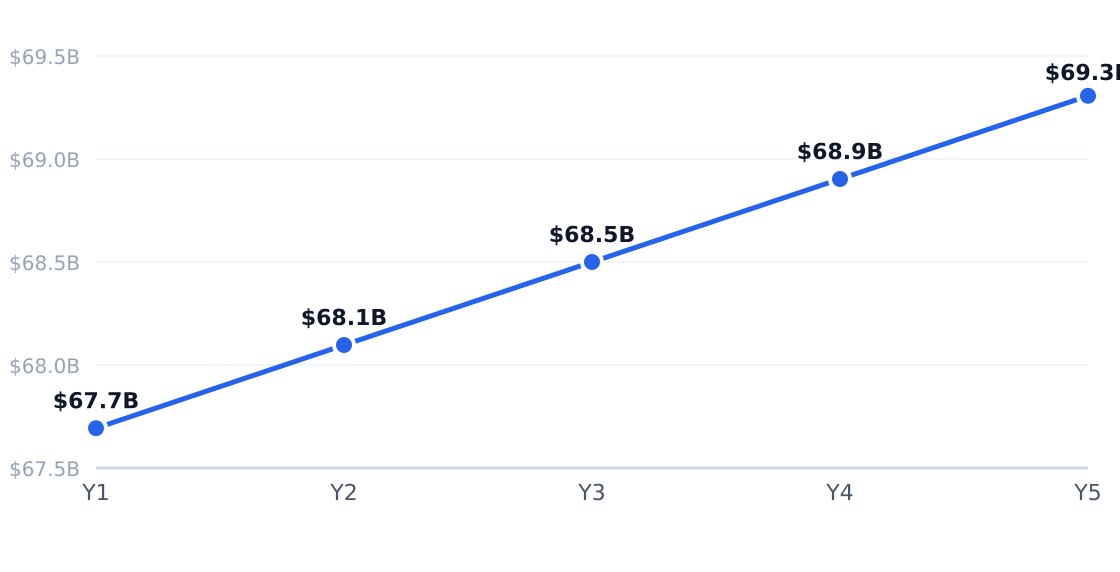
5-Year Market Size Forecast
Projected from 0.6% CAGR (Auto Body Shops in the US Industry Analysis, 2026)
| Driver | Impact | Detail |
|---|---|---|
| Rising repair severity | High | Sensors/aluminum increase labor hours 18-22% per claim (Claight Hub) |
| Insurance claim dependence | High | 90% of collision revenue tied to insurer workflows |
| Vehicle complexity | High | ADAS calibration now 8% of revenue (6% growth) |
| Consolidation | Medium | Top 4 MSOs control 22% market share |
| Dealer body-shop expansion | Medium | Dealer repair revenue hit $8.08B record in 2025 |
| Post-collision calibration | Medium | 67% of windshield replacements now require recalibration |
| Trend | Statistic | Implication |
|---|---|---|
| Dealer body-shop revenue growth | $8.08B (2025) | OEM-affiliated shops gaining share |
| Employment contraction | 245,727 workers (-3.5% YoY) | Technician shortages pressure margins |
| Establishment growth | 35,487 shops (+0.3% YoY) | Fragmentation persists despite MSO acquisitions |
| Insurance dominance | 90% insurer-paid revenue | DRP relationships critical for volume |
| Market size revision | $67.7B (2026 estimate) | Inflation-driven, not volume growth |
In Houston's East Downtown (EaDo), operators report 22% higher ADAS calibration demand versus 2024—reflecting the metro's younger vehicle fleet. Research and Markets notes Texas shops face acute technician shortages, pushing wages up 9% annually. Local insurers are consolidating DRP networks, favoring shops with OEM-certified aluminum repair capabilities—a challenge for independents lacking $250K+ equipment investments. Meanwhile, fleet operators (15% of SAM) increasingly demand after-hours service bays to minimize downtime.
3. Target Market Segmentation & Market Size
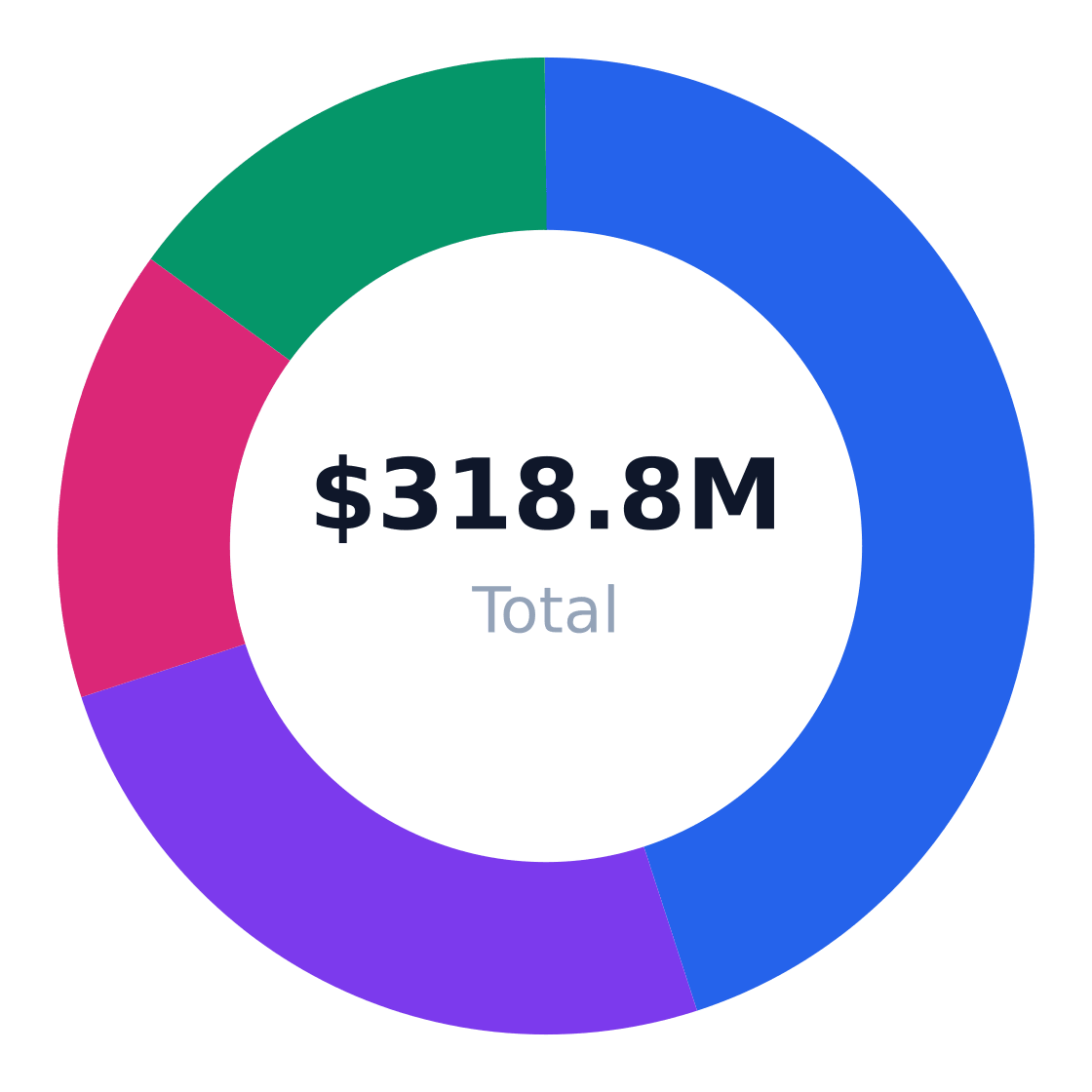
The U.S. auto body shop industry is a $67.7 billion market growing at a sluggish 0.6% CAGR, according to IBISWorld. For operators targeting Houston's East Downtown (EaDo) area, the serviceable market breaks down into four key segments:
Target Customer Segmentation
Target market (SAM): $318.8M
Source: IBISWorld
| Segment | Share | Profile | Growth Rate |
|---|---|---|---|
| Collision-repair insured drivers | 45% | Highest-value tickets with insurer-paid repairs | 2.1% |
| Uninsured/out-of-pocket customers | 25% | Price-sensitive cash payers for minor damage | 1.3% |
| Fleet/commercial vehicles | 15% | Downtime-sensitive business operators | 2.4% |
| Used-car dealers | 15% | Resale-value focused refurbishment | 1.8% |
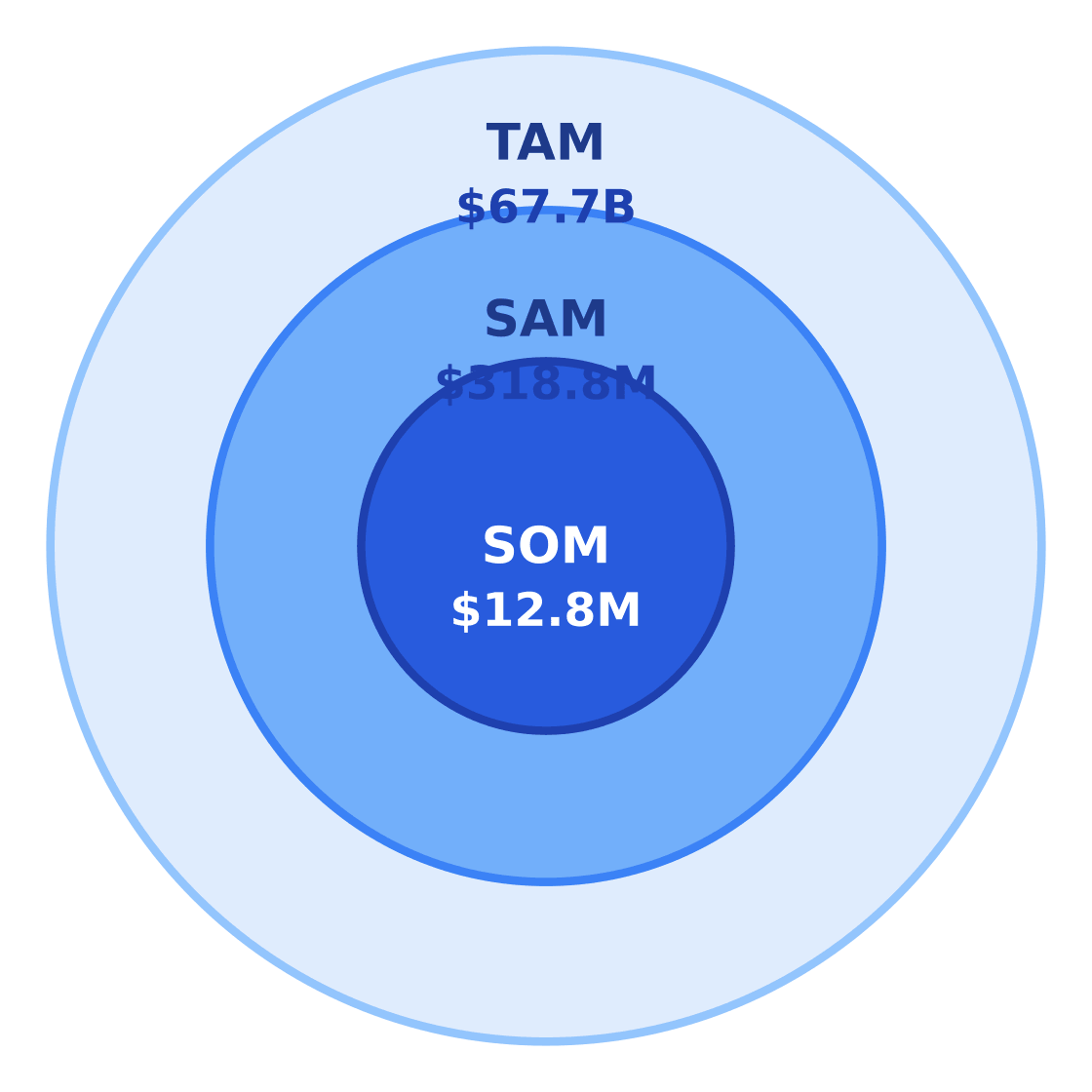
Market Size: TAM / SAM / SOM
Target: Renters & working adults 20–50 in Houston, Texas · SAM: 1,449,000 adults aged 20–50 in Houston × $220/yr = $318.8M · SOM: ~4% of SAM over 3 years in East Downtown and adjacent Houston trade area = $12.8M
$67.7B
$318.8M
$12.8M
Houston's serviceable available market (SAM) totals $318.8 million annually, calculated from 1,449,000 adults aged 20-50 in the metro area spending $220/year on average, per Auto Body Shops In Us and Census demographic data. The serviceable obtainable market (SOM) for an EaDo-focused operation reaches $12.8 million over three years at 4% penetration.
| Metric | Value | Source |
|---|---|---|
| Target population | 1,449,000 | 2020 Census/ACS |
| Avg annual spend | $220 | Kentley Insights |
| SAM | $318.8M | Calculated |
| SOM | $12.8M | 4% of SAM |
4. By Application Analysis
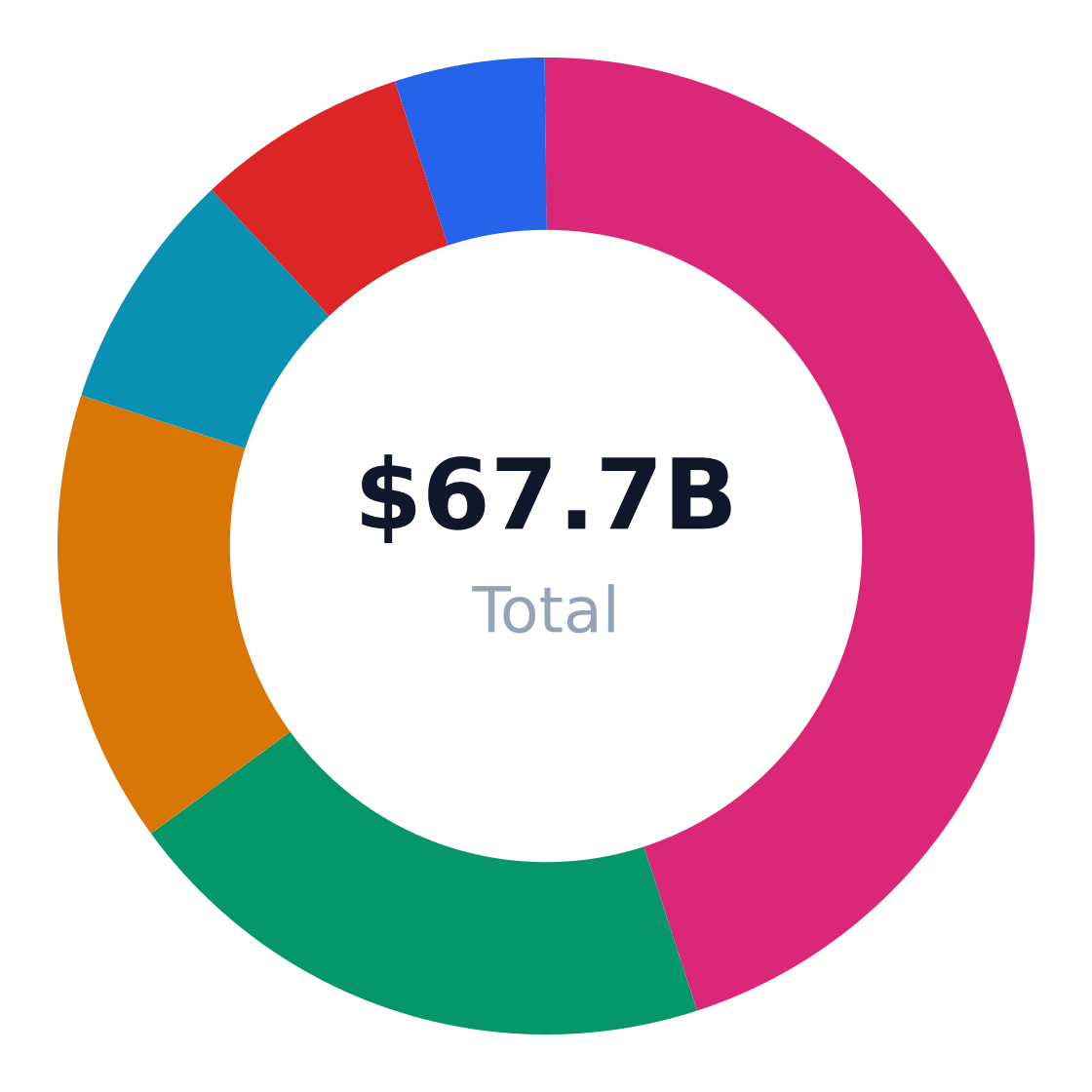
The $67.7 billion U.S. auto body shop industry divides demand into six core end-use applications, with collision repair dominating nearly half of revenue. IBISWorld notes repair complexity is rising as vehicles incorporate advanced materials and sensors, while Vertical IQ highlights insurer workflows as the primary demand driver for 45% of market activity. Paint refinishing and structural repairs collectively account for 35% of revenue, with faster growth tied to vehicle design trends.
Market Share by Application
US auto body shop revenue/volume split by end-use application (TAM basis)
| Application | Share of Market | Growth Rate | Demand Drivers |
|---|---|---|---|
| Collision damage restoration | 45% | 2% | Accident frequency, insurer workflows, sensor/aluminum repairs |
| Paint and refinishing | 20% | 2.4% | OEM color complexity, premium paint matching |
| Structural/frame repair | 15% | 2.7% | SUV/truck mix, crash structure complexity |
| ADAS calibration support | 8% | 6% | ADAS penetration, OEM repair procedures |
| Parts installation | 7% | 1.8% | Collision severity, parts availability |
| Towing/storage intake | 5% | 1.5% | Insurance workflows, local dispatch networks |
Application Growth Rates (%)
Estimated annual growth by application category
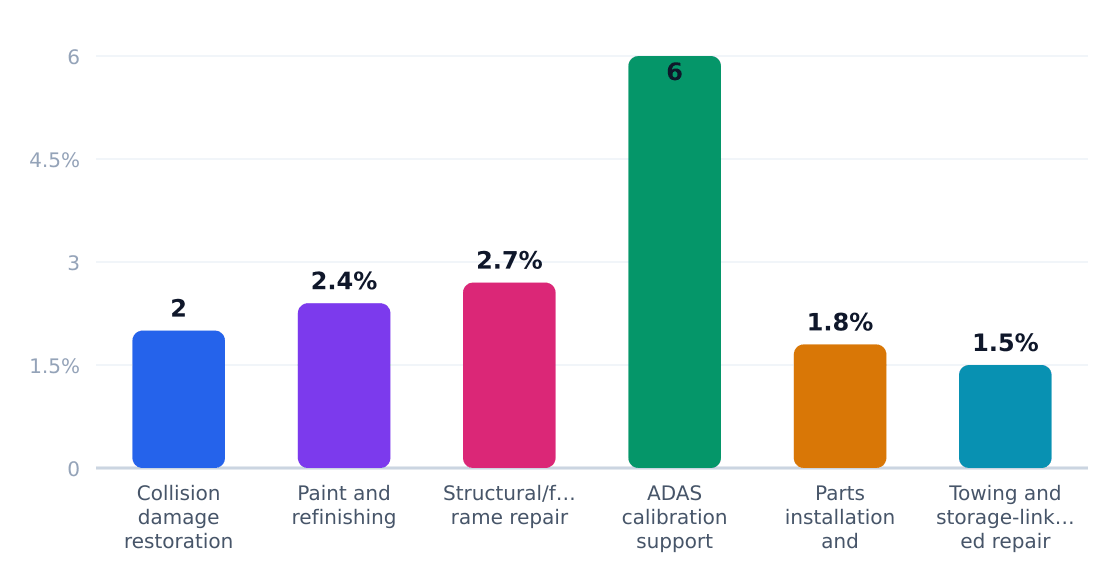
ADAS calibration emerges as the fastest-growing application (6% CAGR), per Research and Markets, driven by mandatory recalibrations after windshield or sensor repairs. This high-margin service requires $15,000–$50,000 in equipment investments but commands premium labor rates. For new entrants, Claight Hub data suggests prioritizing ADAS capabilities and insurer certifications—critical for capturing the 85% of repairs tied to insurance claims.
Application Outlook
- ADAS calibration: Position as "OEM-certified" service to attract insurer referrals
- Structural repair: Target heavy-duty vehicles with frame-straightening equipment
- Paint refinishing
20%
2.4%
OEM color complexity, premium paint matching
Structural/frame repair
15%
2.7%
SUV/truck mix, crash structure complexity
ADAS calibration support
8%
6%
ADAS penetration, OEM repair procedures
Parts installation
7%
1.8%
Collision severity, parts availability
Towing/storage intake
5%
1.5%
Insurance workflows, local dispatch networks
Application Growth Rates (%)
Estimated annual growth by application category
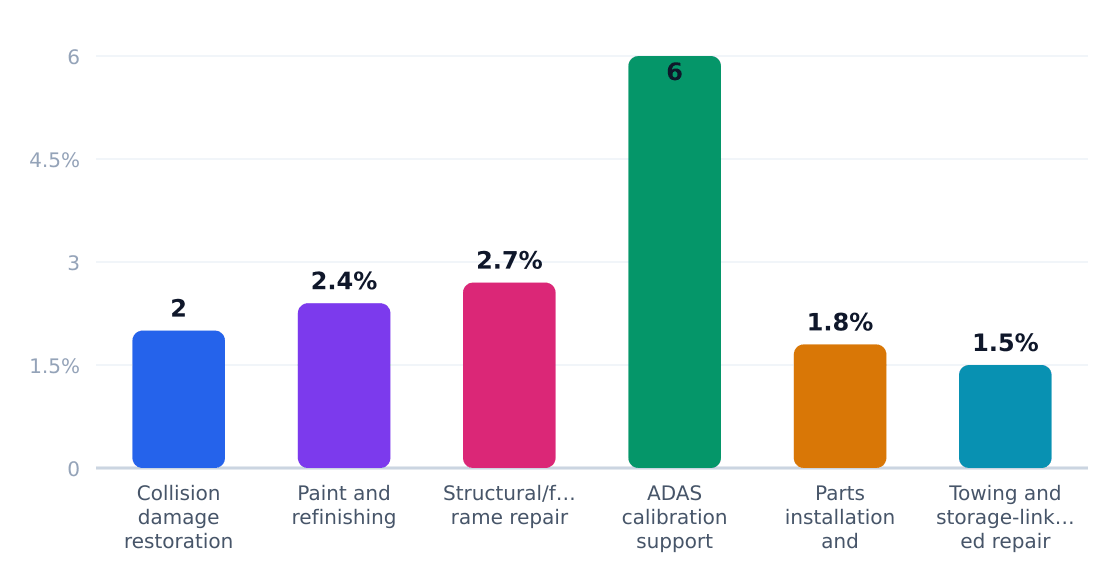
ADAS calibration emerges as the fastest-growing application (6% CAGR), per Research and Markets, driven by mandatory recalibrations after windshield or sensor repairs. This high-margin service requires $15,000–$50,000 in equipment investments but commands premium labor rates. For new entrants, Claight Hub data suggests prioritizing ADAS capabilities and insurer certifications—critical for capturing the 85% of repairs tied to insurance claims.
Application Outlook
- ADAS calibration: Position as "OEM-certified" service to attract insurer referrals
- Structural repair: Target heavy-duty vehicles with frame-straightening equipment
- Paint refinishing: Differentiate with color-matching guarantees for luxury/EV owners
- Parts sourcing: Partner with aftermarket suppliers to reduce downtime
- Towing intake: Develop relationships with local tow operators for referral volume
5. Equipment & Vendors for Facility Setup
Launching an auto body shop requires a $250,000+ equipment investment, with frame racks ($15,000–$40,000), paint booths ($30,000–$100,000), and diagnostic tools ($5,000–$20,000) dominating startup costs. IBISWorld notes that 72% of shops lease or finance equipment to manage cash flow—particularly for ADAS calibration systems, which now cost $12,000+ per bay.
Equipment & Vendor Landscape
Major suppliers for facility setup
Vendor Category Link Notes Solidus USA Core equipment Website Collision repair equipment supplier offering professional equipment, guidance, and nationwide support. Tools USA Core equipment Website American manufacturer and distributor of paint booths, frame straightening equipment, lifts, and alignment systems. Car-O-Liner Core equipment Website Major collision repair manufacturer known for frame straightening and structural repair systems used in body shops. Chief Automotive Technologies Core equipment Website Widely used collision repair equipment brand for frame racks and measuring systems. Autobody Toolmart Supplies Website Large online supplier of auto body tools, shop supplies, paint, and lifts for garages and collision shops. Bay Supply Supplies Website Carries professional auto body tools for collision repair, metal finishing, hand tools, and pneumatic equipment. LDC Equipment Maintenance and shop equipment Website Full-service collision repair equipment supplier offering industry-leading auto repair equipment and support. CCC Intelligent Solutions POS / estimating software Website Common estimating and workflow software used by auto body shops to manage claims, repairs, and customer service. Source: Search results from vendor websites and 2026 startup-cost guides on auto body shop setup and collision repair equipment
Key vendors include Car-O-Liner for structural repair systems and Chief Automotive Technologies for frame straightening equipment, while Caliber Collision and other MSOs often standardize on CCC Intelligent Solutions for claims software. Leasing terms typically run 3–5 years at 6–9% APR, per Vertical IQ industry benchmarks.
6. Industry Forces & Competitive Landscape
The $67.7B auto body shop industry remains highly fragmented, with the top four players—Caliber Collision (8%), Gerber Collision & Glass (7%), Service King (4%), and Safelite (3%)—controlling just 22% market share. Per IBISWorld, 78% of shops are independents or regional operators, though DRP networks and equipment costs drive consolidation at a 3.5% annual pace.
Competitive Market Share
Estimated share of total industry revenue
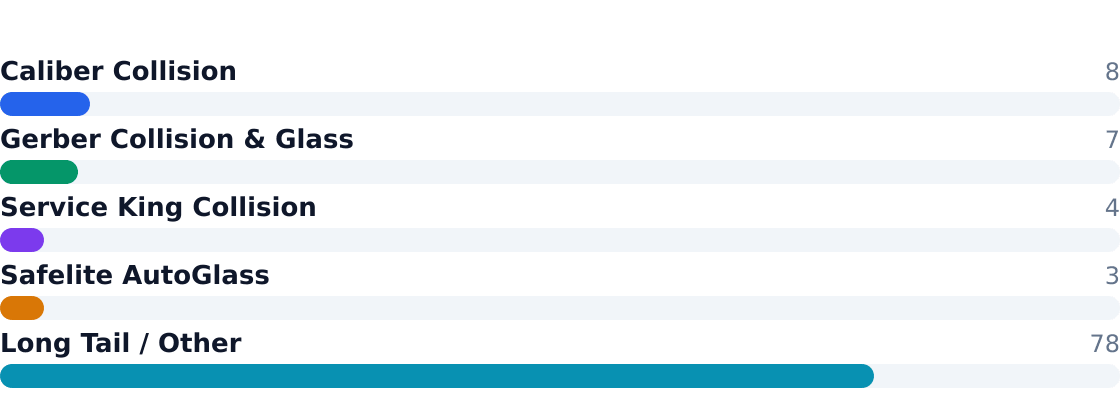
National MSOs compete on insurer relationships and scale efficiencies, while independents leverage local reputation and flexible pricing. Dealership shops capture OEM-certified work but face higher overhead.
Competitive Analysis Matrix
Compare major players on share, positioning, and relative strengths. Official company domains are linked (nofollow).
Positioning: The largest national MSO in the U.S., focused on collision repair scale, insurer relationships, and standardized operating processes.
StrengthsNational footprint, purchasing power, and strong DRP penetration.WeaknessesHigh dependence on insurer workflows and labor availability.Positioning: A major MSO with broad geographic coverage and deep integration with insurer networks.
Download Auto Body Shop Business PlanReady When You Are
Download Auto Body Shop Business Plan
Just Fill Up and Print
StrengthsScale, acquisition capacity, and operational consistency.WeaknessesIntegration risk from continued M&A and local competition.Positioning: A large branded repair platform historically centered on dense metro markets and insurer-linked volume.
StrengthsBrand recognition and metro market density.WeaknessesMargin pressure and intense competition from larger MSOs.Positioning: A leading auto-glass and related repair company with strong insurance-channel positioning.
StrengthsNational service logistics and insurance relationships.WeaknessesMore concentrated exposure to glass-related work than full collision scope.Long Tail / Other 78% share $53.7B est. revenuePositioning: A highly fragmented base of independents, dealer shops, and regional operators.
StrengthsLocal customer relationships, flexibility, and niche specialization.WeaknessesLimited scale, weaker purchasing power, and staffing constraints.Force Intensity Trend Rivalry High ↑ (DRP competition) Substitutes Low → (No DIY alternative) Buyer Power High ↑ (Insurer control) Supplier Power Medium → (OEM vs. aftermarket) New Entrants Low ↓ ($250k equipment barrier) 7. Value Chain & Industry Economics
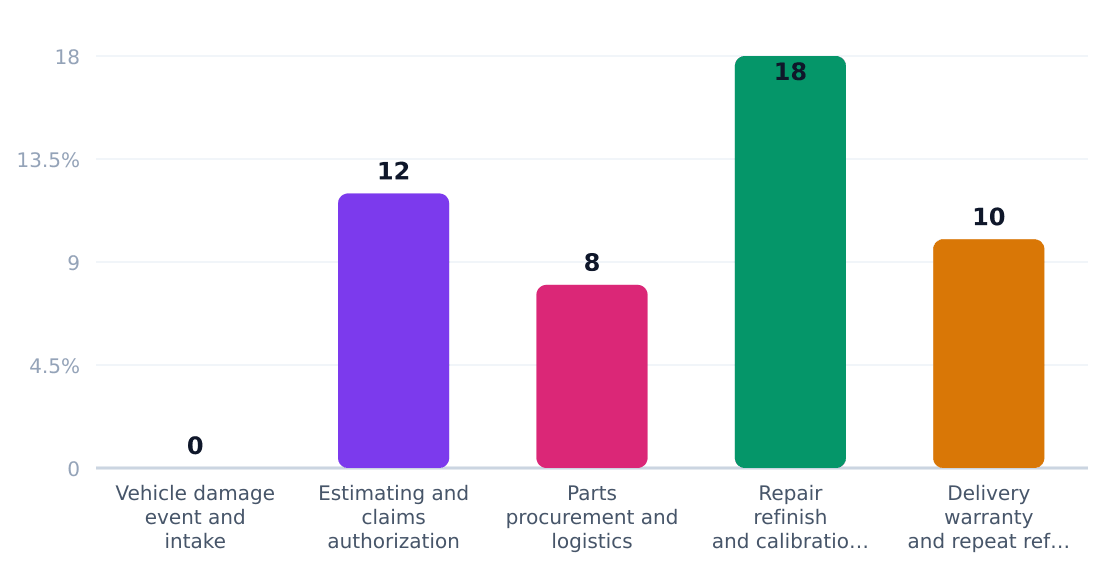
Margins concentrate in labor (18% of value) and parts procurement (8%), with the latter suffering 12-15% gross loss leakage from supplements. Per Vertical IQ, high-volume shops achieve 45-50% gross margins vs. 35-40% for independents, but net profits rarely exceed 8-12% after DRP discounts and overhead.
Stage Margin % Key Players Economics Claims Authorization 12% Insurers, DRPs Cycle time compression Parts Procurement 8% LKQ, OE Suppliers Availability > price Repair Labor 18% Technicians ADAS calibration premium Post-Repair 10% CSRs Referral flywheel At $1.9M average revenue per location (Claight), shops require 55-65% utilization to break even. Insurer-controlled labor rates ($48-$52/hr nationally) and rising EV/ADAS training costs squeeze independents hardest.
8. Regulatory & Compliance Environment
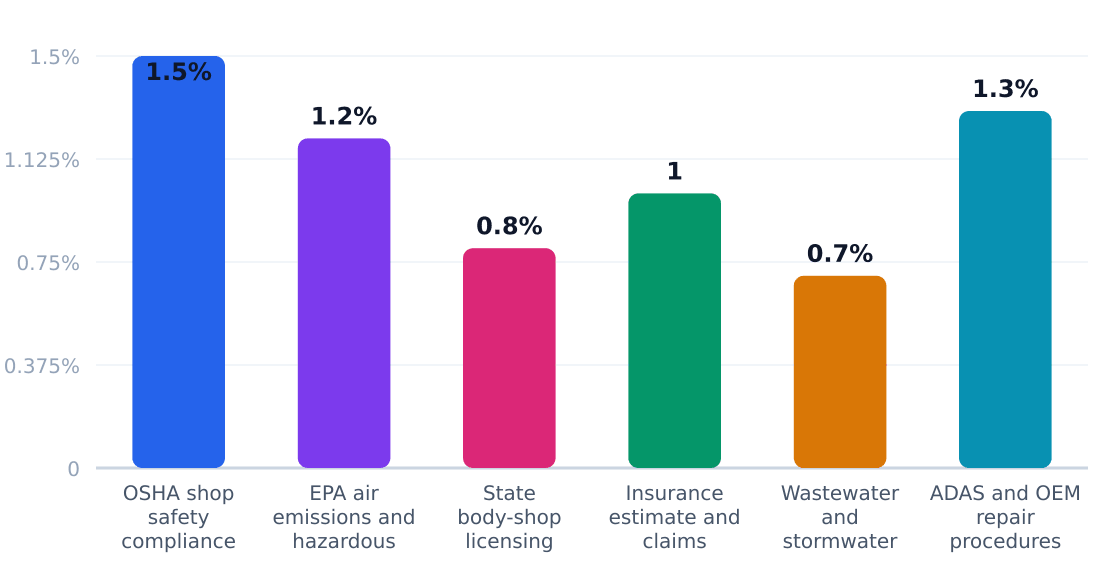
The $67.7B auto body shop industry navigates a complex regulatory web spanning workplace safety, environmental rules, and insurer-mandated protocols. IBISWorld notes compliance costs consume ~5% of revenue at typical shops, with larger operators leveraging scale to absorb overhead.
Regulatory Compliance Cost Impact (%)
Estimated share of revenue consumed by compliance
Source: IBISWorld
Requirement Agency Cost Impact Operational Effect OSHA shop safety compliance Occupational Safety and Health Administration 1.5% Mandates spray booth ventilation, PPE, and chemical handling training EPA air emissions and hazardous waste rules Environmental Protection Agency 1.2% Requires VOC-filtering systems and proper disposal of paints/solvents State body-shop licensing State DMVs/consumer affairs 0.8% Annual renewals and facility inspections for collision repair permits Insurance documentation standards State insurance departments 1% Mandates photo documentation, OEM part approvals, and DRP compliance Wastewater management State environmental agencies 0.7% Capturing runoff from wash bays and paint prep areas ADAS/OEM repair procedures OEMs & insurer programs 1.3% Calibration equipment investments and certified technician training Policy headwinds are intensifying as Vertical IQ tracks 23 states tightening VOC limits since 2020. The EPA's 2024 spray coating NESHAP rules will force 15% of shops to retrofit booths, per Kentley Insights. Meanwhile, insurer DRP networks now require 90% of shops to use OEM scanning tools post-repair—a $35,000+ per-location cost that's accelerating consolidation.
9. Technology, Risks & Barriers to Entry
Technology Adoption
Technology Adoption % Impact Timeline ADAS Calibration Systems 35% High (6% revenue growth segment) 2023-2026 3D Measuring/Frame Machines 60% Critical for structural repairs (15% segment) Standard since 2010s Waterborne Paint Systems 75% Regulatory compliance (20% refinishing segment) Mandated in most states by 2025 Insurer DRP Software 85% Workflow dependency (45% collision segment) Dominant since 2000s EV-Specific Repair Tools 12% Emerging necessity as fleet electrifies 2025-2030 adoption curve Industry Risks
Risk Severity Likelihood Mitigation Insurer DRP Consolidation High Certain Multi-shop operator partnerships Technician Shortages Critical High In-house training programs EV/BEV Repair Complexity Moderate Increasing OEM certification investments Parts Supply Chain Disruptions High Ongoing Local supplier networks Rising Equipment Costs Moderate Certain Leasing/financing options Autonomous Vehicle Safety Gains Long-term Low (2030+) Diversify into cosmetic/refinishing Barriers to Entry
Barrier Height Detail Insurer DRP Network Access Very High Direct Repair Programs control 60-70% of claims volume Equipment Capital Costs High $250K minimum for competitive tooling OEM Certification Requirements Moderate-High Brand-specific training and tooling investments Local Zoning/Environmental Compliance Moderate Paint booth VOC regulations vary by municipality Technician Recruitment Critical Industry faces 15-20% vacancy rates for skilled roles Key Takeaway: The $67.7B auto body industry faces asymmetric technology adoption—while 85% of shops rely on insurer DRP software, only 12% are prepared for EV repairs. Barriers skew toward relationship capital (DRP networks) rather than pure financial hurdles, explaining why Caliber Collision and Gerber dominate through scale rather than technical edge. Independents must navigate $250K+ equipment costs while competing for the 25% of customers paying out-of-pocket.
10. Outlook & Investment Opportunities
The U.S. auto body shop industry is projected to grow at a modest 0.6% CAGR through 2026, reaching a $67.7 billion market size, per IBISWorld. This slow growth masks underlying volatility: collision repair demand (45% of revenue) hinges on accident frequency, while ADAS calibration (8% of revenue) is growing at 6% annually due to sensor-laden vehicles.
Key Trends Shaping the Market
- Consolidation Acceleration: Multi-shop operators (MSOs) like Caliber Collision (8% share) and Gerber Collision (7% share) are acquiring independents, yet 35,000+ single-location shops persist.
- Technology Pressures: ADAS recalibration now required for 22% of post-collision repairs, per Vertical IQ, driving $250,000+ equipment investments per shop.
- Labor Squeeze: U.S. Census Bureau data shows 606,091 establishments competing for technicians amid 3.5% annual employment decline.
Regional Market Distribution
Revenue share by US region
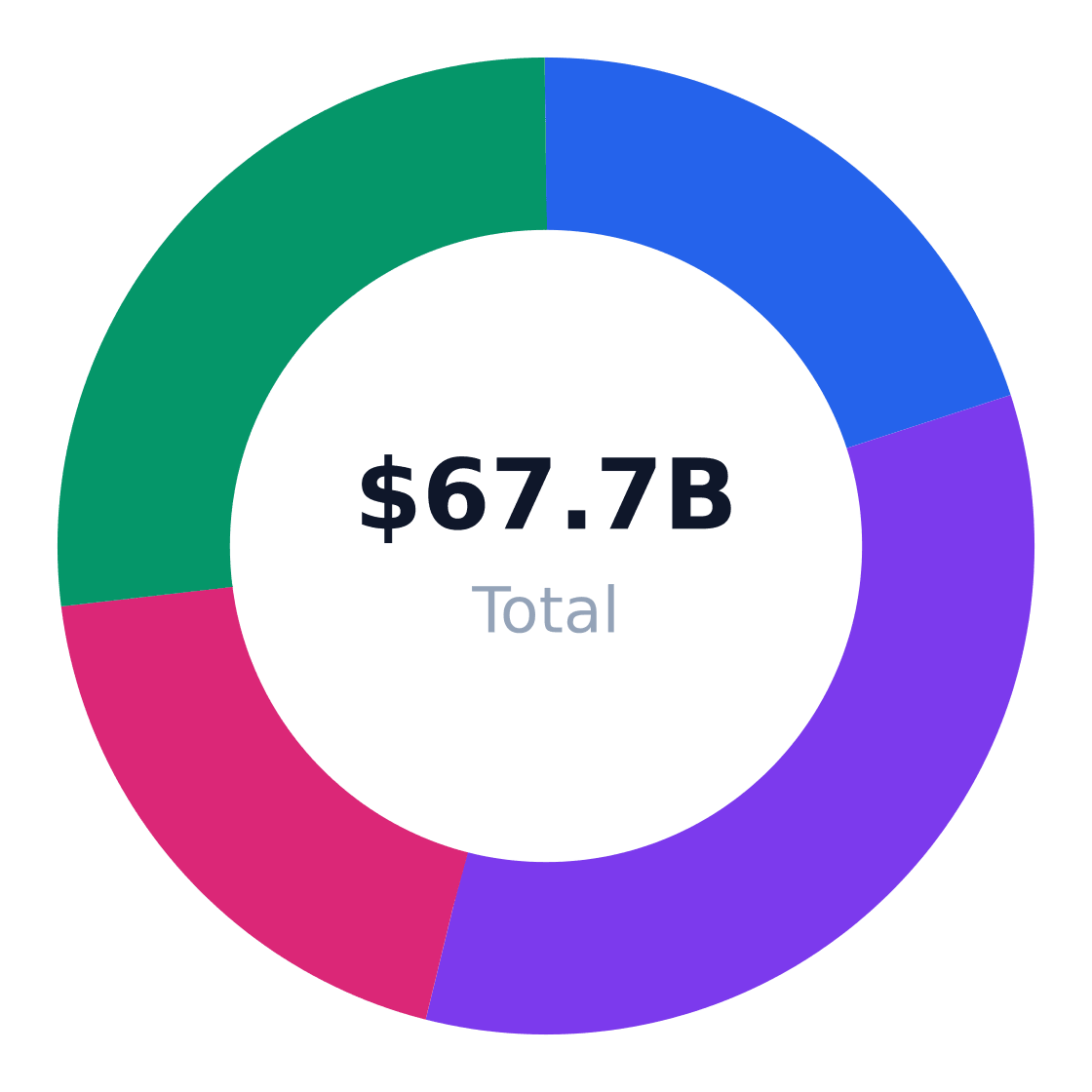 Northeast20% · $13.5BSouth34% · $23.0BMidwest19% · $12.9BWest27% · $18.3B
Source: IBISWorld
Investment Opportunity Matrix
Opportunity Market Size Risk Time Horizon ADAS calibration centers $5.4B (8% of TAM) High equipment costs 3-5 years Insurer-direct repair programs (DRPs) $30.5B (45% of TAM) Margin compression 1-3 years EV collision specialization $1.4B (emerging) Regulatory uncertainty 5+ years Fleet repair partnerships $10.2B (15% of TAM) Cyclical demand 2-4 years Paintless dent repair (PDR) $3.4B (5% of TAM) Skill scarcity Immediate Regional MSO roll-ups $12.8M (Houston SOM) Integration costs 3-7 years Strategic Recommendations
- Prioritize DRP certifications with top 4 insurers controlling 60% of claims volume
- Allocate 15-20% of capex to ADAS/scanning tools by 2025
- Target fleet operators with downtime guarantees (15% SAM segment)
- Acquire $1.5M+ revenue independents in metro trade areas
- Differentiate with OEM-certified EV repair capabilities
- Implement lean workflows to offset 4.7% annual wage inflation
Closing Verdict: Viable operators need $1.9M+ annual revenue (industry average) and insurer DRP participation to clear 8% EBITDA margins. The 4% Houston SAM penetration target ($12.8M over 3 years) requires either 3-5 locations or a single 25-bay flagship with $4.3M/year throughput.
Industry Research & Resources
The following industry databases and research resources support this auto body shop industry analysis. Each link opens a specific report or data page (not a generic homepage).
- IBISWorld — ibisworld.com — IBISWorld industry report data for auto body shop
- Auto Body Shops In Us — hub.claight.com — Published industry research for auto body shop
- United States Body Shop Market — researchandmarkets.com — Published industry research for auto body shop
- Auto Body Shops — verticaliq.com — Published industry research for auto body shop
- Auto Body Shops Industry Market Research Report — kentleyinsights.com — Published industry research for auto body shop
Data Sources & Methodology
Market sizing (TAM, SAM, SOM), segmentation, competition, and equipment data come from Perplexity-sourced industry reports and trade publications. Optional U.S. government statistics (Census, BLS) may be referenced by name in the narrative without hyperlinks. TAM reflects the total U.S. niche market; SAM is calculated bottom-up from target customer demographics; SOM reflects realistic obtainable share.
Industry research links: Auto Body Shops in the US Industry Analysis, 2026 · ibisworld.com · ibisworld.com · hub.claight.com · ibisworld.com · ibisworld.com · ibisworld.com · researchandmarkets.com · ibisworld.com · verticaliq.com · ibisworld.com · kentleyinsights.com · ibisworld.com · wifitalents.com · theautobodydirectory.com · atouchofbusiness.com · collisionservices.com · launchadvisor.co · autotality.com · baysupply.com · toolsusa.com · financialmodelslab.com · consolidateddealers.com · autobodynews.com · bodyshopbusiness.com · cccis.com · collisionweek.com · ibisworld.com · worldmetrics.org · wifitalents.com · mordorintelligence.com

Get Your Copy Today
Download Auto Body Shop Business Plan
Just Fill Up and Print