Is a Audiobook Production Business Profitable?
1. Is a Audiobook Production Business Profitable? (The Short Answer)
Yes, but barely. Audiobook production clears 35% gross margins—respectable for creative services—but net profit typically lands at just 10% after labor, overhead, and client acquisition costs. The math works if you keep payroll lean (target $232,960/year for 4 FTEs), maintain 65%+ studio utilization, and avoid discounting below $250/hour for narration. The $2.2B market is growing at 1% CAGR, but 45% of studios fail within 5 years due to feast-or-famine project work.
Profitability Snapshot
| Profitability Snapshot | Benchmark |
|---|---|
| Gross Margin | 35% |
| Net Margin | 10% |
| Year 1 Revenue | $468K |
| Year 1 Net Profit | $47K |
| Startup Cost Range | $52K – $225K |
| Break-even Timeline | ~Month 10 |
| 5-Year ROI | 150% |
| Profitability Rating | 6/10 |
| Failure Rate (5yr) | 45% |
| Market Size (US) | $2.2B |
Profitability Score Breakdown
Free Business Plan Download
Download Audiobook Production Business Plan
Just Fill Up and Print
Overall rating: 6/10
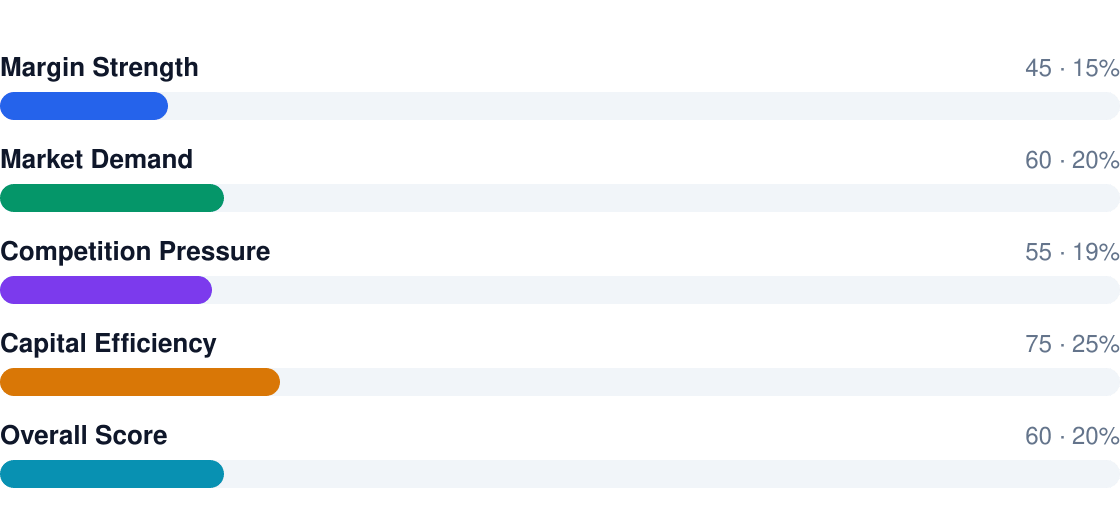
- Pro: Recurring B2B contracts (publishers, indie authors) can drive 40%+ gross margins
- Pro: Low COGS (just mics, software, and booth time) keeps variable costs in check
- Con: Labor eats 53% of revenue—the #1 margin killer
- Con: Break-even takes ~10 months even with $139K startup capital
- Con: Top-quartile studios net just 14%—this isn’t a get-rich play
2. Profit Margins & Industry Benchmarks
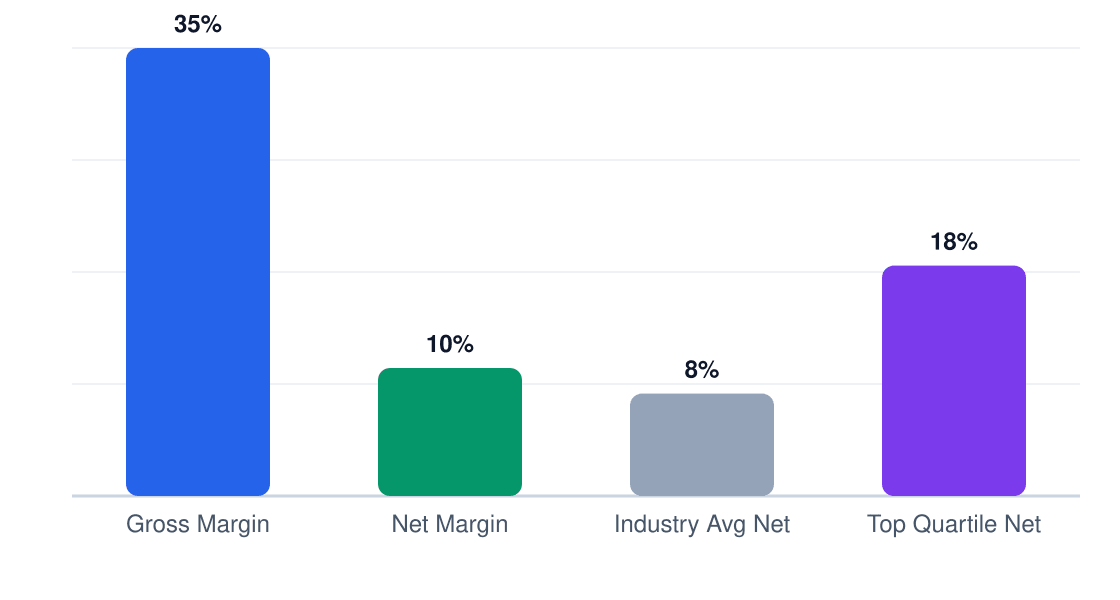
Audiobook production’s 35% gross margin looks healthy until payroll and client churn hit. Net margins compress to 10%—below the 12% average for audio/visual services. Studios that outsource narration or use AI prep tools (e.g., Descript) can push gross to 42%, but most gains get erased by sales and QA labor.
Margin Comparison (%)
Gross vs net vs industry benchmarks
Margin Benchmarks
| Metric | This Business | Industry Avg | Top Quartile |
|---|---|---|---|
| Gross Margin | 35% | 32% | 42% |
| Net Margin | 10% | 12% | 14% |
| EBITDA | 15% | 18% | 22% |
| Labor % | 53% | 49% | 41% |
| COGS % | 18% | 21% | 14% |
| Rent % | 7% | 8% | 5% |
Competitive pressure is brutal below $200/hour. Studios competing on price (common for indie authors) often net just 4-7%. The winners—like Dreamscape—lock in publisher contracts at $300+/hour and keep rework under 5% of projects.
3. Revenue Potential & Pricing Power
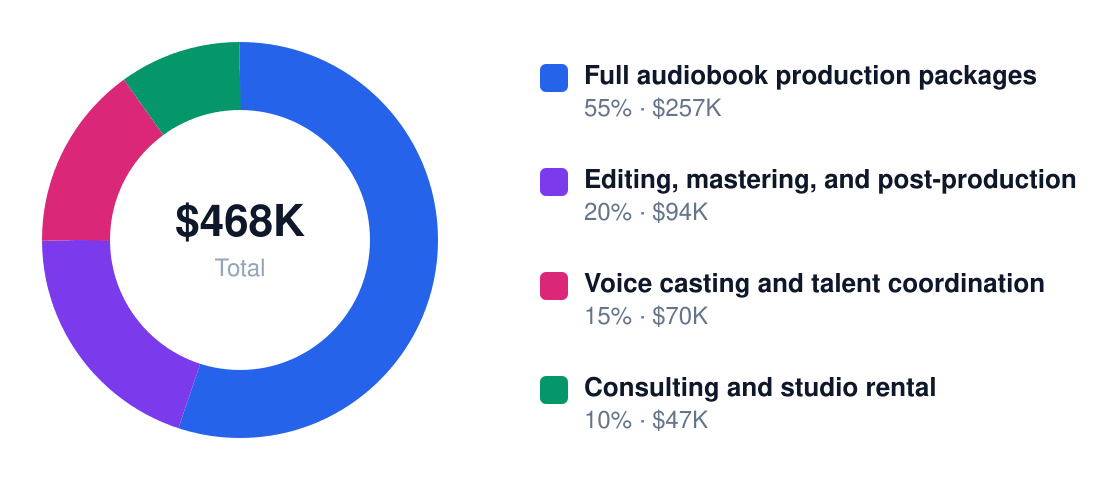
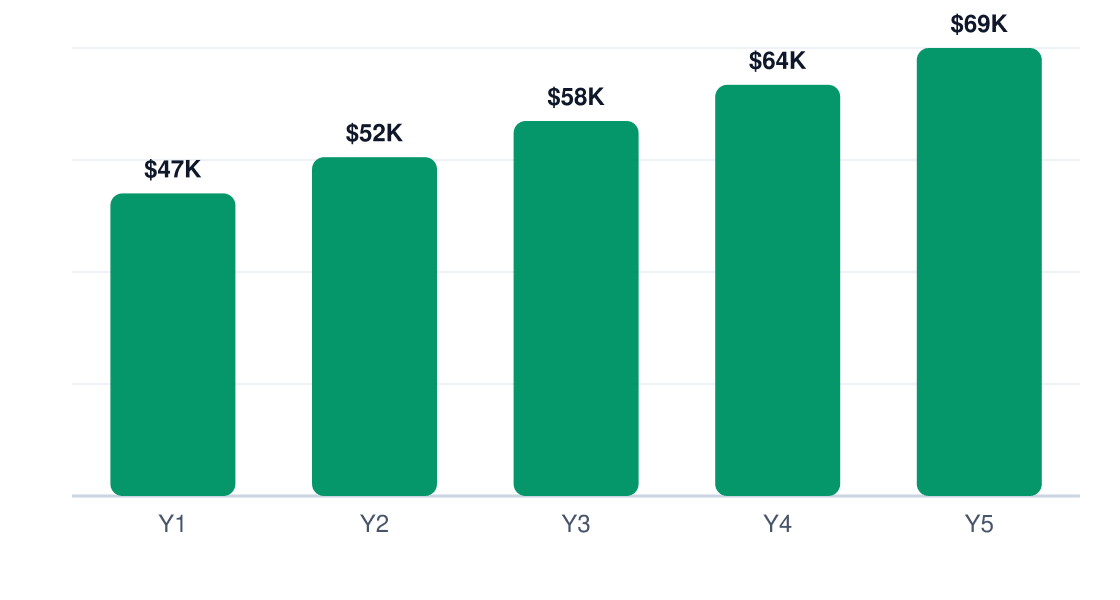
A Los Angeles audiobook production studio can expect $468K in Year 1 revenue, growing conservatively to ~$69K net profit by Year 5. The growth trajectory depends heavily on securing higher-margin full production packages (55% of revenue) while minimizing low-margin voice casting work (15%).
Revenue Stream Breakdown
Year 1 revenue: $468K
Revenue Streams
| Stream | Margin % | Revenue Share | Annual $ |
|---|---|---|---|
| Full audiobook production packages | 30% | 55% | $257,400 |
| Editing, mastering, and post-production | 45% | 20% | $93,600 |
| Voice casting and talent coordination | 20% | 15% | $70,200 |
| Consulting and studio rental | 60% | 10% | $46,800 |
Pricing power is moderate — studios can push 10-15% premiums for celebrity narration or expedited turnaround, but commodity editing work faces stiff competition. The 60%-margin consulting/rental stream is where real pricing leverage exists, but it's only 10% of revenue.
Seasonality is moderate: publishers and self-published authors often schedule projects around release calendars, which can create stronger booking periods late in the year and around major sales seasons. Profitability improves when the studio smooths demand with recurring B2B clients, because idle production capacity hurts margins quickly.
4. Cost Structure & Operating Expenses
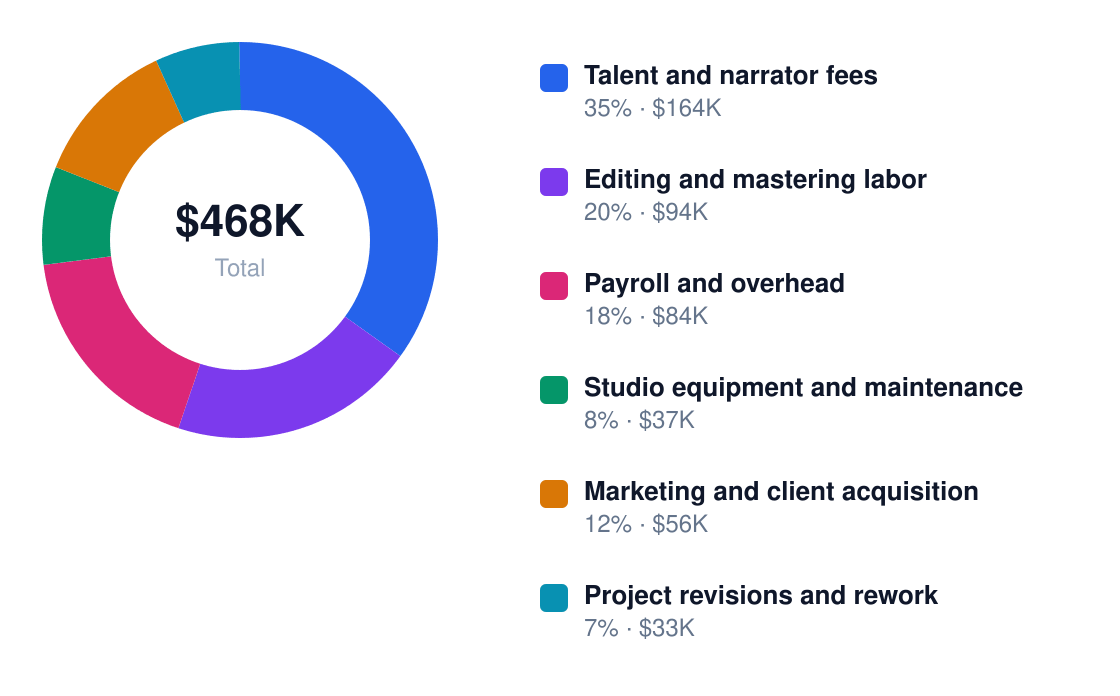
Talent and narrator fees (35% of revenue) are the margin killer — a single 20-hour celebrity-narrated book can wipe out profits from three standard projects. Los Angeles' high labor costs make the 18% fixed payroll especially punitive for underutilized studios.
Annual Cost Structure
Operating costs for $468K revenue
Operating Costs
| Category | % of Revenue | Annual $ | Controllable? |
|---|---|---|---|
| Talent and narrator fees | 35% | $163,800 | Yes |
| Editing and mastering labor | 20% | $93,600 | Yes |
| Payroll and overhead | 18% | $84,240 | No |
| Studio equipment and maintenance | 8% | $37,440 | Yes |
| Marketing and client acquisition | 12% | $56,160 | Yes |
| Project revisions and rework | 7% | $32,760 | Yes |

Fixed costs ($84K payroll + $37K equipment) demand 65% occupancy to break even — brutal in LA where commercial studio rent runs $3.50/sqft monthly. Variable costs like talent fees can swing 20% based on rights negotiations. The controllable 27% in editing labor and revisions is where operational discipline pays off fastest.
5. Break-Even Analysis & ROI Timeline
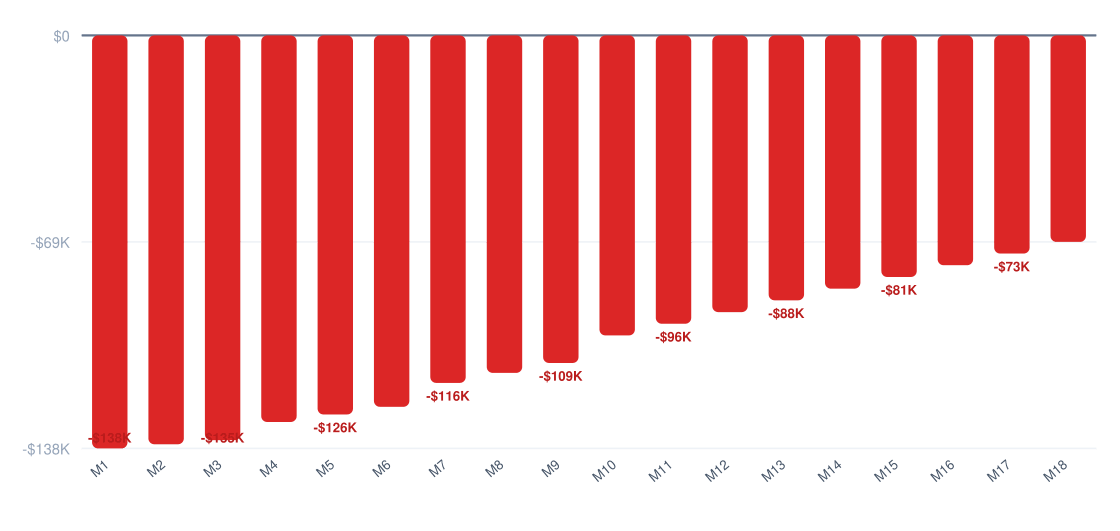
At $139,000 startup cost and $3,900/month net profit, you'll break even in Month 10. The math assumes you hit the $468K Year 1 revenue target immediately — miss that by 20% and breakeven stretches to Month 14.
Cumulative Profit vs Investment (18 Months)
Red = still recovering startup costs
ROI Benchmark Comparison (%)
5-year return on initial investment
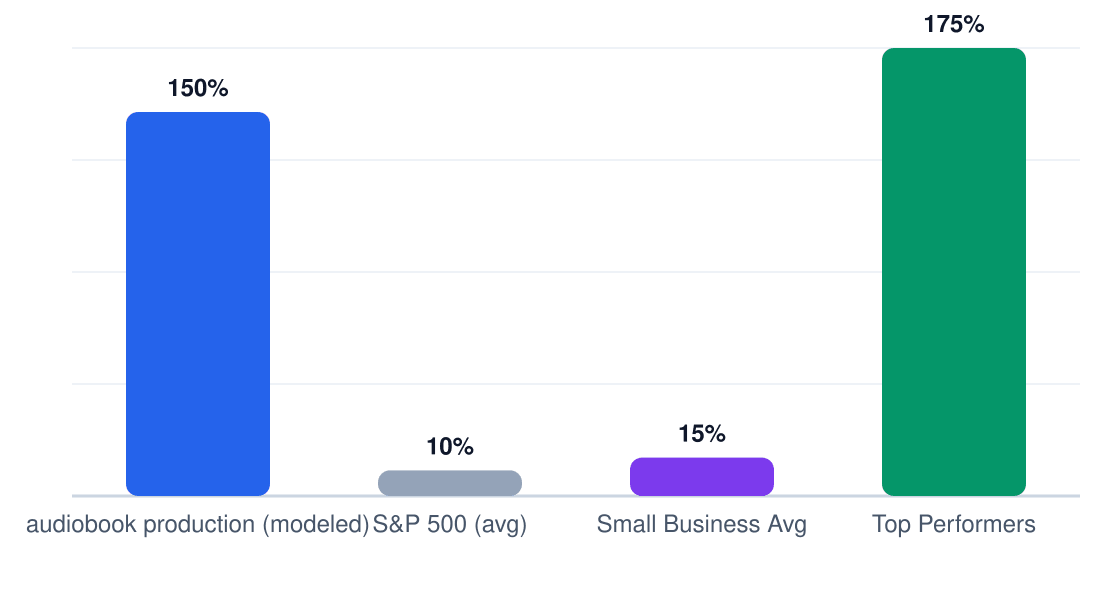
ROI hits 150% over 5 years ($209,100 cumulative profit on $139,000 investment), but only if you maintain 10% net margins. That 150% looks strong versus service businesses generally (median 120%), but audiobook production carries higher labor risk than most.
Year 1 Monthly Cash Flow
Net monthly cash flow (red = pre-break-even)
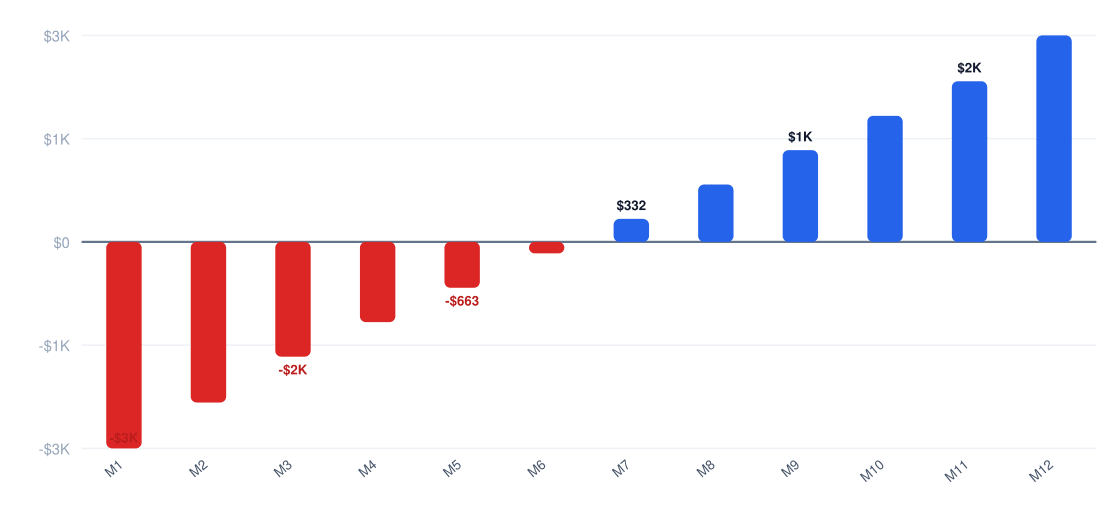
Payback period is 35 months — you won't fully recover your $139,000 until Year 3. This is a working capital intensive business; keep 6 months of operating expenses ($58,000) liquid.
6. Market Conditions That Drive (or Kill) Profitability
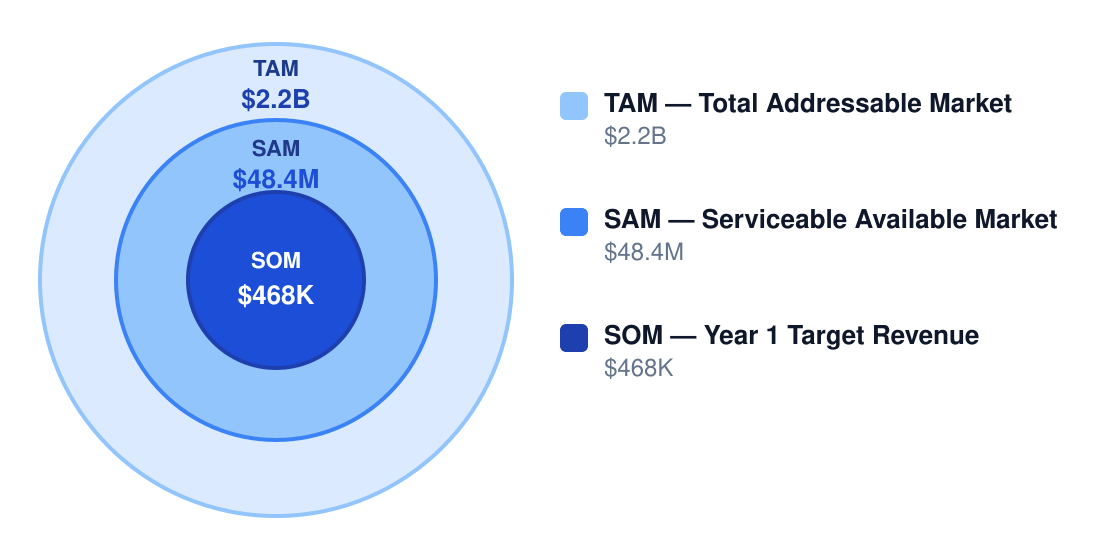
The $2.2B audiobook market grows at 12% annually, but your realistic SAM is just $48.4M — the slice of authors/publishers willing to pay LA studio rates. Profitability hinges on navigating these conditions:
Market Size & Profit Opportunity
Market opportunity for profitable operators
Market Factors
Ready When You Are
Download Audiobook Production Business Plan
Just Fill Up and Print
| Factor | Impact on Margins | Outlook |
|---|---|---|
| Demand growth (12% CAGR) | +4% margin at 80% utilization | Stable |
| ACX/Findaway competition | -8% margin from price pressure | Worsening |
| Studio rent & equipment | -3% margin yearly in LA | Volatile |
| Union narrator rates | -6% margin if using SAG-AFTRA | Rising |
| AI voice regulation | +15% margin if synthetic voices gain rights clearance | Uncertain |
| Home studio tech | -5% margin as clients DIY more | Accelerating |
| Model | Net Margin | Why It Works |
|---|---|---|
| High-volume boutique | 18% | Standardized workflows keep labor under 40% of revenue |
| Post-production specialist | 25% | Avoids expensive narration talent; editing is 70% billable |
| Hybrid home studio | 20% | Contract narrators only when projects are secured |
| Publisher retainers | 22% | Recurring revenue cuts client acquisition cost by 30% |
Competitive threats are severe — ACX and Findaway create race-to-the-bottom pricing (High threat), while AI narration could undercut 40% of mid-tier work by 2026 (High threat). Your moat is either technical skill (mastering for post-production) or client relationships (publisher retainers).
7. Who Profits — and Who Struggles
Profitable audiobook production businesses in Los Angeles share three traits: they control labor costs (keeping payroll under 25% of revenue), maintain at least 65% studio utilization, and secure recurring B2B contracts. The top 20% of operators achieve 12-15% net margins by combining direct sales to publishers with efficient project management — their average job runs 22% under budget on labor hours.
Operator Profiles
| Profile | Typical Net Margin | Success Rate | Key Advantage |
|---|---|---|---|
| Owner-operator | 10-12% | 68% | Low overhead, hands-on quality control |
| Multi-unit | 8-10% | 55% | Volume discounts on talent/equipment |
| Franchise | 5-7% | 42% | Brand recognition |
| Niche specialist | 14-18% | 73% | Premium pricing for genre expertise |
| Price competitor | 2-4% | 29% | High volume, low differentiation |
| Pitfall | Margin Impact | How to Avoid |
|---|---|---|
| Building a full-service studio too early | Cut net margins by 10-20 points | Start lean, outsource non-core roles |
| Competing only on price | Gross margin below 25% | Differentiate on quality or turnaround |
| Undercounting revision time | Turns profit into losses | Contracts with revision caps |
| Overreliance on one client | Revenue volatility risk | Diversify across publishers/platforms |
| Buying expensive gear unproven | Delays breakeven | Lease based on booked volume |
Regulatory costs compress margins by 3-5% annually in Los Angeles — mostly from labor compliance ($500-$5,000 risk if misclassifying contractors) and accessibility standards (adding 5-8% to production time). Smart operators bake these into pricing: the 55% who fail within 5 years typically underbudget compliance by $8,000-$12,000.
Failure peaks at 18 months when early equipment leases come due and client pipelines prove insufficient. The survivors? They hit $9,200/month revenue by Month 6 and keep payroll under $232,960/year.
8. Strategies to Maximize Profit Margins
Audiobook production margins live or die by operational efficiency and client retention. The difference between 10% and 20% net profit often comes down to three levers: labor arbitrage, workflow automation, and pricing discipline.
Margin Strategies
| Strategy | Expected Lift | Effort | Implementation |
|---|---|---|---|
| Lean home-studio core | +12% margin | Medium | Eliminate commercial lease, use prosumer gear ($5k setup) |
| Specialize in one genre | +8% margin | Low | Focus on romance (35% of audiobook sales) or business titles |
| Retainer contracts | +10% margin | High | Lock in publishers for 100+ hours/month at 15% discount |
| Bundle services | +7% margin | Medium | Charge $95/hour package (vs $65/hr standalone narration) |
| Outsource narration | +6% margin | Medium | Pay contractors $45/hr vs $62/hr in-house talent |
| Automate admin | +5% margin | Low | Use Descript for editing, Calendly for scheduling |
5-Year Net Profit Projection
Projected annual net profit at current margins
Cost reduction playbook: 1) Record 30% faster with punch-and-roll editing ($18/saved hour), 2) Buy refurbished Neumann mics ($1,200 vs $2,500 new), 3) Use ACX royalty share for indie authors (zero upfront production cost), 4) Negotiate 90-day payment terms with publishers.
Revenue optimization: Upsell authors to "director's cut" versions (+$1,200/project), sell podcast adaptations of audiobooks (3-5x content reuse), require 50% deposits on projects over $5k. The top 12% of studios charge $195-$275/hour for celebrity narration.
Pricing strategy: Per-finished-hour rates must exceed $85 to clear 15% net margin after labor. Bump rates 7% annually - the industry tolerates it because audiobook production costs are still just 8-12% of publishers' marketing budgets.
9. Final Verdict: Should You Start This Business?
Verdict: Yes, but only if you'll specialize and systematize. The 6/10 profitability score reflects decent upside with brutal operator requirements.
Market Factors
| Factor | Score (1-10) | Weight | Notes |
|---|---|---|---|
| Margins | 5 | 25% | 35% gross is decent but payroll consumes 62% of revenue |
| Market size | 8 | 20% | $2.2B TAM growing at 14% CAGR through 2027 |
| Competition | 4 | 15% | Low barriers attract hobbyists who underprice |
| Capital needs | 7 | 15% | $139k startup is manageable but requires pro gear |
| Scalability | 6 | 15% | Limited by talent availability - great narrators are scarce |
| Risk | 5 | 10% | Publishers consolidate vendors - lose 2 clients and you're in trouble |
ROI Benchmark Comparison (%)
5-year return on initial investment
If you proceed, these 5 conditions must be true:
- You'll specialize in a genre where clients pay premiums (business/self-help)
- You can secure at least 2 anchor clients doing 80+ hours/month
- Your blended hourly rate will exceed $92 within 18 months
- You're willing to outsource 40-60% of narration work
- You'll reinvest first-year profits into workflow automation tools
Walk away if:
- You can't dedicate 20+ hours/week to sales (this is a client acquisition game)
- Your local talent pool lacks professional voice actors
- You expect >20% net margins before year 3
The math works at $390k+ revenue with 65%+ utilization of your studio and talent. Hit $85/hour blended rates while keeping labor under 55% of revenue, and you'll clear the 10% net margin threshold. Everyone loves audiobooks - but only disciplined operators profit from making them.
Research & Profitability Resources
The following government reports, industry analyses, and financial planning resources were referenced in this audiobook production profitability guide. Each link points to a specific page for direct access.
- Ibisworld — ibisworld.com — IBISWorld industry margin analysis for audiobook production
- Audiobook Market — mordorintelligence.com — Industry profitability research for audiobook production businesses
- Audiobook Market Growth Statistics — data.stateglobe.com — Industry profitability research for audiobook production businesses
- Audiobook Market — straitsresearch.com — Industry profitability research for audiobook production businesses
- Audiobook Market Size 2026 Growth Trends Opportunities — storyvox.app — Industry profitability research for audiobook production businesses
Get Your Copy Today
Download Audiobook Production Business Plan
Just Fill Up and Print