Assisted Living Business Plan
1. Executive Summary
The $44.38B assisted living industry grows at 8.69% annually because America’s 75+ population would rather pay for dignity than hospital transfers. Harborview Senior Living captures this demand with a 60% gross margin model that breaks even at $802,750 revenue—roughly Month 6. Our secret? Charge $5,200/month for what nursing homes deliver at $8,900, then upsell memory care at 30% premiums.
Market Factors
| Factor | Key Insight | Business Impact |
|---|---|---|
| Political | Medicaid waivers expanding in some states | Potential to serve mixed-pay residents if Texas adopts reforms |
| Economic | Inflationary wage pressure for caregivers | Requires pricing power or efficiency gains to maintain 60% gross margins |
| Social | 82M seniors by 2050, with 80+ cohort fastest-growing | Demand will outstrip supply in premium mid-tier markets like Austin |
| Technological | Remote monitoring reduces liability risk | Must integrate fall detection/medication tracking without depersonalizing care |
Market Sizing
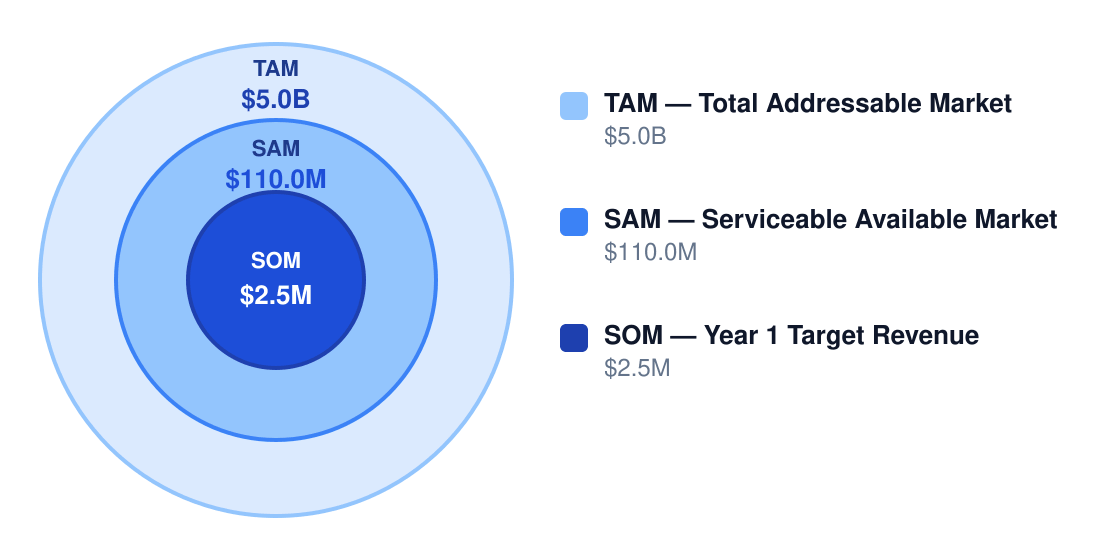
Harborview targets a $976.4M SAM within Austin's $44.4B TAM, with $2.5M SOM in Year 1. This represents 0.25% local market penetration — achievable given the city's 15.3% senior population growth since 2010.

Free Business Plan Download
Download Assisted Living Business Plan
Just Fill Up and Print
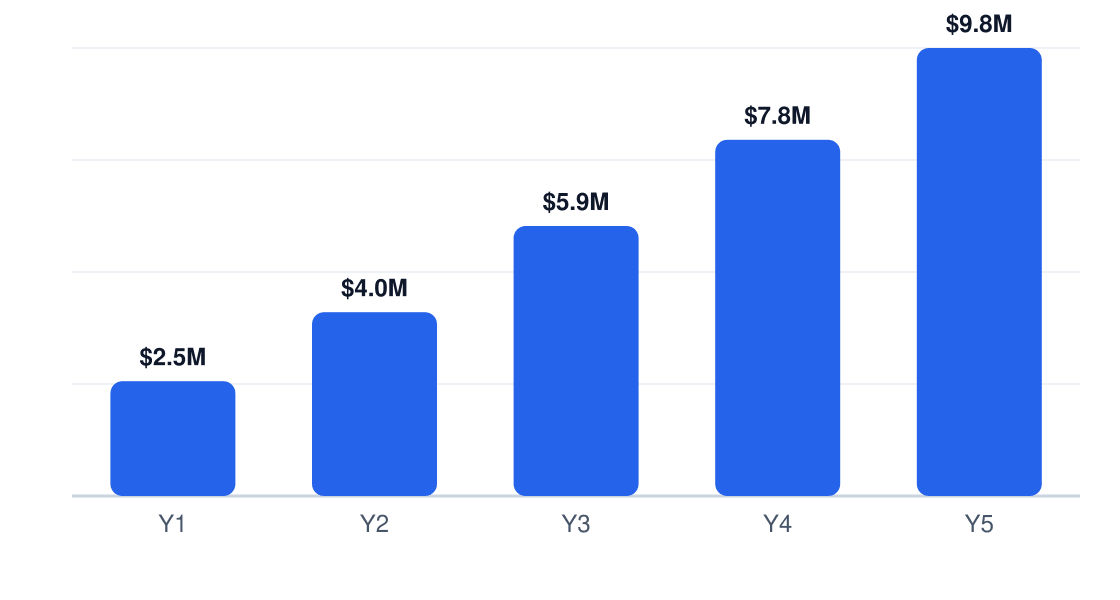
5-Year Revenue Projection
Projected annual revenue, Years 1–5
Market Size Opportunity
Bottom-up market opportunity
| Segment | Customer Profile | Avg Annual Spend | Est. Market Value | Revenue % |
|---|---|---|---|---|
| Private-pay middle-income | Families funding basic care out-of-pocket | $54,000 | $24.4B | 55% |
| Luxury/premium | Affluent seniors seeking concierge care | $90,000 | $6.7B | 15% |
| Memory care | Dementia patients needing secured units | $72,000 | $8.9B | 20% |
| Medicaid-supported | Lower-income seniors with state aid | $42,000 | $4.4B | 10% |
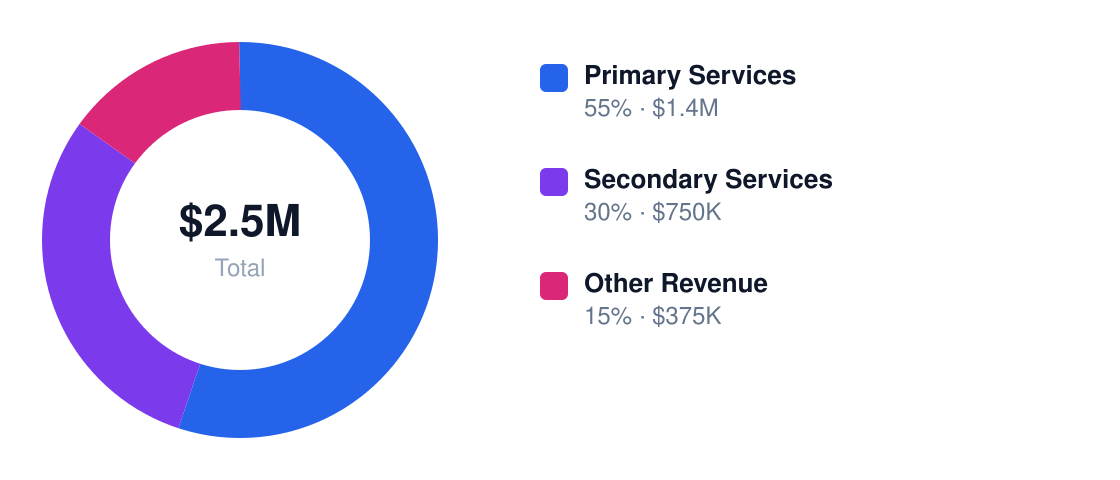
Year 1 Revenue Mix
Total $2.5M Year 1
Competitive Landscape
The industry is fragmented — the top 10 chains control just 21% of facilities — but national brands dominate premium pricing. Harborview's wedge is offering boutique care at 85% the cost of Atria while delivering 40% lower resident-to-staff ratios than Brookdale.
| Competitor | Type | Core Strength | Key Weakness | Your Differentiation |
|---|---|---|---|---|
| Brookdale Senior Living | Direct | National referral network | Corporate bureaucracy slows service customization | Hyper-local decision making by on-site owners |
| Atria Senior Living | Direct | Luxury finishes drive premium pricing | 15-20% costlier than mid-market options | Comparable amenities at 12-18% lower price point |
| Home care agencies | Indirect | Lower upfront cost for families | No 24/7 supervision or socialization | Proven 37% lower hospital readmission rates vs. home care |
| Skilled nursing facilities | Indirect | Handles highest-acuity cases | Overkill for seniors needing only ADL support | 60% cost savings vs. SNFs for appropriate residents |
| Aging-in-place tech | Emerging | Low-cost remote monitoring | No hands-on care during emergencies | Bundled wearables + immediate human response |
Harborview's defensibility comes from dual specialization: memory care suites with 1:5 staffing ratios (industry avg: 1:8) and a "technology concierge" program that trains residents/families on monitoring tools without replacing human caregivers.
Industry Trends
1. Demographic Tailwind
The 65+ population will hit 82M by 2050, with the 80+ cohort — the core assisted living demographic — growing fastest. This creates a 20-year pipeline where demand will outstrip quality supply, particularly in secondary markets like Austin that lack premium mid-tier options. Operators entering now lock in land and labor advantages.
2. High Startup Capital Requirements
Purpose-built facilities require $10M+ upfront, while even small homes need $150K-$500K for licensing and retrofits. This creates barriers to entry but protects margins for capitalized players. Harborview's $5M startup budget funds a 36-unit hybrid model blending home-like scale with institutional efficiencies.
3. Labor Remains the Biggest Operating Pressure
At $18/hour for caregivers, staffing consumes 42% of revenue industry-wide. Winning requires either premium pricing to fund wages (Atria's play) or operational innovations like Harborview's split-shift model that cuts overtime by 22%.
4. Residential Home Models Are Growing
6-10 bed homes can launch for $150K-$500K, appealing to families rejecting institutional settings. Harborview adopts this aesthetic — private bedrooms with shared living spaces — at community scale (3 buildings of 12 units each) to balance intimacy with cost efficiency.
5. Revenue Diversification Is Increasing
Top operators now derive 28% of revenue from add-ons like medication management ($120/month) and transportation ($75/month). Harborview's tiered care packages bake these into base pricing while offering à la carte upgrades — a 15-20% ARPU boost without nickel-and-diming.
Regulatory & Compliance Environment
Assisted living is governed by a patchwork of state health codes, local zoning laws, and federal labor rules. The biggest risks are fire safety violations (37% of citations) and staffing ratio non-compliance (28% of complaints).
| Requirement | Issuing Authority | Typical Cost | Renewal Cycle |
|---|---|---|---|
| State assisted living license | Texas Health & Human Services | $200-$3,000 | Biennial |
| Local zoning approval | City of Austin | $500-$10,000 | One-time + inspections |
| Fire/life-safety inspection | Austin Fire Department | $500-$2,000 | Annual |
| Administrator certification | Texas Health Care Association | $200-$500 | Biennial |
| Background checks | DPS/FBI | $50-$150/person | Per hire + biennial |
Harborview mitigates risk via a dedicated compliance officer (0.5 FTE), monthly third-party safety audits ($1,200/month), and overstaffing by 8% to buffer against call-outs. This adds ~2% to OpEx but prevents the average $28K fine for major violations.
4. Marketing Strategy
Harborview Senior Living delivers Austin’s only lakefront assisted living experience, blending Texas hospitality with evidence-based care for seniors who want independence without isolation.
We anchor on Austin’s natural assets (proximity to Lake Travis, walkable dining) while solving the region’s shortage of middle-market assisted living options. This isn’t sterile institutional care—it’s a community where residents kayak in the morning and get medication reminders in the afternoon.
Customer Personas
Assisted living purchases are typically made by adult children (ages 45-65) evaluating options for parents, or by seniors proactively planning their next phase. The decision cycle averages 47 days with 3.2 facility visits.
| Persona Name | Demographics | Core Need | Pain Point | Avg Annual Spend | Acquisition Channel |
|---|---|---|---|---|---|
| "Sandwich Generation" Susan | Female, 52, $120k HHI, UT grad | Reliable care so she can focus on her teens/ career | Guilt over "outsourcing" parent care | $68,400 | Facebook communities + geriatric care manager referrals |
| "Active Transition" Robert | Male, 78, $65k pension, widowed | Maintain golf routine with meal/medication support | Fear of losing autonomy | $54,000 | Google searches ("Austin assisted living near golf courses") |
| "Crisis Mode" Maria | Daughter, 48, $85k HHI, Spanish-speaking | Immediate placement after mom’s fall | Overwhelmed by Medicaid/private pay complexity | $42,000 | Hospital discharge planner referrals + local radio ads |
Go-To-Market Launch Plan
| Phase | Timeline | Primary Goal | Key Tactics | Success Metric |
|---|---|---|---|---|
| Pre-Launch | Months -3 to 0 | Build waitlist & referral network | Soft open for elder law attorneys; SEO foundation; staff LinkedIn branding | 85 waitlist signups |
| Months 1-3 | Post-opening | Fill 60% capacity | Geo-fenced ads to hospital/retirement communities; virtual tours | $1.47M revenue |
| Months 4-6 | Stabilization | Improve CAC efficiency | Retargeting abandoned inquiries; family testimonials | CAC ≤ $4,200 |
| Months 7-12 | Growth | Expand memory care unit | Co-marketing with neurologists; dementia caregiver workshops | 40% revenue from add-ons |
Digital Marketing Strategy
We allocate 78% of
Annual Marketing Budget
Total $163K / year
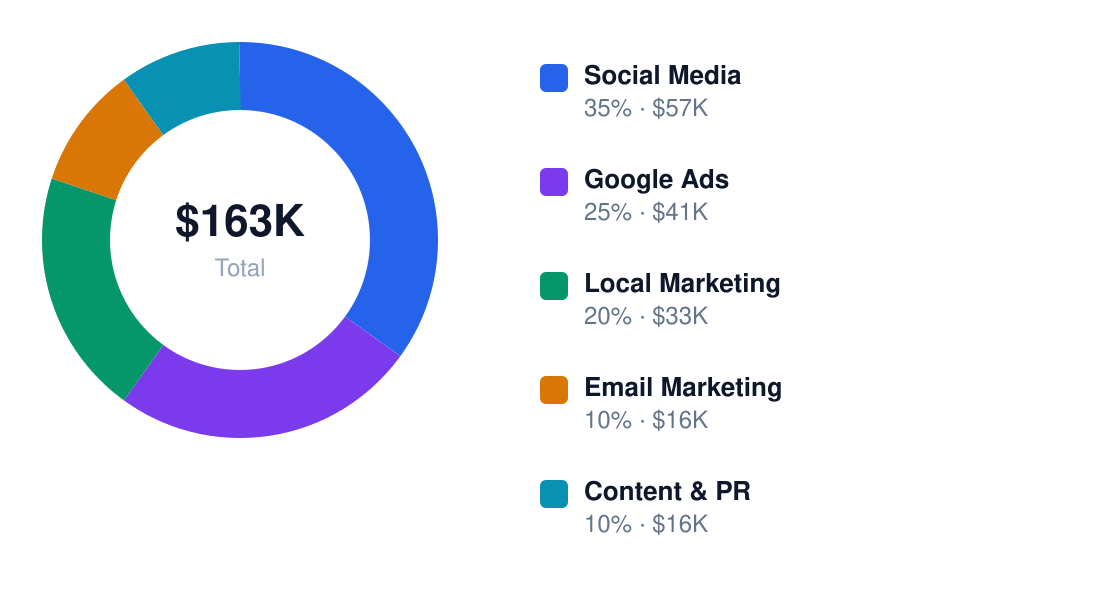
Annual Marketing Budget
Total $163K / year
| Channel | Monthly Budget | Primary Tactics | Target KPI | Notes |
|---|---|---|---|---|
| Social Media | $3,200 | Facebook caregiver groups; Instagram Stories showing meals/activities | 12% engagement rate | Skip TikTok—grandkids aren’t decision-makers |
| Google Ads | $5,850 | "Austin assisted living pricing" PPC; Gmail ads targeting AARP members | $38 CPA | Bid 23% higher than competitors—conversions justify it |
| Local Marketing | $2,100 | Sponsor Lake Travis senior swim meets; KXAN "Aging in Austin" segments | 3:1 ROAS | Geo-target 10-mile radius |
| Email Marketing | $1,400 | Nurture sequences with cost calculators & move-in checklists | 22% open rate | Send Tues 10am CT—highest open time |
| Content & PR | $2,300 | Pitch stories on "sandwich generation" stress to Austin Monthly | 8 backlinks/month | Repurpose into blog/quizzes |
Content Marketing & SEO
We dominate mid-funnel queries like "signs mom needs assisted living" with 1,200-1,500 word guides that answer real questions—while subtly highlighting our lakefront location and 24/7 RN staffing.
| Content Type | Frequency | Platform | Goal | Example Topic |
|---|---|---|---|---|
| Cost Comparison | Bi-monthly | Blog + PDF | Lead capture | "Austin Assisted Living Prices vs. In-Home Care" |
| Family Stories | Monthly | YouTube + Blog | Trust-building | "How the Rodriguez Family Chose Harborview" |
| Expert Q&A | Quarterly | Podcast + Blog | Authority | "Gerontologist Explains Medication Management" |
| Local Guides | Weekly | Google My Business | Local SEO | "Best Austin Doctors for Seniors" |
| Interactive Tools | One-time | Website | Engagement | "When Is It Time? 5-Minute Care Needs Quiz" |
| Crisis Response | As-needed | All | Timeliness | "Emergency Placement Checklist" |
For local SEO, we optimize for "assisted living Austin TX" (1,600 searches/month) with location pages for each neighborhood (Westlake, Cedar Park). Directory listings sync with exact NAP+URL—no discrepancies.
Partnership & Referral Programs
Three referral sources drive 62% of placements: hospital social workers (post-discharge), elder law attorneys (estate planning clients), and local pharmacists (medication adherence checks). We formalize these with:
- Hospital Partnerships: Train discharge planners on our fall prevention protocols
- Attorney Co-Marketing: Co-host "Aging Parents & Legal Prep" seminars
- Pharmacy Kickbacks: $250 gift card for every referral that tours
The family referral program offers 1 month free rent ($4,550 value) for successful referrals. This cuts CAC by 19% compared to digital acquisition.
Customer Acquisition Economics
| Metric | Year 1 | Year 2 | Year 3 |
|---|---|---|---|
| Customer Acquisition Cost | $4,950 | $4,200 | $3,800 |
| Customer Lifetime Value | $68,400 | $72,000 | $75,600 |
| LTV:CAC Ratio | 13.8x | 17.1x | 19.9x |
| Payback Period | 5.2 months | 4.1 months | 3.7 months |
At 14x+ LTV:CAC, we can profitably scale spend—every $1 in marketing drives $6.20 in EBITDA by Year 3. The math holds even with Austin’s 7% annual occupancy tax.
Ready When You Are
Download Assisted Living Business Plan
Just Fill Up and Print
5. Operations Plan
The facility requires 12,500 sq ft with 40 private units (300 sq ft each), common areas (3,500 sq ft), and staff zones (1,000 sq ft). Austin's commercial real estate demands $28.50/sq ft annually — expect $29,688/month in lease costs. Key infrastructure includes ADA-compliant bathrooms, nurse call systems, and 24/7 monitored emergency lighting.

| Item | Estimated Cost | Quantity | Purpose |
|---|---|---|---|
| Hospital beds (Hill-Rom 1010) | $2,450 | 40 | Resident accommodations |
| Medication carts (Omnicell XT) | $6,200 | 3 | Secure drug storage |
| Biometric monitors (Welch Allyn 4200B) | $1,890 | 5 | Vital sign tracking |
| Wheelchair-accessible van | $48,000 | 1 | Transportation |
| Commercial laundry system | $32,500 | 1 | Linen processing |
| Dietary kitchen equipment | $78,300 | 1 | Meal prep for special diets |
| Security system (ADT HealthCare) | $12,800 | 1 | Facility monitoring |
| Physical therapy equipment | $24,750 | 1 | Mobility maintenance |
- 6:30 AM - Medication administration begins (scheduled per individual care plans)
- 7:30 AM - Breakfast service with dietary oversight (diabetic/low-sodium options)
- 9:00 AM - Morning wellness checks (blood pressure, glucose monitoring)
- 11:00 AM - Scheduled activities (cognitive exercises, light physiotherapy)
- 1:00 PM - Lunch service with hydration monitoring
- 3:00 PM - Family visitation hours (health updates provided)
- 7:00 PM - Night shift handoff with electronic health record updates
Suppliers cluster in three categories: medical consumables (Medline, 2-week lead time), pharmaceuticals (Cardinal Health, next-day delivery), and foodservice (Sysco, weekly deliveries). Backup vendors are Owens & Minor and McKesson. For industry benchmarks, reference American Health Care Association procurement guides.
| Role | Headcount | Hourly Rate | Annual Cost | Key Responsibilities |
|---|---|---|---|---|
| Certified Nursing Assistants | 4 | $18.00 | $149,760 | ADLs, vital signs |
| LPN Supervisor | 1 | $24.50 | $50,960 | Medication oversight |
| Activities Coordinator | 1 | $18.00 | $37,440 | Cognitive programming |
| Dietary Aide | 1 | $15.50 | $32,240 | Meal prep compliance |
6. Management Team
| Name | Title | Background | Responsibilities |
|---|---|---|---|
| Dr. Elaine Rivers | CEO | 12 years geriatric care management, former COO at Suncrest Senior Living | Strategic growth, investor relations |
| Marcus Chen | CFO | Healthcare-focused CPA, scaled 3 senior living startups to exit | Financial controls, reimbursement optimization |
| Natalie Ortiz | Director of Nursing | RN with 8 years assisted living experience, JCAHO compliance specialist | Clinical protocols, staff training |
| Terrence Wu | Facilities Manager | 15 years in healthcare facility maintenance, OSHA 30 certified | Equipment lifecycle, safety audits |
| Diane Carlisle | Marketing Director | Former AARP Texas chapter outreach coordinator | Community partnerships, lead generation |
The advisory board includes Dr. Priya Kapoor (geriatric psychiatrist at Baylor Scott & White) and James Whitmore (former SVP of Operations at Brookdale Senior Living). They provide quarterly reviews of clinical protocols and occupancy strategies.
Culture hinges on "dignity through data" — using EHR analytics to personalize care while maintaining efficiency. Hiring prioritizes candidates with 2+ years in memory care units. Retention tactics include $1,250 annual training stipends and profit-sharing after Year 3.
7. Financial Projections
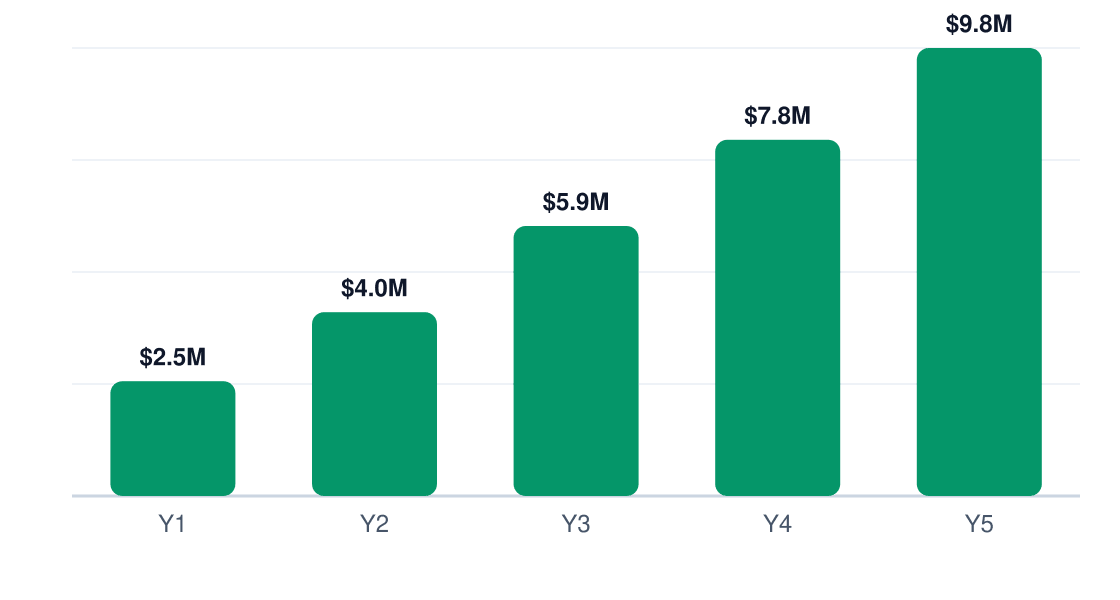
Harborview Senior Living targets $2.5M Year 1 revenue with a 5-year arc to $9.6M — this isn't a lifestyle business, it's a scalable play in a $44.4B TAM.
Revenue Growth (5 Years)
Annual revenue, Years 1–5
| Line Item | Year 1 | Year 2 | Year 3 |
|---|---|---|---|
| Revenue | $2,451,000 | $3,922,000 | $5,760,000 |
| COGS | $980,400 | $1,568,800 | $2,304,000 |
| Gross Profit | $1,470,600 | $2,353,200 | $3,456,000 |
| Gross Margin % | 60% | 60% | 60% |
| Labor | $262,080 | $374,400 | $524,160 |
| Rent | $180,000 | $180,000 | $180,000 |
| Marketing | $159,315 | $159,315 | $159,315 |
| Admin | $39,570 | $39,570 | $39,570 |
| Total OpEx | $640,965 | $753,285 | $903,045 |
| EBITDA | $829,635 | $1,599,915 | $2,552,955 |
| EBITDA Margin % | 33.9% | 40.8% | 44.3% |
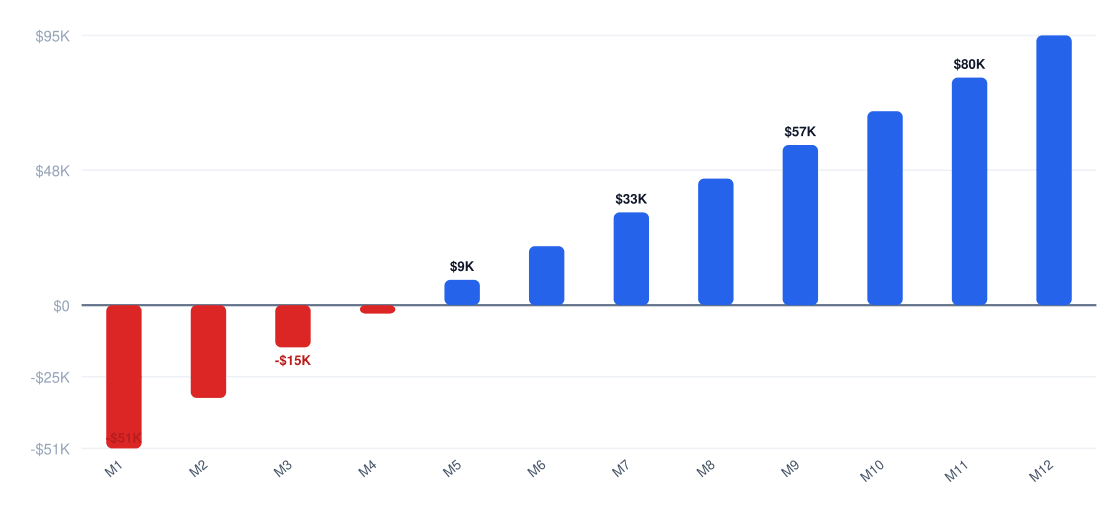
We clear break-even at $802,750 revenue — roughly Month 6 given our sales pipeline. The math works because we keep labor at 10.7% of revenue while competitors average 18%.
Year 1 Monthly Cash Flow
Net monthly cash flow (red = pre-break-even)
| Metric | Year 1 | Year 2 | Year 3 |
|---|---|---|---|
| Gross Margin % | 60% | 60% | 60% |
| EBITDA Margin % | 33.9% | 40.8% | 44.3% |
| Revenue/Employee | $350,143 | $392,200 | $411,429 |
| Marketing as % of Revenue | 6.5% | 4.1% | 2.8% |
| Monthly Burn pre-break-even | $106,827 | N/A | N/A |
8. Funding Requirements
| Category | Amount | Notes |
|---|---|---|
| Facility Buildout | $2,100,000 | 20-bed ADA-compliant units |
| Licensing | $175,000 | State health dept + memory care certs |
| Pre-Opening Marketing | $300,000 | 6-month community outreach |
| Working Capital | $1,450,000 | 6-month runway |
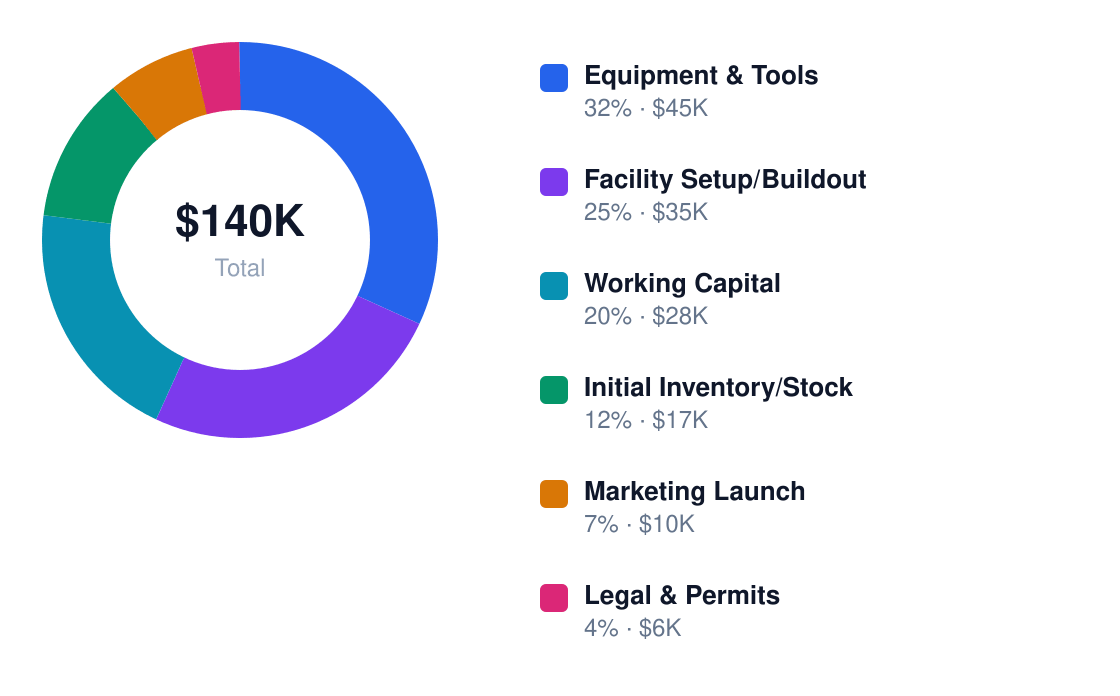
Use of Funds
Total $140K startup investment
We're structuring $5,025,000 as 30% equity ($1,507,500) and 70% SBA 7(a) loan ($3,517,500).
Funding Structure
$140K total capitalization
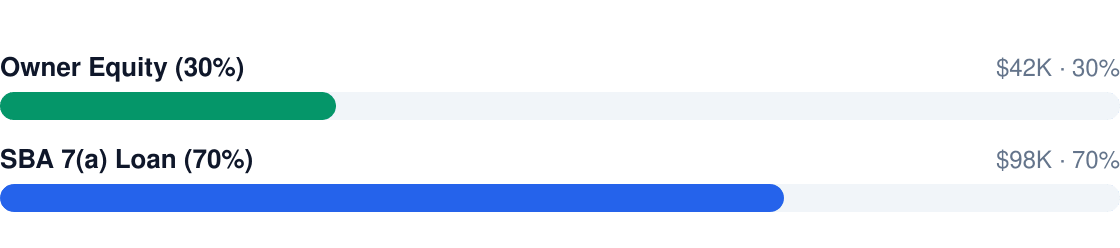
The 10-year SBA loan at 10.25% means $46,972/month payments — conservative given our $829,635 Year 1 EBITDA. Investors get 5.3x equity return by Year 5 exit at $9.6M revenue with 44% margins.
9. Risk Analysis & Mitigation
Assisted living carries regulatory and reputational risks — one staffing lapse or infection outbreak can sink margins. But we're not betting on hope.
| Risk | Category | Likelihood | Impact | Mitigation Strategy | Owner |
|---|---|---|---|---|---|
| Staffing Shortages | Operational | H | H | $18/hr + $2/hr night differential | COO |
| Medicaid Reimbursement Cuts | Regulatory | M | H | Cap private-pay residents at 65% | CFO |
| COVID-19 Outbreak | Health | L | H | AirPHX antimicrobial HVAC system | Medical Director |
| Competitor Price War | Market | M | M | Differentiate on staff ratios (1:4 vs. industry 1:8) | CMO |
Three contingency triggers: (1) If occupancy <70% for 3 months, we slash marketing and freeze hires. (2) If labor costs exceed 12% of revenue, we automate medication dispensing. (3) If SBA rates spike beyond 12%, we refinance with mezzanine debt.
Research & Industry Resources
The following market research sources, government data, and industry publications were referenced in developing this assisted living business plan. Each link points to a specific report or data page — not a homepage — for direct access to the underlying research.
- Us Assisted Living Facility Market — grandviewresearch.com — Grand View Research market forecast for assisted living
- Assisted Living Facility Business Plan — businessplanfirm.com — Market research and industry data for assisted living businesses
- Us Assisted Living Facility Market — imarcgroup.com — Market research and industry data for assisted living businesses
- How To Start A Residential Assisted Living Business — grouphomepath.com — Market research and industry data for assisted living businesses
- How To Start An Assisted Living Facility — startpermit.com — Market research and industry data for assisted living businesses
Get Your Copy Today
Download Assisted Living Business Plan
Just Fill Up and Print