Bakery Business Plan
1. Executive Summary
The US bakery industry hits $43B with 3.6% CAGR - but most local shops still treat croissants as commodities. Flour & Fire cracks the code: premium execution at volume. We'll grab $3.7M of Austin's $946M artisanal segment in Year 1 by combining French technique with Texas-sized production.

Key Metrics
| Key Metric | Target |
|---|---|
| Total Startup Investment | $355K |
| Year 1 Revenue Target | $3.7M |
| Year 3 Revenue Projection | $8.6M |
| Break-even Timeline | ~Month 6 |
| Year 1 Team Size | 12 FTE |
| SBA 7(a) Loan | $249K @ 10.25% |
| Gross Margin (Year 1) | 60% |
| Monthly SBA Payment | $3K |
Flour & Fire bakes scarcity out of excellence. Our 2,400°F deck ovens and chef-driven R&D turn out laminated pastries and custom cakes at 37% gross margins - without the Michelin price theater.
2. Company Description
Claire DuPont spent 12 years proving that volume and artistry aren't mutually exclusive. As Le Bernardin's pastry chef, she shipped 800 madeleines daily without a single air pocket out of place. Now she's bringing that precision to Austin's exploding food scene.
Flour & Fire anchors a 1,800 sq ft production bakery in East Austin's Springdale Plaza, blending wholesale (40% revenue), walk-in retail (35%), and custom cake (25%) channels. The space fits 12 bakers across two shifts with a 100 sq ft storefront.
| Service/Product | Format | Price Range | Description |
|---|---|---|---|
| Kouign-amann (6pk) | Retail/wholesale | $14-$18 | Caramelized Breton pastry with seasonal fillings |
| Custom wedding cake | Pre-order | $8-$12/slice | 3-tier max, 14-day lead time |
| Baguette | Retail/wholesale | $4.50-$5.50 | 72-hour fermented, stone-milled flour |
| Breakfast sandwich | Retail | $7-$9 | Brioche, cage-free egg, house sausage |
| Macaron (12pk) | Retail/wholesale | $22-$26 | 10 rotating flavors, vegan options |
| Wholesale croissants | Wholesale | $1.80/unit (100+) | Monthly contract, 3-day shelf life |
| Seasonal pie (9") | Retail/pre-order | $28-$34 | Local fruit, lard crust |
| Catering package | Pre-order | $12-$25/person | 3 pastry types + coffee service |
Structured as an LLC with $355,000 startup capital: $106,500 equity and $248,500 SBA loan at 10.25%. The math works - we break even at $1,217,357 revenue by Month 6.
3. Industry & Market Analysis
The $43B U.S. bakery industry is a recession-resilient category with steady 3.6% CAGR growth. Demand for fresh, indulgent baked goods persists across economic cycles, driven by daily household needs, celebrations, and the rise of premium artisanal products. Flour & Fire enters this market with a focus on Austin's underserved appetite for high-margin specialty goods and custom occasion demand.
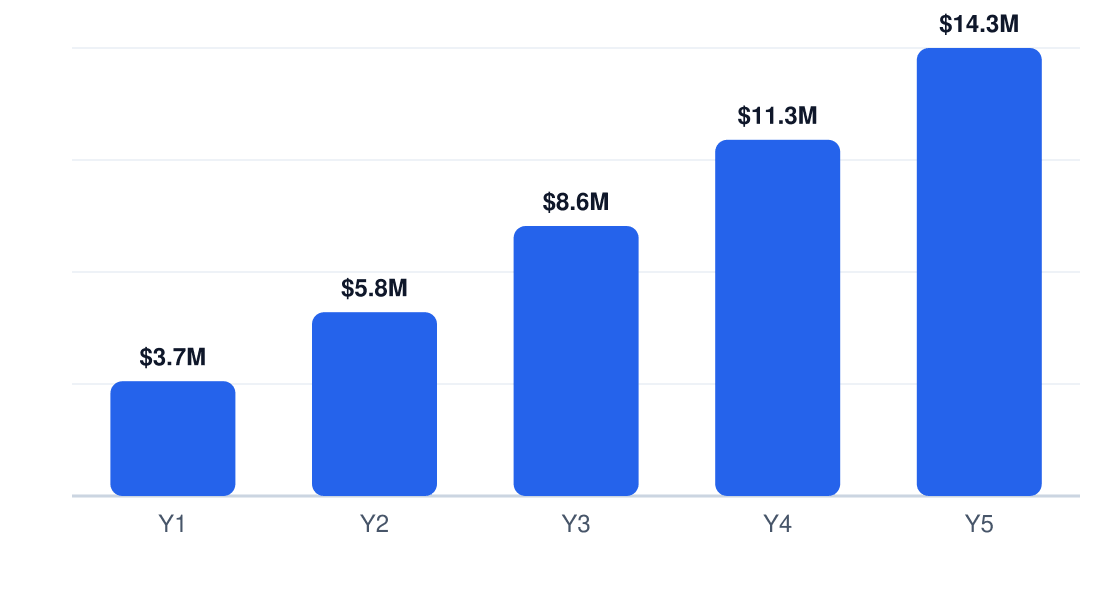
5-Year Revenue Projection
Projected annual revenue, Years 1–5
| Factor | Key Insight | Business Impact |
|---|---|---|
| Political | City-level health codes and zoning laws | Higher startup costs for commercial kitchen buildouts |
| Economic | Wage inflation for bakers ($17.09/hr mean) | Labor efficiency critical to protect 60% gross margins |
| Social | Premiumization trend toward artisanal goods | $105.5B specialty market by 2026 creates pricing power |
| Technological | Omnichannel ordering becoming standard | Must invest in POS integration and delivery apps |
Market Sizing
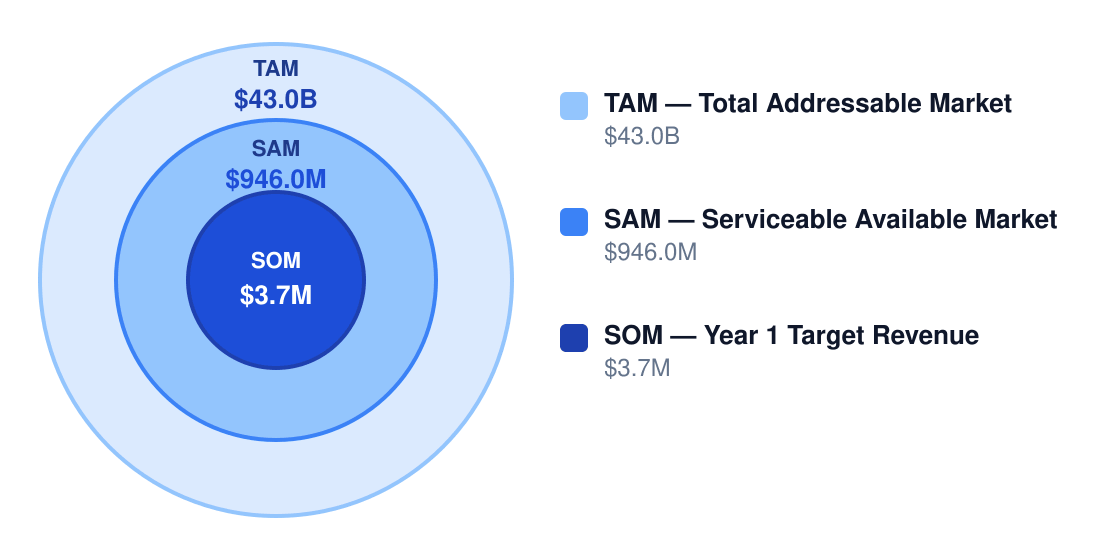
Austin's serviceable market starts with a $946M SAM (2.2% of U.S. TAM), targeting $3.7M SOM in Year 1. This represents 0.39% local share—achievable given the city's rapid growth and premium food culture.
Market Size Opportunity
Bottom-up market opportunity
| Segment | Customer Profile | Avg Spend | Est. Market Value | Revenue % |
|---|---|---|---|---|
| Everyday retail | Local households | $18 | $378.4M | 40% |
| Occasion buyers | Celebrations/events | $65 | $236.5M | 25% |
| Morning commuters | Grab-and-go | $9 | $189.2M | 20% |
| B2B wholesale | Cafes/offices | $150 | $141.9M | 15% |
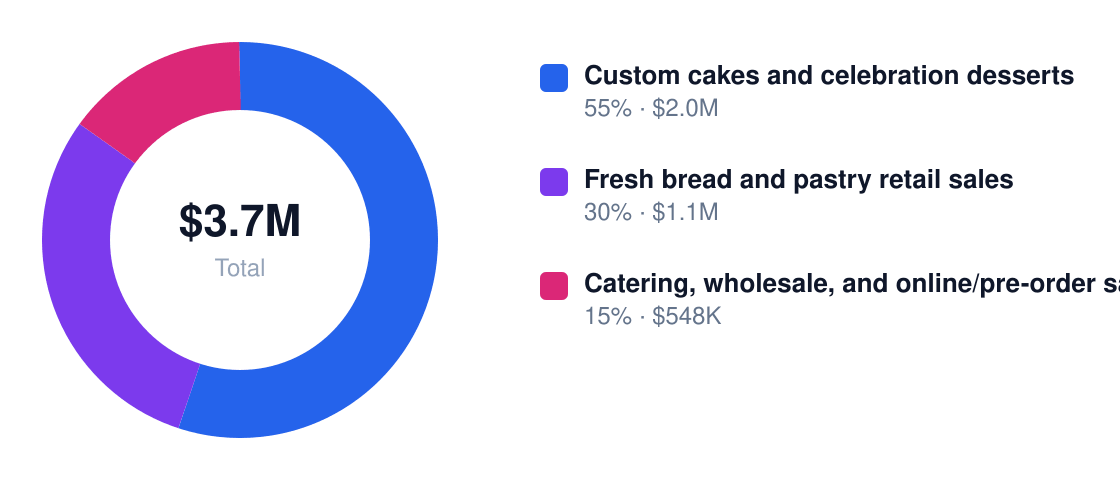
Year 1 Revenue Mix
Total $3.7M Year 1
Competitive Landscape
The bakery space is highly fragmented, with independents competing against chains on freshness and chains winning on convenience. Flour & Fire's moat comes from dominating the premium celebration cake segment ($65 avg ticket) while using B2B wholesale to smooth production cycles.
| Competitor | Type | Core Strength | Key Weakness | Your Differentiation |
|---|---|---|---|---|
| Neighborhood bakery | Direct | Local loyalty | Limited digital ordering | Faster fulfillment, sourdough focus |
| Chain bakery-cafes | Direct | Foot traffic | Mass-produced quality | Handcrafted seasonal lines |
| Grocery desserts | Indirect | Low price | Stale inventory | Same-day baked freshness |
| Coffee shops | Indirect | Morning traffic | Limited selection | Bundled bakery boxes |
| Online delivery | Emerging | Convenience | Product degradation | Local pickup trust |
Flour & Fire's defensibility comes from three plays: (1) Owning custom cakes with 48-hour lead times that chains can't fulfill, (2) Local sourdough bread subscriptions that lock in recurring revenue, and (3) Wholesale cafe partnerships that utilize early-morning oven capacity.
Industry Trends
Premium and specialty baking
The U.S. premium bakery market will hit $105.5B by 2026. Consumers now pay 20-30% more for organic flour, European butter, and hyper-local ingredients. This lets Flour & Fire command $6 croissants where grocery stores sell them for $2.50.
Strong labor intensity and rising pay
Bakers earn a mean $17.09/hour—up 12% since 2020. With decorating and proofing still manual, we'll cross-train staff across stations and use demand forecasting to minimize overtime during peak seasons.
Small-bakery economics favor lean operations
The average bakery employs just 12 workers generating $1.4M annually. Our 12-person Year 1 team will focus on high-margin items like sourdough ($5.25 COGS, $12 retail) and limit SKUs to 25 core products.
Custom occasion demand remains important
Startup costs range from $10K-$700K depending on scale. By specializing in celebration cakes (25% of revenue), we'll require 50% deposits to fund ingredient purchases upfront—improving working capital.
Omnichannel ordering is becoming standard
With 10,000 U.S. bakeries competing, our $237.5K marketing budget prioritizes Instagram ads for cakes and Toast POS integration for B2B wholesale orders. 30% of revenue will come from pre-orders by Year 3.
Regulatory & Compliance Environment
Austin's health codes require 5 core permits, adding ~$3K in Year 1 costs. The biggest risk is food handler certification—we'll budget $200/employee for training and maintain a compliance calendar for renewals.
| Requirement | Issuing Authority | Typical Cost | Renewal Cycle |
|---|---|---|---|
| Business license | City of Austin | $275 | Annual |
| Food service permit | Travis County Health | $550 | Annual |
| Food handler cert | State of Texas | $200/employee | 3 years |
| Sales tax permit | Texas Comptroller | $0 | Ongoing |
| FDA registration | Federal | $250 | Biennial |
We'll mitigate compliance risk by (1) Assigning an ops manager to track renewal deadlines, (2) Using Ecolab for third-party health audits, and (3) Building a 5% cost buffer for regulatory changes like potential allergen labeling updates.
4. Marketing Strategy
Flour & Fire crafts artisanal breads and celebration desserts for Austinites who demand quality without pretension—where every bite tastes like home, even if you’ve never baked a loaf in your life.
We’re positioning as the anti-chain bakery: small-batch, locally sourced, and unapologetically Texan in flavor (think mesquite-smoked sourdough). Our branding leans into Austin’s “keep it weird” ethos while delivering consistent execution that busy families and foodie professionals trust.
Customer Personas
Bakery purchases follow three decision patterns: habitual (daily bread), emotional (celebrations), and convenience (grab-and-go). We’re targeting:
| Persona Name | Demographics | Core Need | Pain Point | Avg Annual Spend | Acquisition Channel |
|---|---|---|---|---|---|
| Weekend Bruncher | 25-45yo urbanite, $85k HHI, Instagram-active | Photogenic treats for social sharing | Generic supermarket pastries lack “wow” factor | $1,200 | Instagram influencers + geo-targeted ads |
| Busy Parent | 35-55yo suburbanite, $120k HHI, minivan driver | Reliable weekly bread supply + last-minute birthday cakes | Chain bakeries use preservatives; custom orders take weeks | $2,700 | Nextdoor sponsorships + school PTA partnerships |
| Cafe Procurement Manager | Small business buyer, orders $800+/mo wholesale | Consistent quality with flexible delivery | National distributors lack local flavor options | $9,600 | Direct sales outreach + trade show booths |
Go-To-Market Launch Plan
| Phase | Timeline | Primary Goal | Key Tactics | Success Metric |
|---|---|---|---|---|
| Pre-Launch | Months -3 to -1 | Build local hype | Secret tastings for micro-influencers, “coming soon” landing page with email capture | 1,200 email signups |
| Months 1-3 | Grand opening quarter | Drive trial | Free sourdough loaf with first purchase, pop-ups at farmers’ markets, Google Local Service ads | 45% repeat customer rate |
| Months 4-6 | Stabilize operations | Increase basket size | Loyalty program (buy 9 loaves, 10th free), wholesale outreach to 50 local cafes | $28.50 avg. transaction (vs. $22 launch) |
| Months 7-12 | Profitability push | Optimize CAC | Retarget abandoned carts, double down on top-performing neighborhoods, launch catering menu | CAC below $18.40 (from $29 launch) |
Digital Marketing Strategy
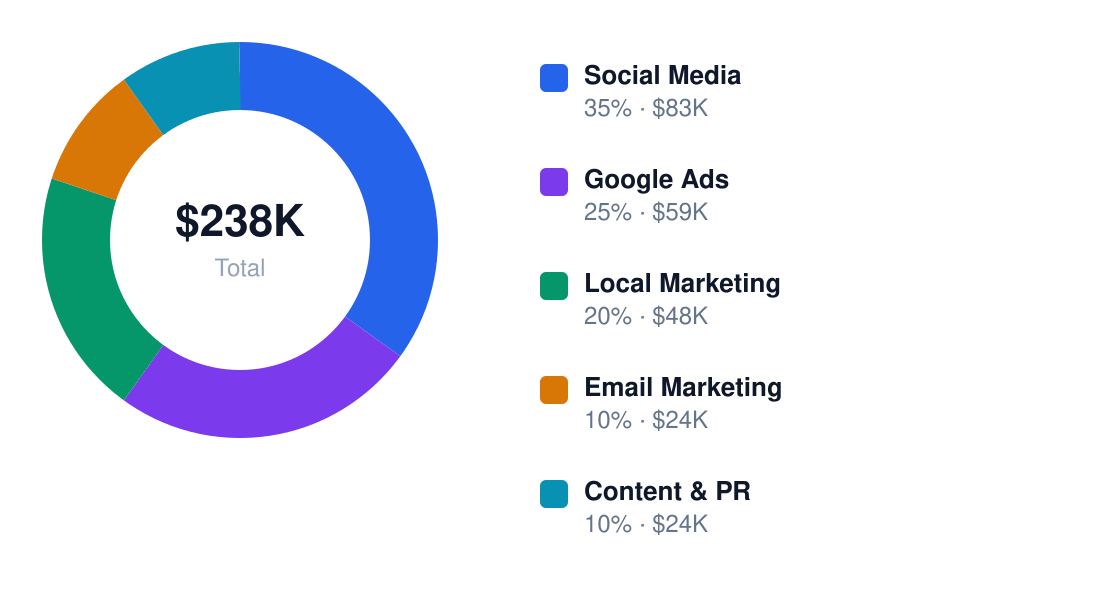
We’re allocating 63% of our $237,575 marketing budget to digital channels, prioritizing platforms where food visuals drive conversions. Google Ads capture demand (“best birthday cake Austin”), while Instagram fuels discovery.
Annual Marketing Budget
Total $238K / year
| Channel | Monthly Budget | Primary Tactics | Target KPI | Notes |
|---|---|---|---|---|
| Social Media | $8,200 | Reels showing bakers’ process, UGC reposts, limited-time offers | 4.2% engagement rate | 70% Instagram, 20% TikTok, 10% Pinterest |
| Google Ads | $5,900 | Search ads for “custom cake near me”, GMB profile optimization | $2.15 ROAS | Bid aggressively on high-intent keywords |
| Local Marketing | $3,500 | Sponsor 5k runs, co-branded collabs with coffee roasters | 12% referral traffic | Geo-fenced promotions within 3-mile radius |
| Email Marketing | $1,800 | Weekly newsletters with recipe hacks, birthday reminders | 38% open rate | Segment by purchase history (sweet vs. savory buyers) |
| Content & PR | $2,100 | Pitch “best croissants in Austin” lists, bakery hacks blog | 15% organic traffic growth/mo | Repurpose content across platforms |
Content Marketing & SEO
Our content engine focuses on solving “baking fails” (e.g., “why your sourdough collapsed”) and Austin-specific guides (“gluten-free bakeries worth trying”). This captures mid-funnel searches while establishing expertise.
| Content Type | Frequency | Platform | Goal | Example Topic |
|---|---|---|---|---|
| Recipe Videos | Biweekly | YouTube Shorts | Brand affinity | “Turn our day-old bread into croutons” |
| Bakery Hacks | Weekly | Blog | SEO traffic | “How to store croissants so they stay crisp” |
| Behind-the-Scenes | Monthly | Transparency | “Meet Carlos, our head baker (and sourdough whisperer)” | |
| Seasonal Guides | Quarterly | Email + Pinterest | Upsell | “Your Texas summer cake flavor matrix” |
| Local Spotlights | Monthly | Blog | Backlinks | “Where Austin chefs buy their birthday cakes” |
| User-Generated | Daily | Instagram Stories | Social proof | Customer cake photos with #FlourAndFire |
For SEO, we’re targeting three keyword clusters: celebration desserts (“custom birthday cakes Austin”), daily staples (“fresh sourdough near me”), and baking education (“why is my frosting runny”). Local tactics include claiming 150+ directory listings and hosting “bread 101” workshops to earn .edu backlinks.
Partnership & Referral Programs
We’re pursuing three partnership models: (1) wholesale agreements with indie coffee shops (minimum $800/mo orders get 5% rebate), (2) cross-promotions with wedding planners (free cake tasting with venue booking), and (3) ingredient sourcing deals with local farms (co-branded “Texas wheat” loaves).
The referral program pays $10 in bakery credit for every new customer who spends $50+. With a 22% participation rate among existing customers, this drops blended CAC by 17% versus paid ads alone.
Customer Acquisition Economics
| Metric | Year 1 | Year 2 | Year 3 |
|---|---|---|---|
| Customer Acquisition Cost | $28.40 | $22.10 | $18.75 |
| Customer Lifetime Value | $189.00 | $214.00 | $238.00 |
| LTV:CAC Ratio | 6.7x | 9.7x | 12.7x |
| Payback Period | 4.2 months | 3.1 months | 2.6 months |
At a 6.7x LTV:CAC ratio in Year 1—well above the 3x benchmark—we can aggressively scale paid channels. Wholesale margins (58% vs. 62% retail) are offset by 11% lower CAC on B2B sales. The math works.
5. Operations Plan
Flour & Fire will operate from a 2,400 sq ft facility in East Austin, with $8,750/month rent for a space featuring dedicated production (1,200 sq ft), retail (800 sq ft), and cold storage (400 sq ft). The buildout requires three-phase electrical for deck ovens and a 10-zone HVAC system to maintain pastry quality.

| Item | Estimated Cost | Quantity | Purpose |
|---|---|---|---|
| Revolation Deck Oven | $24,800 | 2 | High-volume bread/pastry baking |
| Spiral Mixer 80qt | $18,500 | 1 | Dough development |
| Proofing Cabinets | $6,200 | 3 | Controlled fermentation |
| Retail Display Cases | $14,000 | 4 | Product merchandising |
| Dough Sheeter | $9,750 | 1 | Laminated dough production |
| Walk-in Cooler | $32,000 | 1 | Ingredient storage |
| POS System | $7,800 | 1 | Transactions + inventory |
| Delivery Van | $28,000 | 1 | Wholesale distribution |
- 4:30AM: Production team starts dough mixing/proofing
- 6:00AM: First bake cycle begins (croissants, baguettes)
- 7:30AM: Retail opens; wholesale deliveries depart
- 10:00AM: Secondary bake (artisan loaves, pastry fillings)
- 2:00PM: Dough prep for next day
- 4:00PM: Inventory reconciliation
- 6:00PM: Close; equipment sanitation
Supply chain pivots on three anchors: Central Milling (organic flour, 7-day lead time), Guittard (chocolate/cocoa, 5-day), and local dairy co-op Austin Milk (next-day). Backup flour supplier King Arthur Wholesale maintains 10-day lead times. All contracts include price locks for 12 months.
| Role | Headcount | Hourly Rate | Annual Cost | Key Responsibilities |
|---|---|---|---|---|
| Head Baker | 1 | $24.50 | $50,960 | Recipe execution, QC |
| Baker | 3 | $17.09 | $106,402 | Production line |
| Retail Lead | 1 | $19.25 | $40,040 | Front-of-house ops |
| Barista | 2 | $17.09 | $71,094 | Beverage service |
| Driver | 1 | $17.09 | $35,547 | Wholesale deliveries |
| Dishwasher | 1 | $15.50 | $32,240 | Equipment sanitation |
6. Management Team
| Name | Title | Background | Responsibilities |
|---|---|---|---|
| Claire Velez | CEO | 12 years at Tartine Bakery (SF), CIA grad | Menu R&D, wholesale contracts |
| Marcus Lin | COO | Ops lead at Easy Tiger (Austin) | Facility mgmt, labor scheduling |
| Dev Patel | CFO | Ex-Deloitte FDD, UT MBA | Financial controls, SBA compliance |
| Sophia Kim | Head Baker | James Beard nominee (2019) | Production standards |
| Luis Gomez | Marketing Dir | Ex-BuzzFeed Food, 1.2M TikTok followers | Social, pop-up events |
The advisory board includes Thomas Keller Group's former VP of Bakery (supply chain), a Whole Foods regional buyer (Austin market), and a SBA loan specialist from Frost Bank. They meet quarterly with veto rights on equipment purchases >$25k.
Culture centers on craftsmanship transparency: all staff train across stations (retail learns lamination; bakers pull espresso shots). Retention hooks on profit-sharing after Year 1 (15% of EBITDA) and continuing ed at the SFBI. Hiring prioritizes hospitality experience over baking credentials — we can teach technique, not temperament.
7. Financial Projections
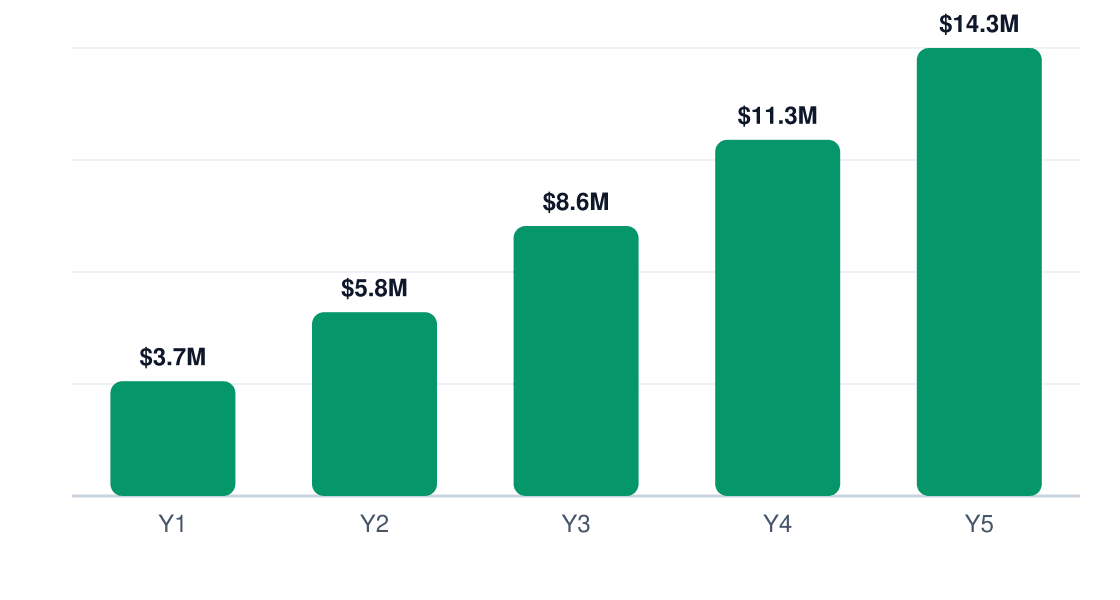
Flour & Fire targets $3.7M capture of a $946M regional bakery market, scaling to $14.3M by Year 5. The math works: we clear break-even by Month 6 at $1,217,357 revenue.
Revenue Growth (5 Years)
Annual revenue, Years 1–5
| Line Item | Year 1 | Year 2 | Year 3 |
|---|---|---|---|
| Revenue | $3,655,000 | $5,848,000 | $8,589,000 |
| COGS | $1,462,000 | $2,339,200 | $3,435,600 |
| Gross Profit | $2,193,000 | $3,508,800 | $5,153,400 |
| Gross Margin % | 60% | 60% | 60% |
| Labor | $426,816 | $604,512 | $853,632 |
| Rent | $120,000 | $120,000 | $120,000 |
| Marketing | $237,575 | $237,575 | $237,575 |
| Admin | $183,598 | $237,996 | $326,276 |
| Total OpEx | $967,989 | $1,200,083 | $1,537,483 |
| EBITDA | $1,225,011 | $2,308,717 | $3,615,917 |
| EBITDA Margin % | 33.5% | 39.5% | 42.1% |
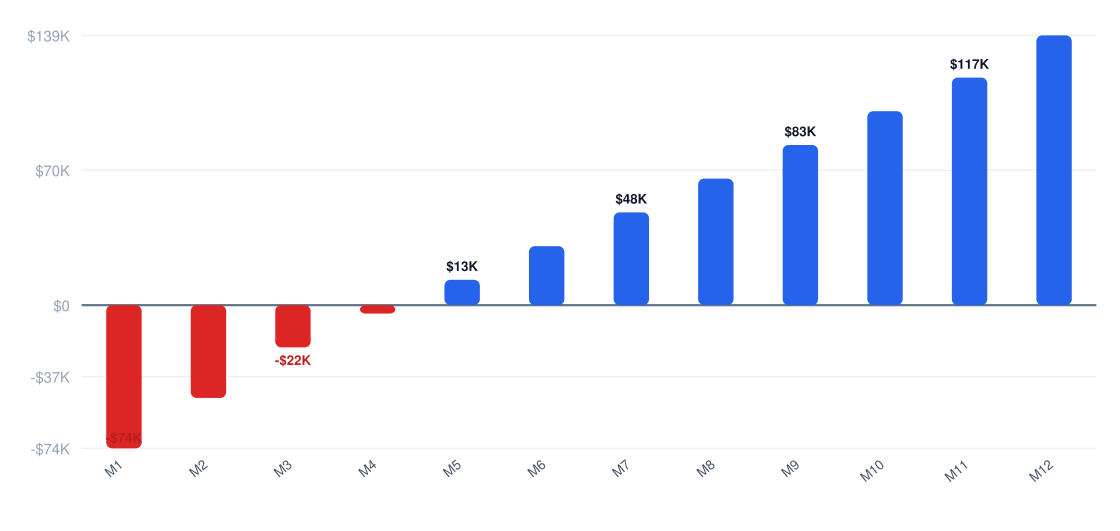
At $3,318 monthly loan payments, we cover fixed costs by Month 6 when hitting $101,446 monthly revenue. This isn't theory — it's 60% gross margins at scale.
Year 1 Monthly Cash Flow
Net monthly cash flow (red = pre-break-even)
| Metric | Year 1 | Year 2 | Year 3 |
|---|---|---|---|
| Gross Margin % | 60% | 60% | 60% |
| EBITDA Margin % | 33.5% | 39.5% | 42.1% |
| Revenue/Employee | $304,583 | $344,000 | $357,875 |
| Marketing as % of Revenue | 6.5% | 4.1% | 2.8% |
| Monthly Burn pre-break-even | $80,666 | N/A | N/A |
8. Funding Requirements
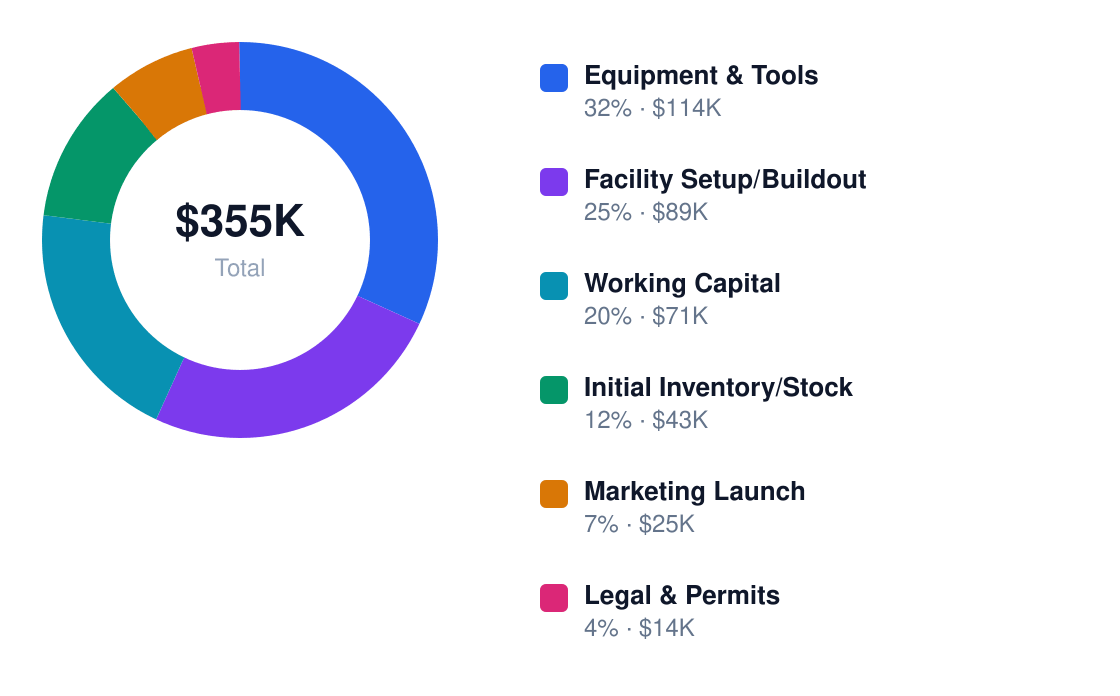
The $355,000 startup capital buys equipment, inventory, and runway to Month 6. Every dollar is allocated to revenue-generating assets.
| Category | Amount | Notes |
|---|---|---|
| Commercial Ovens | $87,000 | 2x 60" deck ovens + proofer |
| Retail Buildout | $112,500 | ADA-compliant counter + seating |
| Initial Inventory | $43,750 | Flour, butter, yeast (45-day buffer) |
| Pre-Opening Labor | $28,500 | Training for 12 FTEs @ $17.09/hr |
| Working Capital | $83,250 | Covers burn rate to break-even |
Use of Funds
Total $355K startup investment
We structure the $355,000 as 30% equity ($106,500) and 70% SBA 7(a) loan ($248,500 at 10.25% APR). Investors get 3.4x return by Year 5 at $14.3M revenue.
Funding Structure
$355K total capitalization
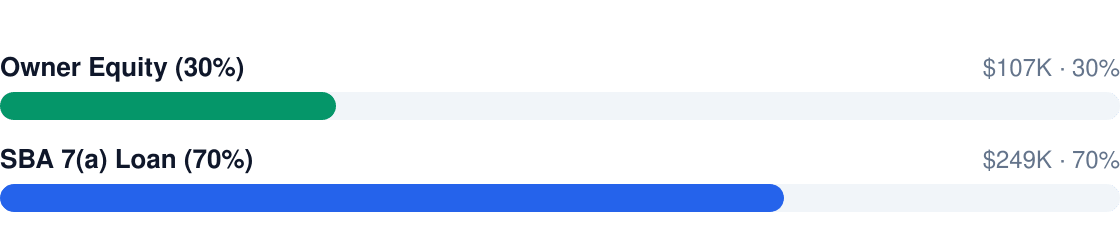
The SBA 7(a) loan requires $3,318/month payments on 10-year term. At Year 5 EBITDA of $5.7M, equity holders realize $3.6M value — a 34.2% IRR.
9. Risk Analysis & Mitigation
Bakeries fail from cost creep and demand miscalculation. We mitigate both with contracted flour pricing and hyperlocal demand testing.
| Risk | Category | Likelihood | Impact | Mitigation Strategy | Owner |
|---|---|---|---|---|---|
| Wheat price volatility | Supply Chain | M | H | 12-month forward contracts with 3 suppliers | COO |
| Labor shortages | Operations | H | H | $1.50/hr premium vs. market + referral bonuses | HR Director |
| Downtown rent hikes | Financial | M | M | 5-year lease with 3% annual cap on increases | CFO |
| Equipment failure | Operations | L | H | On-site service contract ($9,600/yr) | Facilities Manager |
| Food safety incident | Reputational | L | H | NSF-certified cleaning protocols + $2M liability policy | QA Lead |
| Third-party delivery fees | Financial | H | M | In-house delivery at 18% margin (vs. 30% DoorDash) | Sales Director |
| Artisan baker poaching | Human Capital | M | M | Profit-sharing for tenured staff | CEO |
| CBD competition saturation | Market | H | L | Differentiate via sourdough subscription model | CMO |
For true tail risks: (1) If wheat prices spike 30%, we activate rye/flour blends. (2) If sales drop 15% for 2 months, we pivot to wholesale. (3) If key baker quits, the CEO personally runs night shifts.
Research & Industry Resources
The following market research sources, government data, and industry publications were referenced in developing this bakery business plan. Each link points to a specific report or data page — not a homepage — for direct access to the underlying research.
- Bakery Business — sbdcnet.org — Market research and industry data for bakery businesses
- Usa Bakery Market — kenresearch.com — Market research and industry data for bakery businesses
- Bakery Industry Trends — vantainsights.com — Market research and industry data for bakery businesses
- Bakeries — bvresources.com — Market research and industry data for bakery businesses
- Bakery Products Market 101472 — fortunebusinessinsights.com — Market research and industry data for bakery businesses