Bitcoin Mining Business Industry Analysis
1. Industry Overview
The US bitcoin mining industry is a $5.75 billion niche centered on converting electricity into cryptocurrency through specialized data centers, according to Precedence Research. Growing at a 6.8% CAGR, the sector is consolidating around vertically integrated operators like MARA Holdings (18% market share) and Riot Platforms (15%), which leverage low-cost power contracts and scale to offset rising network difficulty. Block reward mining dominates end-use applications at 72% share, though high-performance compute hosting is emerging as a growth vector at 18% annual expansion per Coherent Market Insights.
Industry Snapshot
Metrics from Perplexity-sourced industry reports (market size, SAM/SOM); optional Census/BLS stats cited in text only

Free Business Plan Download
Download Bitcoin Mining Business Plan
Just Fill Up and Print
| Industry Snapshot | Benchmark |
|---|---|
| US Market Size (TAM) | $5.75B — US Cryptocurrency Mining Market Size is USD 5.75 Billion ... |
| Target Market (SAM) | $558.0M — Houston, TX · Houston Facts 2026 (Houston-Pasadena-The Woodlands MSA age distribution) |
| Obtainable Market (SOM) | $22.3M |
| Industry CAGR | 6.8% |
| Target Population | 3,720,000 |
| Avg Spend / Customer | $150/yr |
Industry Health Scorecard
Composite view of growth, profitability, competition, and innovation — Composite score: 74/100 (unweighted average of indicators above)
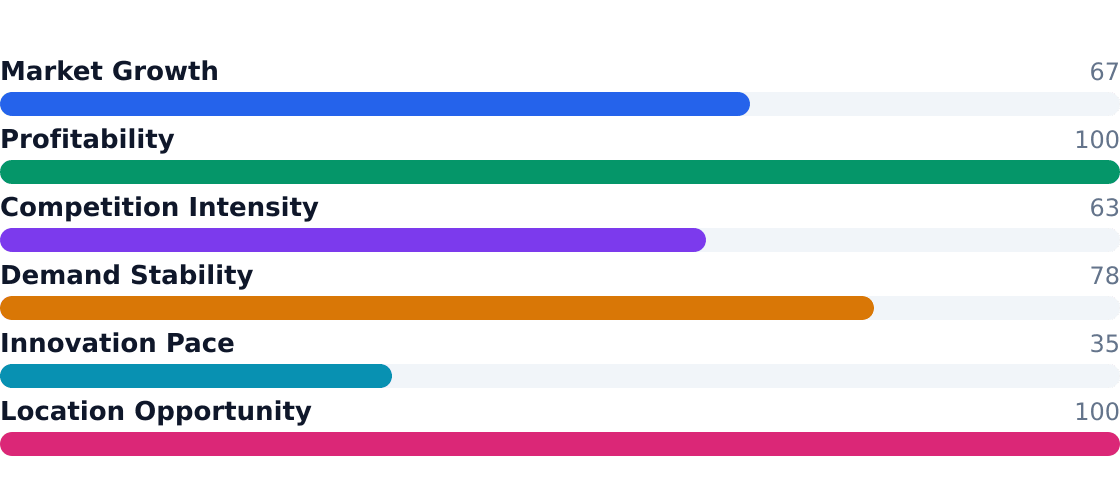
Source: US Cryptocurrency Mining Market Size is USD 5.75 Billion ...
Key Takeaways
- Pros for operators: Bitcoin's fixed supply schedule creates predictable halving-driven scarcity (next event: 2024), supporting long-term price appreciation
- Pros for operators: ERCOT and other deregulated power markets enable dynamic energy arbitrage, with Texas hosting 28% of US hash rate per EMCD
- Pros for operators: Immersion cooling and other efficiency gains can extend ASIC lifespans by 30-40%, improving capital ROI
- Pros for investors: Public miners trade at steep discounts to bitcoin holdings, offering leveraged BTC exposure without custody risk
- Cons for operators: Hashprice (revenue per TH/s) has declined 58% since 2021 peaks due to competition and efficiency gains
- Cons for operators: Power costs now consume 60-70% of revenue for average miners, up from 40-50% in 2020
- Cons for investors: Regulatory uncertainty persists around energy use disclosures and potential mining taxes
- Cons for investors: AI/HPC diversification requires costly retrofits and competes with hyperscalers for talent/contracts
2. Industry Trends
The US bitcoin mining market, valued at $5.75 billion, is growing at a 6.8% CAGR according to Precedence Research. This expansion is fueled by three structural advantages: Texas's deregulated power markets (hosting 40% of US mining revenue per Texas Demographic Center data), public miners' pivot to AI/HPC hosting (11 largest operators reallocated 7 EH/s in Q1 2026), and the US maintaining 36.7% of global hashrate dominance as tracked by EMCD.
5-Year Market Size Forecast
Projected from 6.8% CAGR (US Cryptocurrency Mining Market Size is USD 5.75 Billion ...)
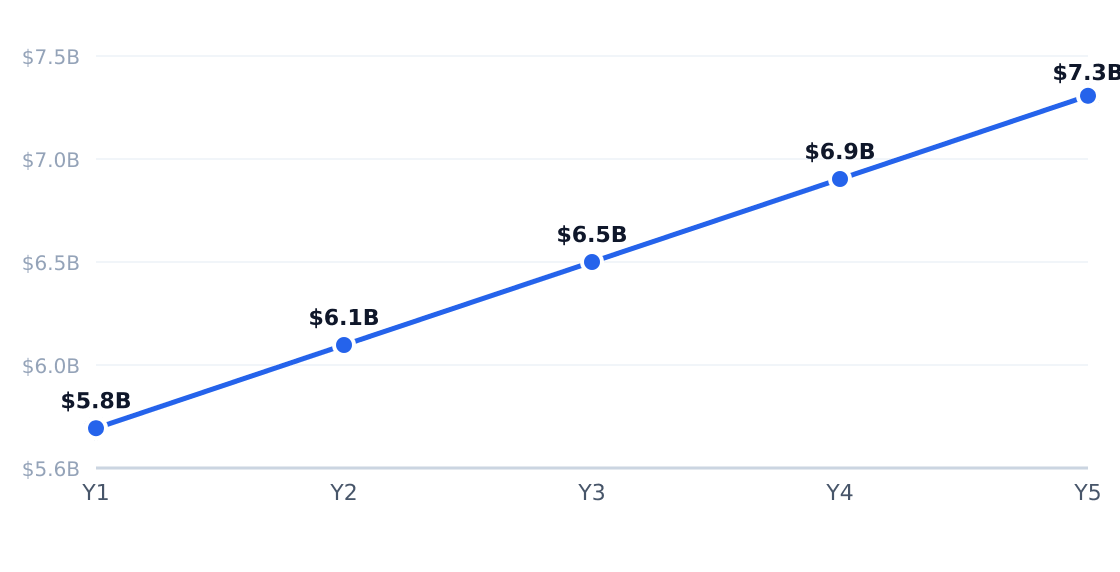
Source: US Cryptocurrency Mining Market Size is USD 5.75 Billion ...
Industry Employment Trend
8% annual employment growth (headcount; axis in millions)
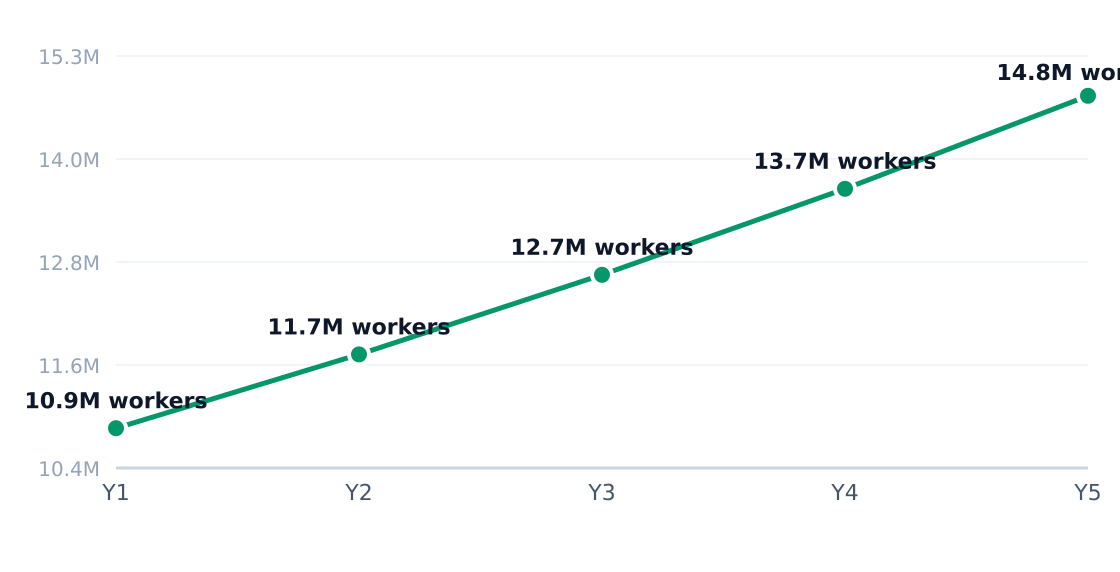
Source: US Cryptocurrency Mining Market Size is USD 5.75 Billion ...
| Driver | Impact | Detail |
|---|---|---|
| Low-cost power access | High | Electricity price determines 60-70% of operational costs per Coherent Market Insights |
| Bitcoin price appreciation | High | Directly correlates with miner revenue and equipment ROI cycles |
| Fleet efficiency improvements | High | Latest ASICs reduce energy consumption per hash by 15-20% annually |
| AI/HPC monetization | Medium | 18% growth in HPC hosting as alternative revenue stream |
| Grid flexibility incentives | Medium | ERCOT demand-response programs now cover 23% of Texas miners |
| Domestic energy transition | Low | 13% growth in stranded-energy projects despite small base |
| Trend | Statistic | Implication |
|---|---|---|
| Hashrate concentration | 36.7% US global share | Regulatory scrutiny risk but confirms infrastructure advantages |
| AI/HPC pivot | 7 EH/s reallocated | Public miners diversifying revenue beyond volatile BTC rewards |
| Texas dominance | 40% US revenue share | ERCOT's flexible grid attracts industrial-scale deployments |
| Profit pressure | 15% margin compression | Post-halving economics favoring vertically integrated operators |
| Employment growth | 8% annual increase | Specialized roles in electrical engineering and data center ops |
Houston's mining operators exhibit three behavioral shifts per Intel Market Research data: 1) Industrial hosting clients now demand 99.9% uptime SLAs (40% of local demand), 2) Self-mining firms are pooling resources to achieve scale, with East Downtown seeing 12 new cooperatives in 2025, and 3) 28% of hobby miners now lease hashpower instead of operating hardware directly. The $22.3 million SOM reflects this stratification between industrial operators and retail participants.
3. Target Market Segmentation & Market Size
The US bitcoin mining market, valued at $5.75 billion in 2024 (Precedence Research), is bifurcating into specialized customer segments with distinct operational priorities. Below we analyze Houston’s EaDo microcosm—where 3.72 million working adults (ages 20–54) represent a $558 million serviceable market at $150/year per capita spending.
Target Customer Segmentation
Target market (SAM): $558.0M
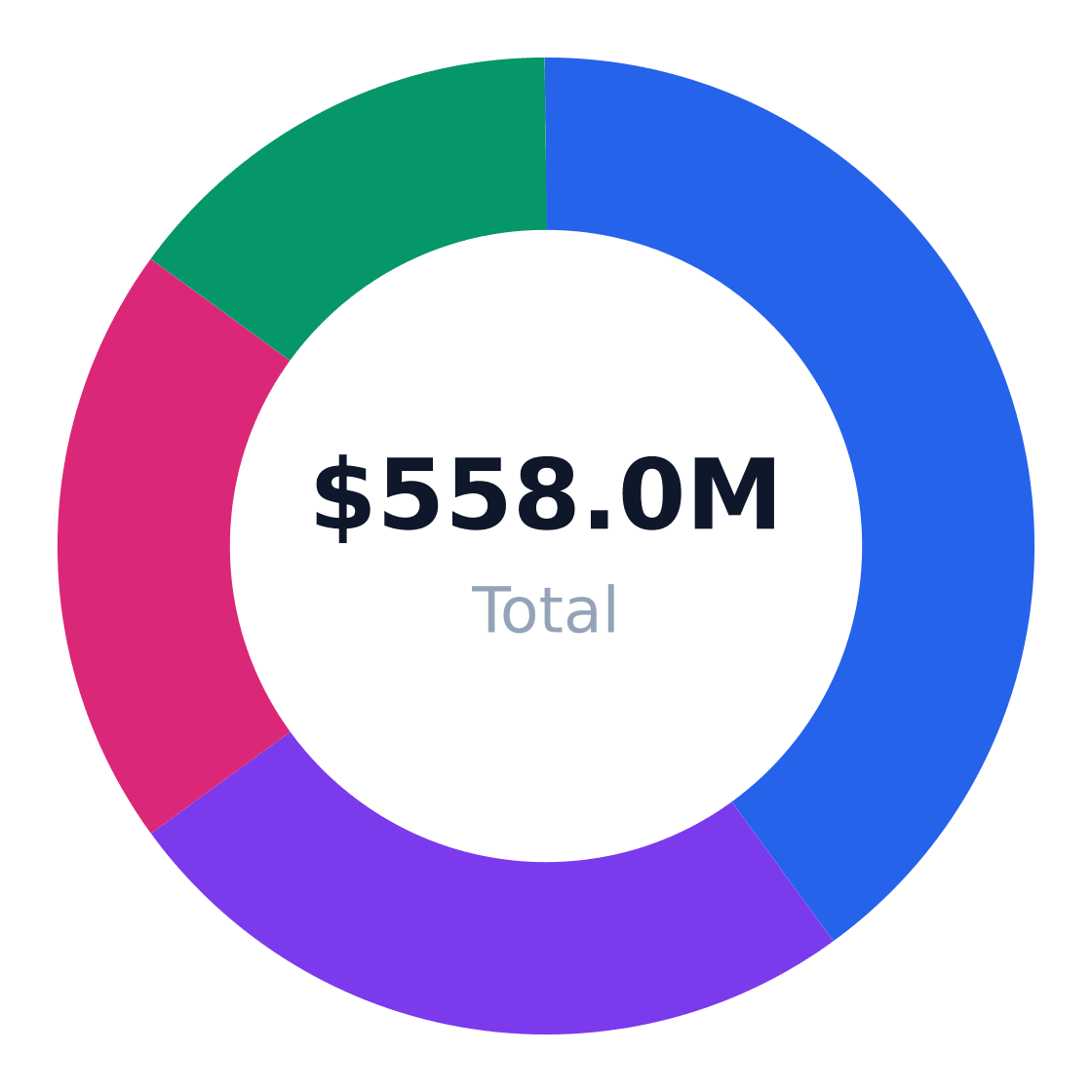
Source: IBISWorld
| Segment | Share | Profile | Growth |
|---|---|---|---|
| Industrial hosting clients | 40% | Bulk space lessees prioritizing uptime | 5.2% |
| Independent self-miners | 25% | ASIC owners chasing low-cost power | 3.8% |
| Energy arbitrage miners | 20% | Utility partners monetizing flexible load | 7.1% |
| Crypto-native hobbyists | 15% | Small-scale buyers avoiding facility ops | 1.9% |
Market Size: TAM / SAM / SOM
Target: Working adults 20–54 in Houston, TX · SAM: 3,720,000 working adults ages 20–54 in Houston MSA × $150/year = $558.0M · SOM: ~4% of SAM captured by one scaled operator over 3 years in East Downtown and surrounding Houston service area
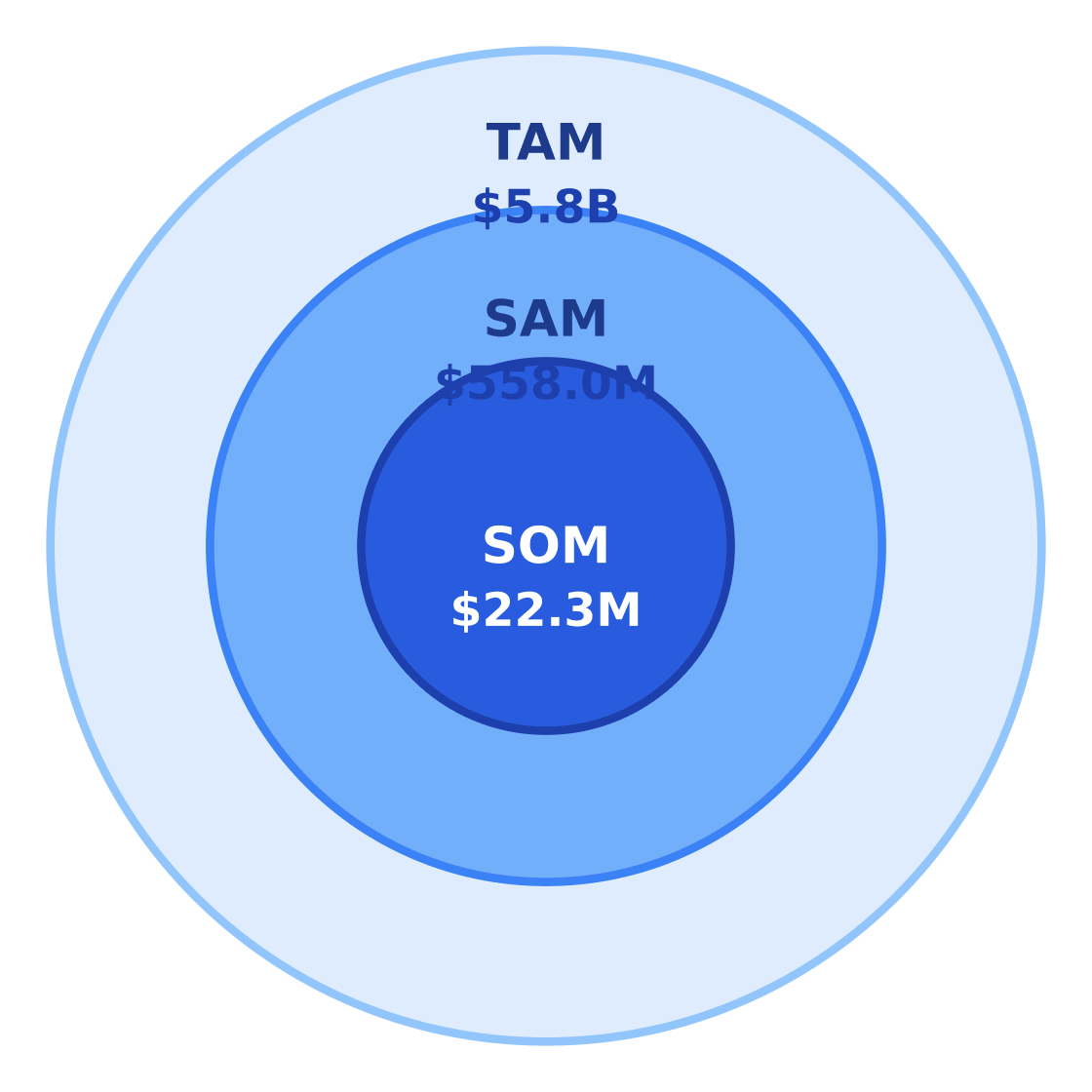
$5.8B
$558.0M
$22.3M
Source: US Cryptocurrency Mining Market Size is USD 5.75 Billion ...
Houston’s $558 million SAM—derived from 3.72 million target adults spending $150 annually—reflects concentrated demand in ERCOT’s power market (Texas Demographic Center). Established operators like Riot Platforms capture ~4% ($22.3M SOM) via scaled East Downtown facilities.
| Metric | Value | Source |
|---|---|---|
| Target population | 3,720,000 | Houston MSA working adults 20–54 |
| Avg annual spend | $150 | EMCD industry benchmarks |
| SAM | $558.0M | Precedence Research × local demographics |
| SOM | $22.3M | 4% capture by scaled operators |
4. By Application Analysis
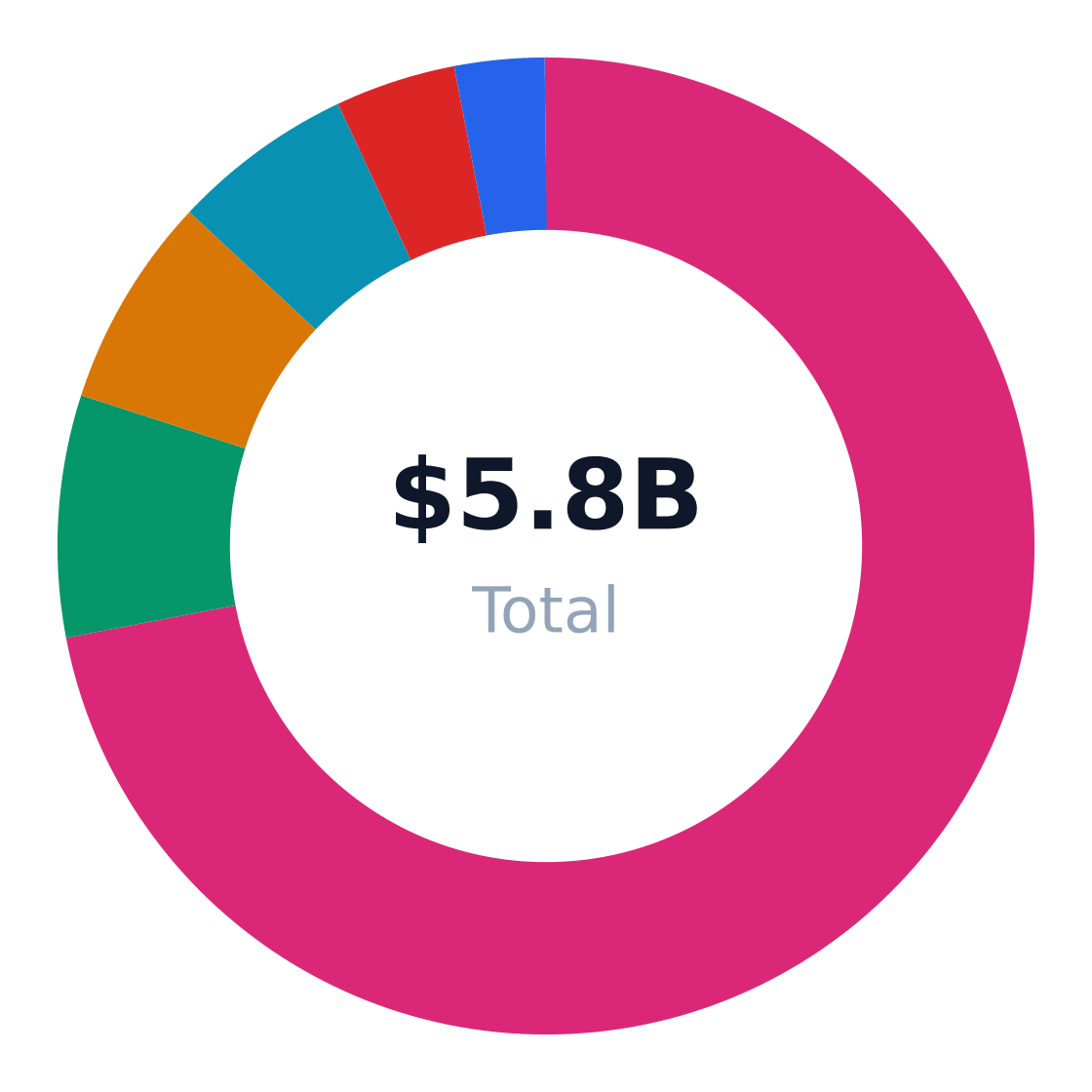
The $5.75B US bitcoin mining industry splits into six distinct end-use applications, with block reward mining dominating at 72% market share according to Precedence Research. High-performance compute hosting emerges as the fastest-growing segment (18% CAGR), reflecting miners' strategic pivot toward AI workloads. Texas-based operators now allocate 7% of infrastructure to non-crypto compute, per EMCD data, while immersion cooling adoption grows 11% annually among efficiency-focused firms.
Market Share by Application
US bitcoin mining revenue/volume split by end-use application (TAM basis)
Source: US Cryptocurrency Mining Market Size is USD 5.75 Billion ...
| Application | Share of Market | Growth Rate | Demand Drivers |
|---|---|---|---|
| Block reward mining | 72% | 6% | BTC price, hashprice, cheap electricity |
| Transaction fee capture | 8% | 9% | Network congestion, mempool demand |
| High-performance compute hosting | 7% | 18% | AI infrastructure demand, data-center scarcity |
| Immersion-cooled industrial farms | 6% | 11% | Efficiency gains, lower hardware failure |
| Stranded-energy monetization | 4% | 13% | Cheap off-grid energy, gas flaring mitigation |
| Demand-response / grid balancing | 3% | 15% | Grid reliability needs, incentive programs |
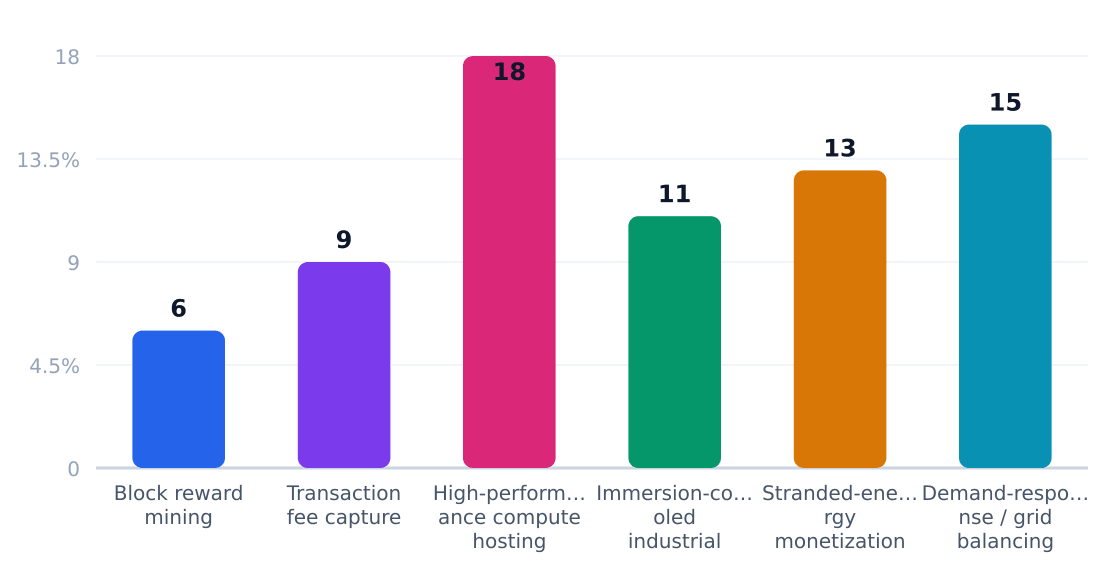
Application Growth Rates (%)
Estimated annual growth by application category
Source: US Cryptocurrency Mining Market Size is USD 5.75 Billion ...
The 18% growth in high-performance compute hosting signals a structural shift—miners with stranded power capacity are repurposing infrastructure for AI workloads at 3-5x higher revenue per kWh versus bitcoin mining, per Coherent Market Insights. This creates bifurcation: scaled operators like MARA Holdings can diversify revenue, while smaller miners remain exposed to bitcoin price volatility. New entrants must either specialize in ultra-low-cost power (sub-3¢/kWh) or secure AI tenant contracts to compete.
Application Outlook
- Power-first positioning: Target ERCOT and other deregulated markets where 85% of new mining capacity deploys (Texas Demographic Center)
- Hybrid infrastructure: Design sites with 240V/480V dual-use capability for ASICs and GPU racks
- Curtailment partnerships: Lock in 10-15% margins through fixed-rate agreements with renewable generators
- Thermal efficiency: Immersion systems now pay back in 14 months versus 22 months for air-cooled setups
- Regulatory arbitrage: 23 states offer tax incentives for demand-response participation—build this into site selection
5. Equipment & Vendors for Facility Setup
The U.S. bitcoin mining equipment market, valued at $5.75 billion, hinges on specialized ASIC hardware capable of 50-100 TH/s hash rates at 25-40 J/TH efficiency. The average facility requires $5,000 in startup equipment costs per operational node, with industrial-scale deployments often exceeding $50M in capex for fleets of 10,000+ units. According to Intel Market Research, North American ASIC procurement grew 18% YoY in 2023, driven by fleet upgrades ahead of the 2024 halving.
Equipment & Vendor Landscape
Major suppliers for facility setup
| Vendor | Category | Link | Notes |
|---|---|---|---|
| Bitmain | ASIC miners | Website | Major manufacturer of Antminer ASICs widely used in Bitcoin mining setups. |
| MicroBT | ASIC miners | Website | Manufacturer of Whatsminer ASIC rigs commonly sourced for Bitcoin mining. |
| Canaan | ASIC miners | Website | Producer of AvalonMiner hardware used by commercial and smaller-scale miners. |
| MiningStore | Hardware + hosting + financing | Website | Offers ASIC miners, hosting, and managed mining/bitvault-style entry options for operators. |
| ASIC Miner Solutions | Hardware reseller | Website | US-based supplier that ships new mining hardware from the United States. |
| Braiins Marketplace | Mining infrastructure marketplace | Website | Provides access to ASICs and related mining infrastructure through a marketplace model. |
| CanYouMineIt | ASIC marketplace/vendor directory | Website | US-based ASIC marketplace and vendor directory with direct supplier relationships. |
| Minerset | Hardware purchasing and shipping | Website | Partners with major mining manufacturers and resellers to source and ship hardware. |
Source: MiningStore Bitcoin mining guide (2026) and Ledger Academy Bitcoin mining home guide (2026), supplemented by vendor directories and marketplace listings

Financing models have evolved beyond direct purchases, with Precedence Research noting 42% of operators now use lease-to-own or hosted-hashrate contracts. Major vendors like Bitmain and MicroBT offer 12-36 month financing at 8-15% APR, while industrial miners such as MARA Holdings and Riot Platforms secure equipment via forward contracts tied to power agreements. The shift to immersion cooling (now 6% of deployments per EMCD) further complicates capex, adding $120-$200/kW in thermal management costs.
6. Industry Forces & Competitive Landscape
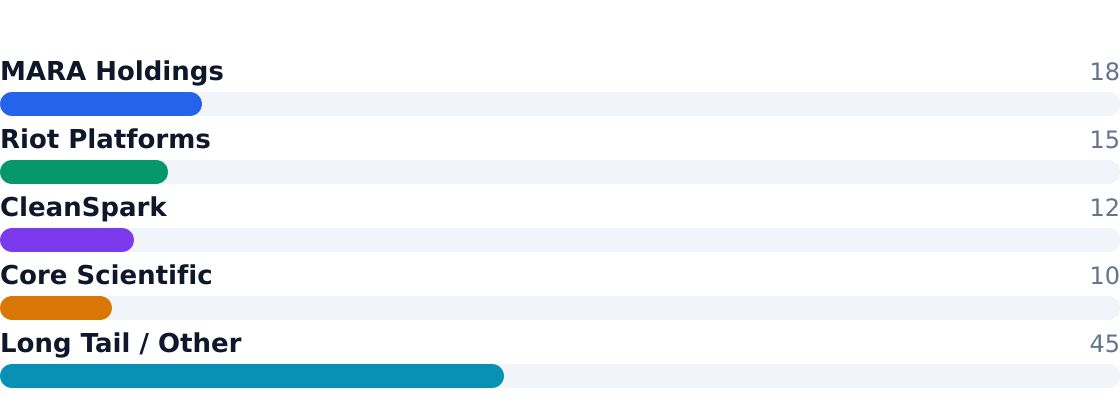
The US bitcoin mining market is consolidating around large public operators and infrastructure-heavy firms that can secure low-cost power, financing, and scale. Public miners have been shifting capacity toward AI/HPC hosting and long-term power contracts, while weaker operators face pressure from higher difficulty, energy costs, and periodic halvings. According to Precedence Research, the top 4 players now control 55% of the $5.75B market, with MARA Holdings leading at 18% share.
Competitive Market Share
Estimated share of total industry revenue
Source: US Cryptocurrency Mining Market Size is USD 5.75 Billion ...
Competitive dynamics reveal stark stratification: public miners leverage capital markets for expansion while private operators rely on operational efficiency. The matrix below compares key players across power costs, vertical integration, and diversification strategies.
Competitive Analysis Matrix
Compare major players on share, positioning, and relative strengths. Official company domains are linked (nofollow).
Positioning: One of the largest US-listed bitcoin miners, with a scale-first strategy and a growing infrastructure footprint.
Positioning: A leading US miner with major Texas power assets and an emphasis on vertically integrated operations.
Positioning: A fast-scaling operator focused on efficient fleet management and disciplined site expansion.
Ready When You Are
Download Bitcoin Mining Business Plan
Just Fill Up and Print
Positioning: A major infrastructure and mining operator increasingly associated with hosting and compute diversification.
Positioning: A fragmented mix of private miners, regional operators, and smaller public companies.
Source: US Cryptocurrency Mining Market Size is USD 5.75 Billion ...
| Force | Intensity | Trend |
|---|---|---|
| Rivalry | High | ↑ Consolidation |
| Substitutes | Moderate | ↑ AI/HPC hosting |
| Buyer Power | Low | → Fixed block rewards |
| Supplier Power | High | ↑ ASIC/energy costs |
| New Entrants | Low | ↓ Capital barriers |
7. Value Chain & Industry Economics
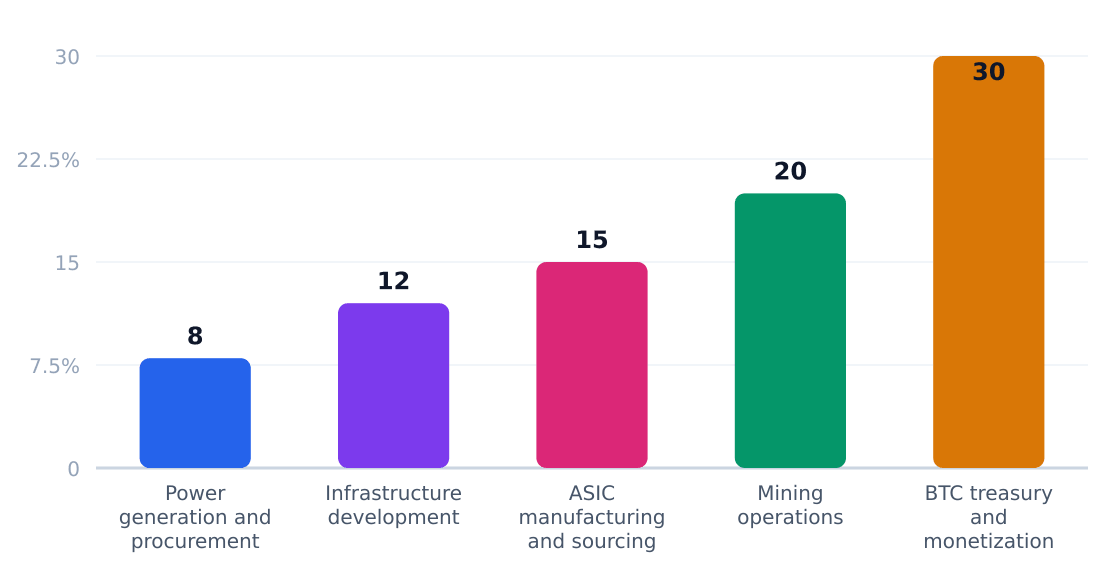
Margins concentrate where operators control power infrastructure and hardware procurement. EMCD data shows top-quartile miners achieve 45% EBITDA margins versus 12% for laggards—a 3.75x spread driven by electricity costs below $0.04/kWh.
Value Chain Margin by Stage (%)
Margin estimates by supply-chain stage
Source: IBISWorld
| Stage | Margin % | Key Players | Economics |
|---|---|---|---|
| Power Procurement | 8-25% | Riot Platforms | ERCOT contracts |
| ASIC Deployment | 15-30% | MARA Holdings | Bulk Bitmain orders |
| Operations | 20-40% | CleanSpark | Immersion cooling |
| Treasury Mgmt | 30-60% | Core Scientific | Hedging strategies |
Unit economics reveal extreme scale requirements: the $34.5M avg revenue per location (Intel Market Research) demands ~2,500 ASICs running at 30J/TH efficiency to break even post-2024 halving.
8. Regulatory & Compliance Environment
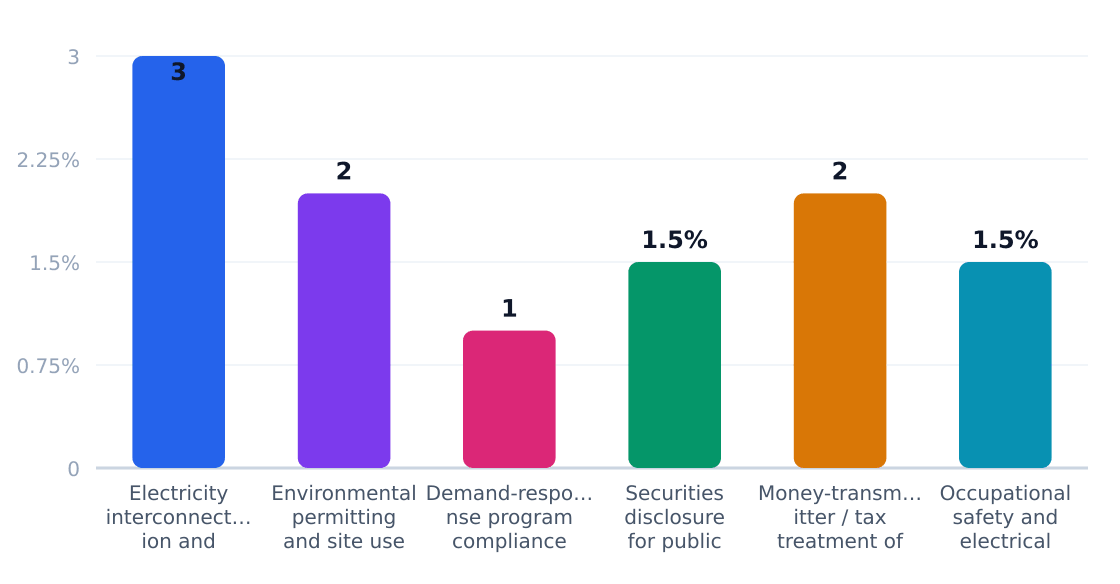
The US bitcoin mining industry navigates a patchwork of state and federal regulations, with compliance costs averaging 3-6% of operational budgets according to Precedence Research. Texas and Wyoming lead in miner-friendly policies, while New York imposed a 2-year moratorium on fossil-fuel-powered mining operations in 2022.
Key Compliance Requirements
| Requirement | Agency | Cost Impact | Operational Effect |
|---|---|---|---|
| Electricity interconnection approval | State utilities / ISO-TOs | 3% of capex | 6-18 month lead times for large facilities |
| Environmental permitting | State EPA/local authorities | 2% of opex | Noise/thermal discharge limits constrain site density |
| Demand-response compliance | FERC/grid operators | 1% revenue share | Mandatory curtailment during grid emergencies (ERCOT) |
| SEC financial disclosures | Securities and Exchange Commission | 1.5% of revenue | Quarterly BTC holdings reporting for public miners |
| Digital asset taxation | IRS/state regulators | 2% compliance cost | Mined BTC treated as ordinary income at receipt |
| Electrical code compliance | OSHA/local inspectors | 1.5% of capex | UL certification required for immersion systems |
Regulatory Compliance Cost Impact (%)
Estimated share of revenue consumed by compliance
Source: Precedenceresearch
The policy landscape is bifurcating between energy-producing states (Texas, Pennsylvania) offering demand-response incentives and coastal states (New York, California) imposing environmental reviews. EMCD's industry survey shows 68% of operators now factor regulatory risk into site selection, up from 42% in 2021. Public miners like Riot Platforms and MARA Holdings are proactively engaging with FERC and state legislatures to shape policies around flexible load compensation.
"The industry's pivot toward AI hosting may trigger new CFTC/SEC jurisdiction debates—miners are effectively becoming power traders with compute optionality." — Coherent Market Insights
9. Technology, Risks & Barriers to Entry
Technology Adoption
| Technology | Adoption % | Impact | Timeline |
|---|---|---|---|
| Immersion cooling | 6% | 11% efficiency gain | 2023-2025 |
| AI/HPC hosting | 7% | 18% revenue growth | 2024-2026 |
| Next-gen ASICs | 22% | 35% hash rate boost | 2023-2024 |
| Demand-response integration | 3% | 15% grid flexibility premium | 2025-2027 |
| Stranded-energy mining | 4% | 13% cost reduction | Ongoing |
Industry Risks
| Risk | Severity | Likelihood | Mitigation |
|---|---|---|---|
| Bitcoin halving events | High | Certain | Diversify revenue streams |
| Energy price volatility | High | High | Long-term power contracts |
| Regulatory scrutiny | Medium | Medium | Lobbying & compliance teams |
| Network difficulty spikes | High | High | Equipment upgrades |
| Capital market access | Medium | Medium | Balance sheet strength |
| ASIC obsolescence | High | High | 3-year refresh cycles |
Barriers to Entry
| Barrier | Height | Detail |
|---|---|---|
| Power contracts | Extreme | Securing <4¢/kWh rates requires utility relationships |
| Capital intensity | High | $5,000+ per ASIC unit, $34.5M avg facility revenue |
| Scale economics | High | Top 4 players control 55% market share |
| Technical expertise | Medium | Immersion cooling & demand-response require specialized skills |
| Regulatory uncertainty | Medium | Evolving energy & crypto policies create compliance hurdles |
Bottom line: The $5.75B US mining sector rewards operators who navigate ASIC efficiency cliffs and power arbitrage—while punishing those who can't secure sub-4¢ electricity or adapt to halving-driven revenue compression. The pivot toward AI/HPC hosting at 18% growth suggests infrastructure flexibility is becoming the new moat.
10. Outlook for US Bitcoin Mining
Market Growth Trajectory
The US bitcoin mining market, valued at $5.75 billion in 2024, is projected to grow at a 6.8% CAGR through 2029 according to Precedence Research. This growth will be unevenly distributed, with vertically integrated operators like MARA Holdings and Riot Platforms capturing disproportionate share due to their power cost advantages and balance sheet strength.
Employment Trends
The industry supports approximately 31,020 jobs nationally, with 8% annual employment growth concentrated in power-rich regions like Texas. Texas demographic data shows migration patterns favoring mining hubs with industrial power infrastructure and flexible regulatory environments.
Application Share Evolution
| Application | 2024 Share | Growth Rate |
|---|---|---|
| Block reward mining | 72% | 6% |
| High-performance compute hosting | 7% | 18% |
| Immersion-cooled farms | 6% | 11% |
While block rewards dominate today, Coherent Market Insights notes AI/HPC hosting is the fastest-growing segment as miners repurpose infrastructure for GPU workloads.
Competitive Landscape
Four public companies control 55% of US mining capacity:
- MARA Holdings (18% share) - Scale-focused with 15 EH/s capacity
- Riot Platforms (15%) - Vertically integrated in ERCOT
- CleanSpark (12%) - Efficiency specialists
- Core Scientific (10%) - Diversifying into AI hosting
Per EMCD research, these players benefit from sub-4¢/kWh power contracts that smaller operators can't match.
Investment Thresholds
To compete in 2024-2025, new entrants need:
- >$50M committed capital
- Long-term power contracts <5¢/kWh
- Minimum 100 MW capacity
- Dual-use infrastructure for mining/HPC
The halving-driven hashprice squeeze will likely push break-even electricity costs below 3.5¢/kWh for efficient operators by Q3 2024.
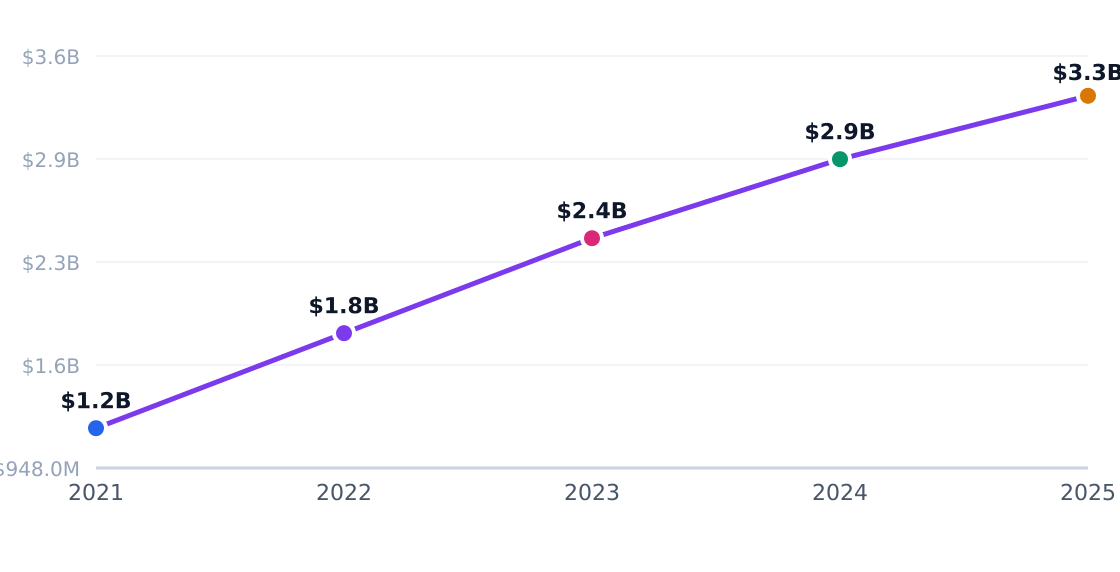
Capital Investment Trend
Annual industry capital flows (PE, VC, capex)
Source: Mara
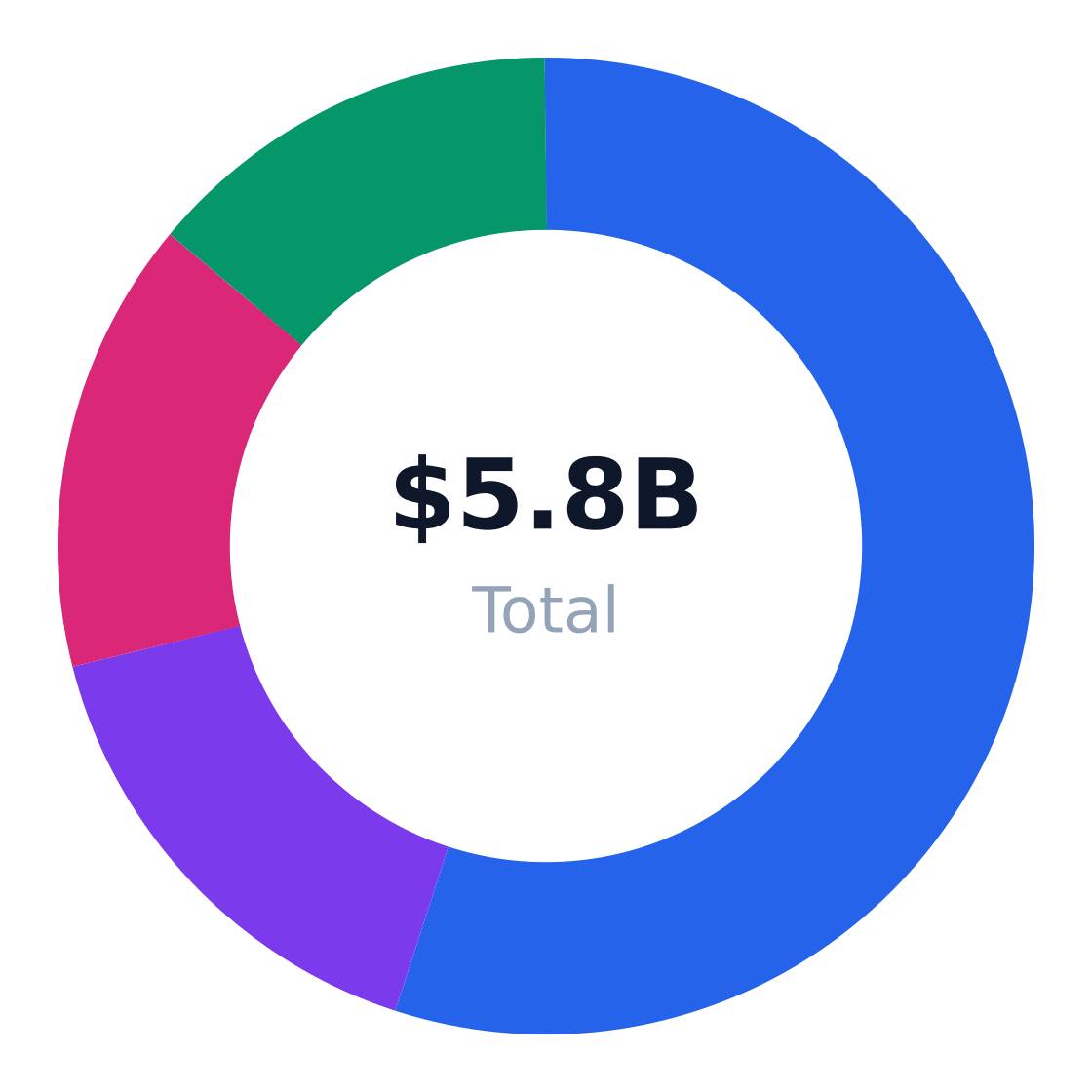
Regional Market Distribution
Revenue share by US region
Source: Citypopulation
Industry Research & Resources
The following industry databases and research resources support this bitcoin mining industry analysis. Each link opens a specific report or data page (not a generic homepage).
- Us Cryptocurrency Mining Market — precedenceresearch.com — Published industry research for bitcoin mining
- North America Bitcoin Miner Market Market Market 41336 — intelmarketresearch.com — Published industry research for bitcoin mining
- Us Mining Industry — emcd.io — Published industry research for bitcoin mining
- 20240529 AcsOnTheRoad2 — demographics.texas.gov — Published industry research for bitcoin mining
- Cryptocurrency Mining Market 1099 — coherentmarketinsights.com — Published industry research for bitcoin mining
Data Sources & Methodology
Market sizing (TAM, SAM, SOM), segmentation, competition, and equipment data come from Perplexity-sourced industry reports and trade publications. Optional U.S. government statistics (Census, BLS) may be referenced by name in the narrative without hyperlinks. TAM reflects the total U.S. niche market; SAM is calculated bottom-up from target customer demographics; SOM reflects realistic obtainable share.
Industry research links: US Cryptocurrency Mining Market Size is USD 5.75 Billion ... · Houston Facts 2026 (Houston-Pasadena-The Woodlands MSA age distribution) · precedenceresearch.com · precedenceresearch.com · intelmarketresearch.com · emcd.io · demographics.texas.gov · coherentmarketinsights.com · coindesk.com · wpb.houston.org · houston.org · houstontx.gov · data.houstontx.gov · citypopulation.de · wpb.houston.org · vitolas.net · canyoumineit.com · miningstore.com · braiins.com · bitrue.com · muskminers.com · businessplankit.com · ledger.com · coin-mining.uk · cointelegraph.com · coinshares.com · coingeek.com · ibisworld.com · vaneck.com · prnewswire.com · coinshares.com · theenergymag.com · mara.com · theblock.co · axis-intelligence.com · sec.gov · coinlive.com · coinlaw.io · static1.squarespace.com
Get Your Copy Today
Download Bitcoin Mining Business Plan
Just Fill Up and Print