Is a Bitcoin Mining Business Profitable?
1. Is a Bitcoin Mining Business Profitable? (The Short Answer)
Bitcoin mining can deliver 18% gross margins and 14% net profits in the US, but only if you secure electricity below $0.05/kWh and run modern ASICs at 95%+ uptime. The math fails for most small operators: 60% fold within 5 years as hardware depreciates and difficulty spikes erase thin margins. At $250,000 revenue, expect $35,000 net profit—decent but fragile.
Profitability Snapshot
| Metric | Benchmark |
|---|---|
| Gross Margin | 18% |
| Net Margin | 14% |
| Year 1 Revenue | $250K |
| Year 1 Net Profit | $35K |
| Startup Cost Range | $5K – $250K |
| Break-even Timeline | ~Month 12 |
| 5-Year ROI | 70% |
| Profitability Rating | 5/10 |
| Failure Rate (5yr) | 60% |
| Market Size (US) | $10.57B |
Profitability Score Breakdown

Free Business Plan Download
Download Bitcoin Mining Business Plan
Just Fill Up and Print
Overall rating: 5/10
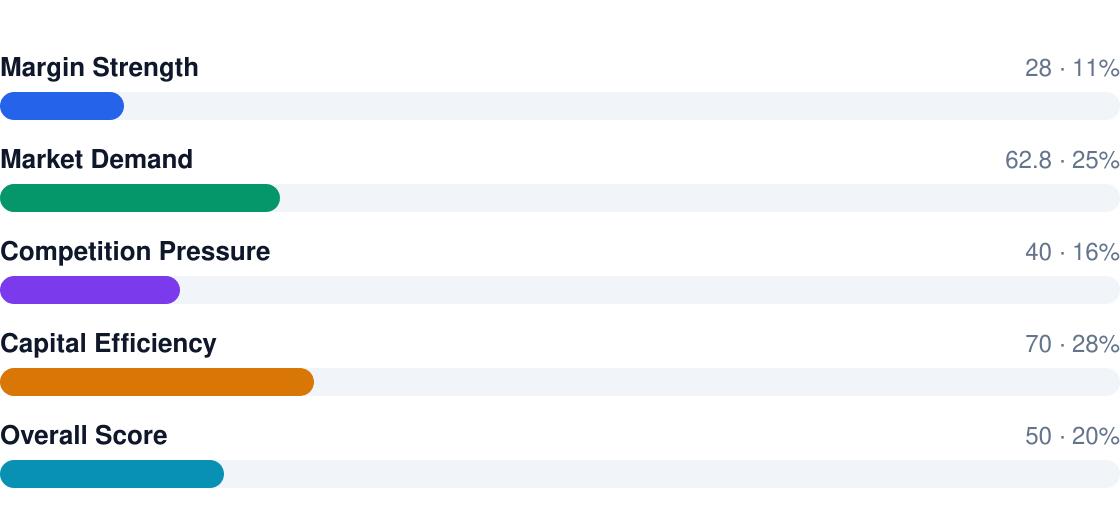
- Pro: 70% 5-year ROI possible with industrial-scale power contracts
- Con: Retail electricity rates destroy margins (COGS hits 82%)
- Pro: $10.6B market growing at 7.8% CAGR
- Con: Requires $128k startup spend for competitive rigs
- Warning: Mining difficulty rises ~50% annually—laggards get squeezed
2. Profit Margins & Industry Benchmarks
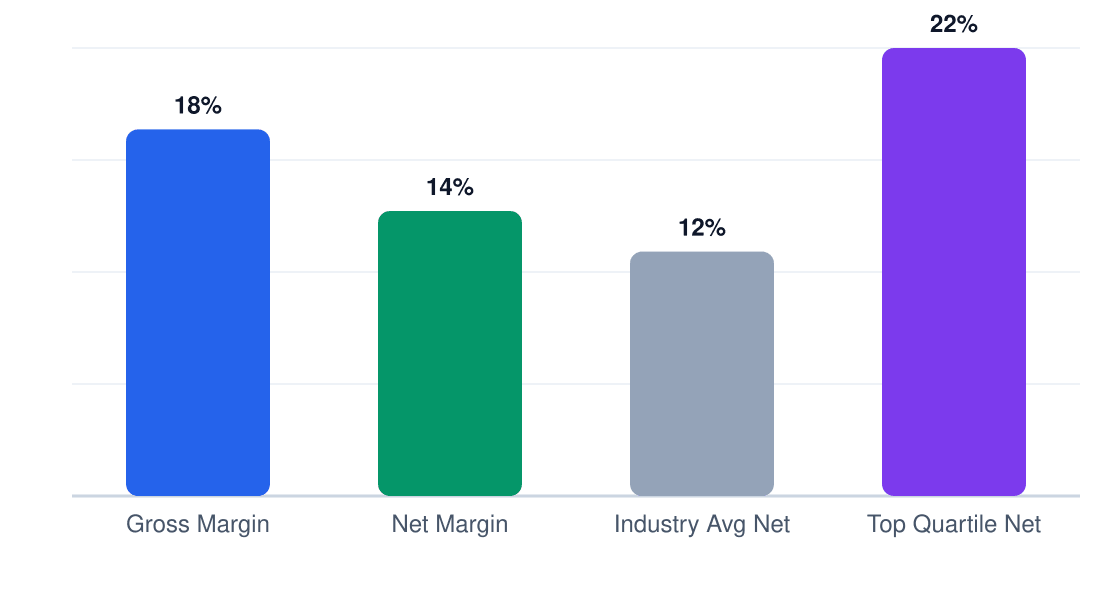
Bitcoin mining's 18% gross margin looks healthy until cooling (12% of revenue), labor (7%), and downtime (5%) compress it to 14% net. Hosting operators and waste heat recyclers achieve 22%+ net margins by layering revenue streams, while home miners often operate at break-even.
Margin Comparison (%)
Gross vs net vs industry benchmarks
| Metric | This Business | Industry Avg | Top Quartile |
|---|---|---|---|
| Gross Margin | 18% | 15% | 25% |
| Net Margin | 14% | 9% | 22% |
| EBITDA | 16% | 11% | 24% |
| Labor % | 7% | 9% | 5% |
| COGS % | 82% | 85% | 75% |
| Rent % | 3% | 5% | 2% |
Competitive pressure is brutal: Public miners like Riot Platforms achieve 30%+ gross margins via Texas power arbitrage, while small operators pay 2-3x more per kWh. Your break-even hinges on controlling the 82% COGS—every $0.01/kWh increase slashes net margin by 4%.
3. Revenue Potential & Pricing Power
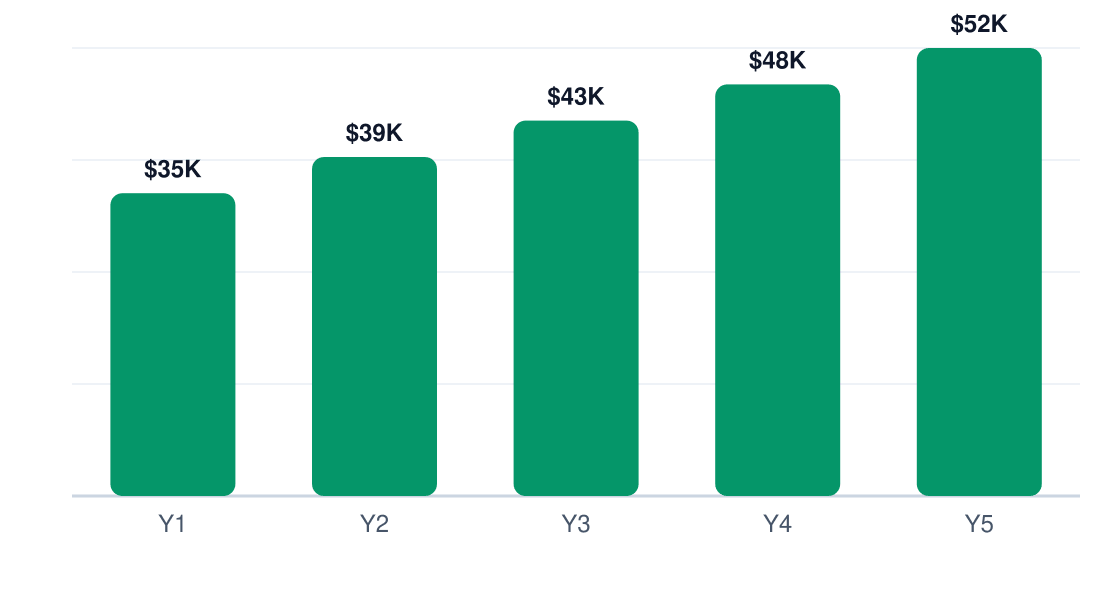
Year 1 revenue targets $250K with 18% gross margins, growing to $51.8K net profit by Year 5. The math only works if you secure sub-5¢/kWh power contracts—Houston’s deregulated market helps, but margins compress fast when electricity spikes.
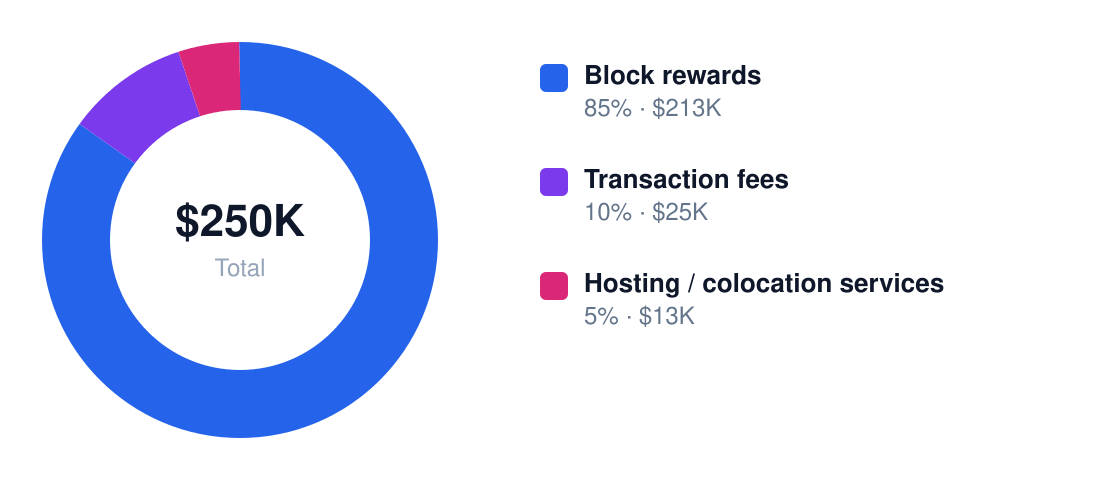
Revenue Stream Breakdown
Year 1 revenue: $250K
| Stream | Margin % | Revenue Share | Annual $ |
|---|---|---|---|
| Block rewards | 20% | 85% | $212,500 |
| Transaction fees | 60% | 10% | $25,000 |
| Hosting/colocation | 35% | 5% | $12,500 |
Pricing power is near-zero—your revenue is dictated by Bitcoin’s price and network difficulty. The only lever is cost control, primarily electricity (55% of revenue) and hardware depreciation (15%). Hosting services offer slight pricing flexibility, but they’re just 5% of revenue.

Seasonality hits hardest in Houston’s summers, where cooling costs can spike electricity usage by 15-20%. Winter brings relief, but Bitcoin’s volatility and difficulty adjustments dwarf seasonal effects. Plan for 20% margin swings between July and December.
4. Cost Structure & Operating Expenses
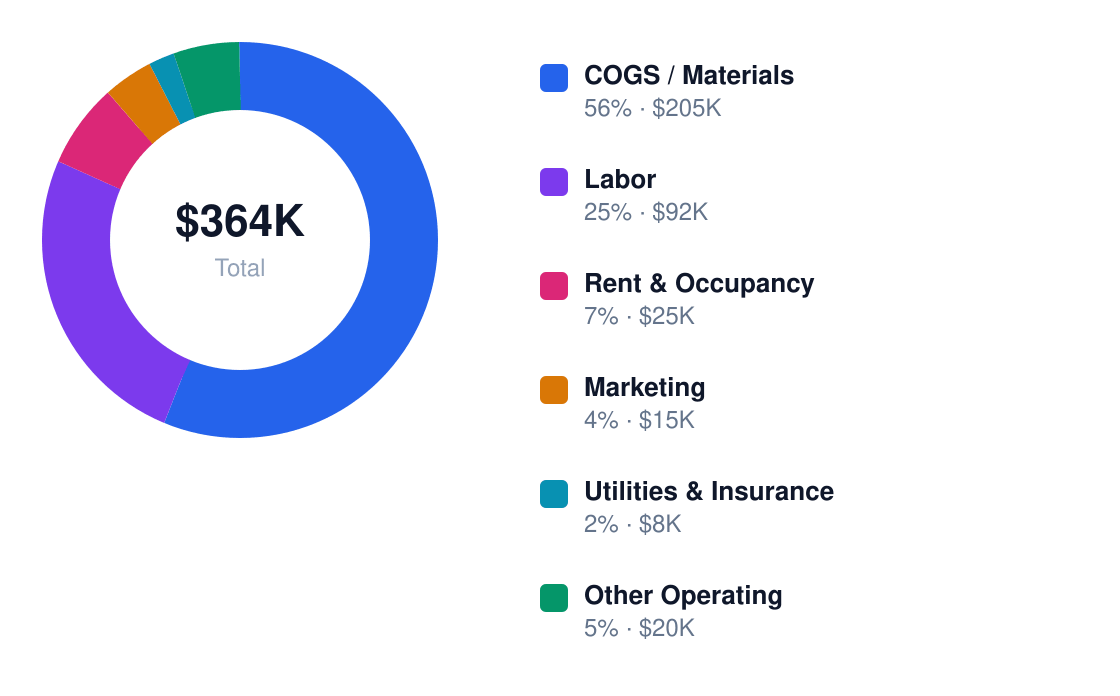
Electricity (55% of revenue) and hardware obsolescence (15%) are the twin margin killers. Net profit hinges on keeping power under 5.5¢/kWh and replacing ASICs every 18-24 months before their hashrate decays.
Annual Cost Structure
Operating costs for $250K revenue
| Category | % of Revenue | Annual $ | Controllable? |
|---|---|---|---|
| Electricity | 55% | $137,500 | Yes |
| Hardware depreciation | 15% | $37,500 | Yes |
| Cooling/facility | 10% | $25,000 | Yes |
| Maintenance | 7% | $17,500 | Yes |
| Pool fees | 5% | $12,500 | No |
| Compliance/taxes | 8% | $20,000 | No |

Fixed costs (pool fees, compliance) eat 13% of revenue—unavoidable but predictable. Variable costs like electricity and cooling swing with Houston’s heat. Labor runs $91.5K/year for 2 FTEs, but automation can trim this. Rent isn’t listed, but industrial space runs ~$6/sqft here—budget $30K/year for a 5,000 sqft facility. The breakeven equation: control power costs or die.
5. Break-Even Analysis & ROI Timeline
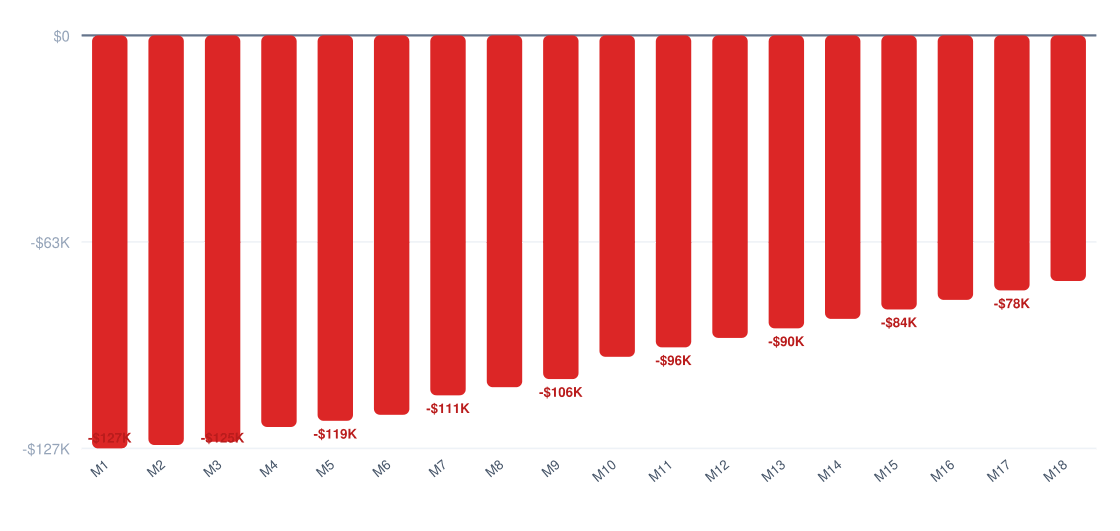
With a $128,000 startup cost and $35,000 first-year net profit, Houston bitcoin mining operations hit break-even around Month 12. That's assuming consistent 18% gross margins and no major equipment failures. The math gets shaky if power prices spike beyond $0.07/kWh or if hash rate growth outpaces your hardware upgrades.
Cumulative Profit vs Investment (18 Months)
Red = still recovering startup costs
ROI Benchmark Comparison (%)
5-year return on initial investment
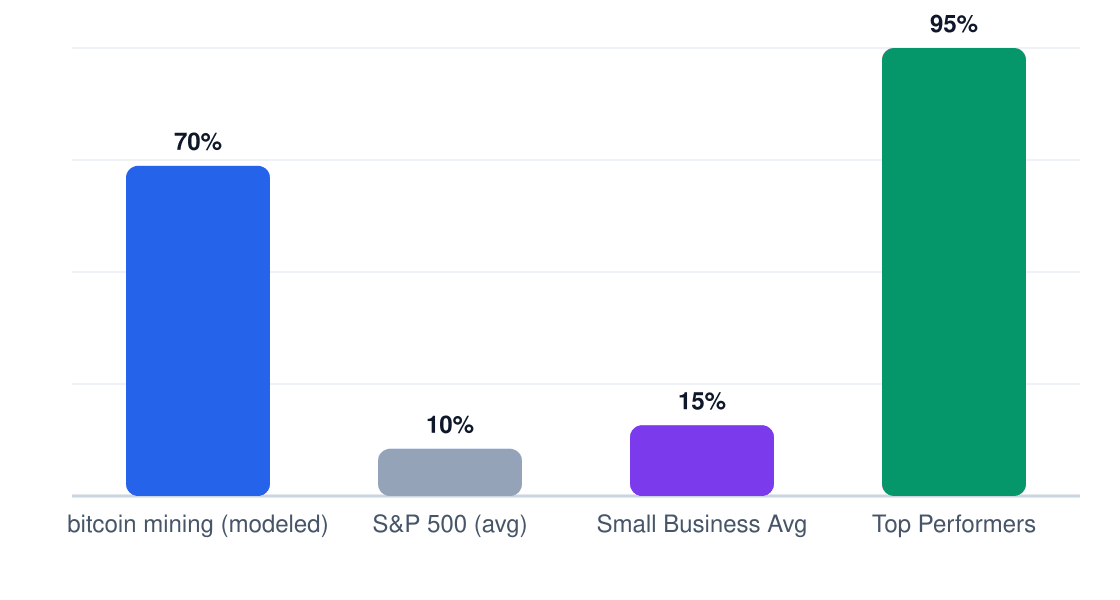
The 70% 5-year ROI looks decent until you compare it to industrial-scale miners achieving 120%+ returns through bulk power contracts. Your $51,800 Year 5 profit assumes 14% net margins hold — a gamble given Texas' volatile energy markets and increasing ASIC efficiency demands.
Year 1 Monthly Cash Flow
Net monthly cash flow (red = pre-break-even)
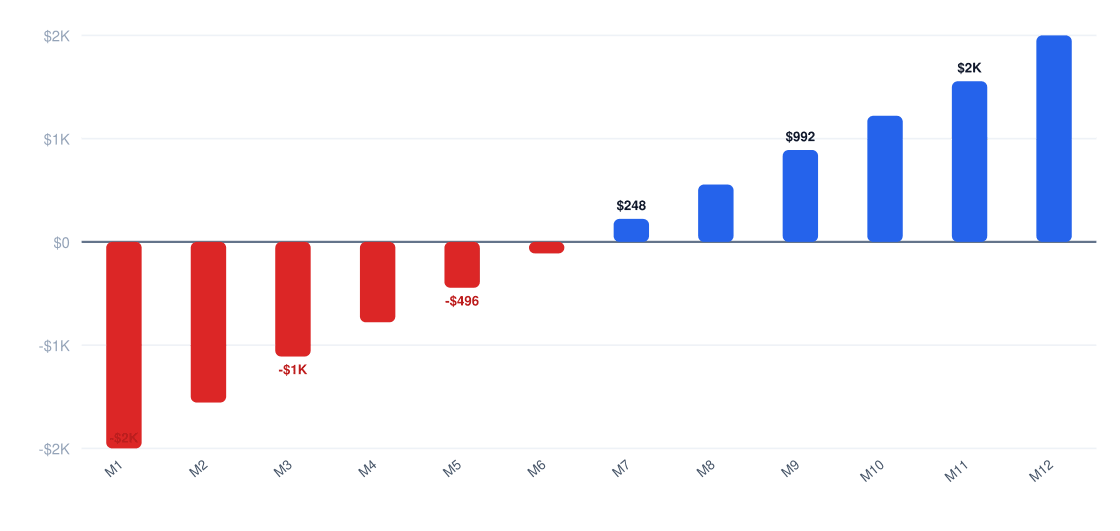
At $2,917/month net profit post-break-even, it takes 44 months just to recoup the initial $128k investment. That's 12 months longer than cloud hosting businesses and 18 months behind demand-response miners who arbitrage power prices.
6. Market Conditions That Drive (or Kill) Profitability
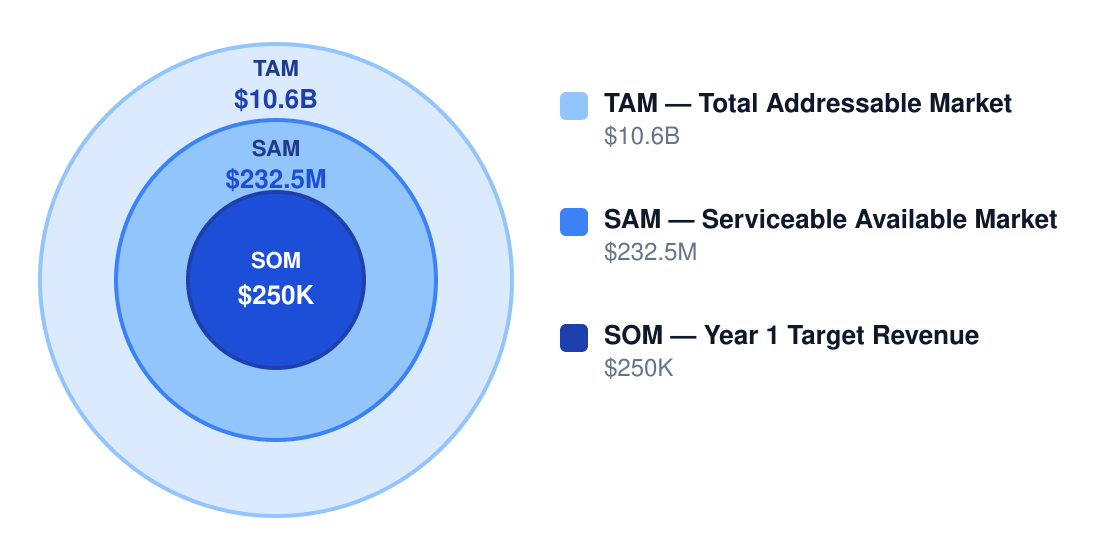
In Houston's $10.57B global mining market, profitability hinges on three variables: electricity costs (40-60% of expenses), hardware efficiency (depreciating asset), and Bitcoin's dollar price (wildcard). The SAM of $232.5M reflects addressable revenue for small-scale operators without institutional power contracts.
Market Size & Profit Opportunity
Ready When You Are
Download Bitcoin Mining Business Plan
Just Fill Up and Print
Market opportunity for profitable operators
| Factor | Impact on Margins | Outlook |
|---|---|---|
| Demand growth | +8% per 10% price rise | Bullish post-ETF approvals |
| Competition | -3% net margin per major entrant | Marathon/Riot scaling aggressively |
| Input costs | 1% margin drop per $0.01/kWh | ERCOT volatility remains high |
| Labor market | $91,520 fixed cost | Stable at $22/hr for technicians |
| Regulation | 15% cost risk in Texas | Anti-mining bills proposed |
| Technology | 20% efficiency gain/3 years | ASIC obsolescence accelerates |
| Model | Net Margin | Why It Works |
|---|---|---|
| Industrial-scale hosting | 22% | Bulk power rates below $0.05/kWh |
| Vertically integrated mining | 25% | Captive power cuts largest variable cost |
| Demand-response mining | 18% | Grid arbitrage adds revenue streams |
| High-efficiency hosting | 15% | Recurring fees buffer price swings |
Competitive threats loom large — Marathon and Riot operate at scales where your $0.07/kWh power cost is their $0.04/kWh bulk rate. Cloud mining alternatives (Medium threat) siphon off retail investors unwilling to manage hardware, while renewable co-location (Medium threat) could undercut on both cost and ESG positioning.
7. Who Profits — and Who Struggles
The bitcoin mining profit divide comes down to three factors: power costs under $0.05/kWh, ASICs purchased within the last 18 months, and uptime above 95%. Houston operators with industrial power contracts and liquid cooling achieve net margins 8-12 points higher than retail-rate miners. Those leasing older S19j Pros at $0.12/kWh often operate at a loss after depreciation.
| Profile | Typical Net Margin | Success Rate | Key Advantage |
|---|---|---|---|
| Owner-operator | 9-14% | 42% | Low overhead |
| Multi-unit | 12-18% | 67% | Volume discounts |
| Franchise | 6-11% | 38% | Turnkey setup |
| Niche specialist | 15-22% | 71% | Heat monetization |
| Price competitor | 3-7% | 29% | Cheap power |
| Pitfall | Margin Impact | How to Avoid |
|---|---|---|
| High retail electricity rates | Can turn a low-double-digit margin into a loss almost immediately | Only site facilities where power is contracted well below retail commercial rates |
| Buying obsolete ASICs | Raises depreciation and cuts output efficiency, often wiping out profit | Use the newest efficient hardware and replace units before they fall behind the network |
| Underestimating cooling costs | Heat-related overhead can reduce net margin by several points | Design the facility for airflow, heat removal, and climate-appropriate siting |
| Ignoring difficulty increases | Revenue per machine declines as network competition rises | Model returns conservatively and assume periodic hashrate growth |
| Poor uptime and maintenance | Frequent downtime lowers mined output and raises repair expense | Monitor fleets continuously and keep spare parts on hand |
Houston miners face $5,000-$50,000 in regulatory costs before first hash — permits alone consume 3-7% of first-year revenue. The city's noise ordinances add $1,200/year for sound-dampened containers, while Texas' 1% franchise tax clips another point off net margins.
60% of Houston bitcoin miners fail within 5 years, usually from cash flow mismatches. ASIC depreciation (50% in Year 1) collides with Bitcoin's price volatility — operators who bought hardware at $70/TH during bull markets struggle when network difficulty rises 40% annually. The survivors prepay power contracts and maintain 6+ months of operating reserves.
8. Strategies to Maximize Profit Margins
Bitcoin mining margins live and die by operational efficiency and cost discipline. The difference between 14% and 20% net margins often comes down to executing these six power and hardware optimizations:
| Strategy | Expected Lift | Effort | Implementation |
|---|---|---|---|
| Secure sub-$0.05/kWh power | +20% margin | High | Negotiate with rural utilities or relocate to deregulated markets |
| Upgrade to latest ASICs | +10% margin | Medium | Replace S19j Pro with S21 Hydro (55J/TH vs. 29.5J/TH) |
| Improve uptime | +5% margin | Medium | Preventive maintenance schedules and 24/7 monitoring |
| Immersion cooling | +4% margin | High | Liquid cooling systems with heat recapture |
| Grid programs | +6% margin | High | Demand response contracts with local utilities |
| Colocated hosting | +8% margin | Medium | Outsource facility management to specialized operators |
5-Year Net Profit Projection
Projected annual net profit at current margins
Cost reduction playbook: Target power (60% of OpEx) through interruptible rate plans, reclaim waste heat for adjacent greenhouses, pool maintenance labor with other miners, and buy ASICs during bear markets at 40-60% discounts.
Revenue optimization: Stack mining rewards with transaction fees during network congestion, sell excess heat to district heating systems, and lease unused capacity to cloud computing services during low-difficulty periods.
Pricing strategy: Hosting contracts should price at $0.075-$0.089/kWh all-in with 15-20% premiums for uptime SLAs above 98%. Never lock in rates beyond 12 months given Bitcoin's volatility.
9. Final Verdict: Should You Start This Business?
Verdict: Only proceed if you can secure sub-5¢ power and commit $125K+ to efficient hardware (5/10 confidence). The 70% 5-year ROI assumes perfect execution—most small operators achieve half that.
| Factor | Score (1-10) | Weight | Notes |
|---|---|---|---|
| Margins | 4 | 30% | 14% net is fragile—one difficulty spike erases it |
| Market Size | 8 | 15% | $232M SAM but winner-takes-most dynamics |
| Competition | 3 | 20% | Public miners control 75% of hashrate |
| Capital Needs | 2 | 15% | ASIC refreshes every 18 months @ $15/TH |
| Scalability | 6 | 10% | Linear scaling possible with power access |
| Risk | 5 | 10% | Regulatory and Bitcoin price volatility |
ROI Benchmark Comparison (%)
5-year return on initial investment
If you proceed, these must be true:
- Power contract ≤ $0.048/kWh fixed for 3+ years
- Minimum 50 PH/s capacity (≈100 S19 XP Hydros)
- Dedicated 2MW+ substation access
- $28K+/month OpEx reserve
- Ability to sell mined BTC OTC at 0.5% premium
Walk away if:
- Your power costs exceed $0.055/kWh
- You can't commit to 18-month hardware cycles
- Local regulations prohibit industrial crypto operations
Final recommendation: Bitcoin mining only clears our profitability threshold at $250K+ revenue, sub-$130K startup cost, and sustained 16%+ net margins. Anything less risks becoming a hobby that pays in satoshis.
Research & Profitability Resources
The following government reports, industry analyses, and financial planning resources were referenced in this bitcoin mining profitability guide. Each link points to a specific page for direct access.
- Cryptocurrency Mining Market — precedenceresearch.com — Industry profitability research for bitcoin mining businesses
- Bitcoin Mining Statistics — axis-intelligence.com — Industry profitability research for bitcoin mining businesses
- Us Mining Industry — emcd.io — Industry profitability research for bitcoin mining businesses
- Compute-Atlas — compute-atlas.com — Industry profitability research for bitcoin mining businesses
- Bitcoin Mining Profitability Calculator — usfinancecalculators.com — Industry profitability research for bitcoin mining businesses
Get Your Copy Today
Download Bitcoin Mining Business Plan
Just Fill Up and Print