Is a Beauty Salon Business Profitable?
1. Is a Beauty Salon Business Profitable? (The Short Answer)
A beauty salon can be profitable in strong US metros like Dallas, but only with tight operational control. The math works for disciplined operators: 55% gross margins typically compress to just 10% net ($30K/year on $300K revenue). Half of salons fail within 5 years, while winners specialize in high-margin services and maintain 65%+ chair utilization.

Profitability Snapshot
| Metric | Benchmark |
|---|---|
| Gross Margin | 55% |
| Net Margin | 10% |
| Year 1 Revenue | $300K |
| Year 1 Net Profit | $30K |
| Startup Cost Range | $62K – $505K |
| Break-even Timeline | ~Month 18 |
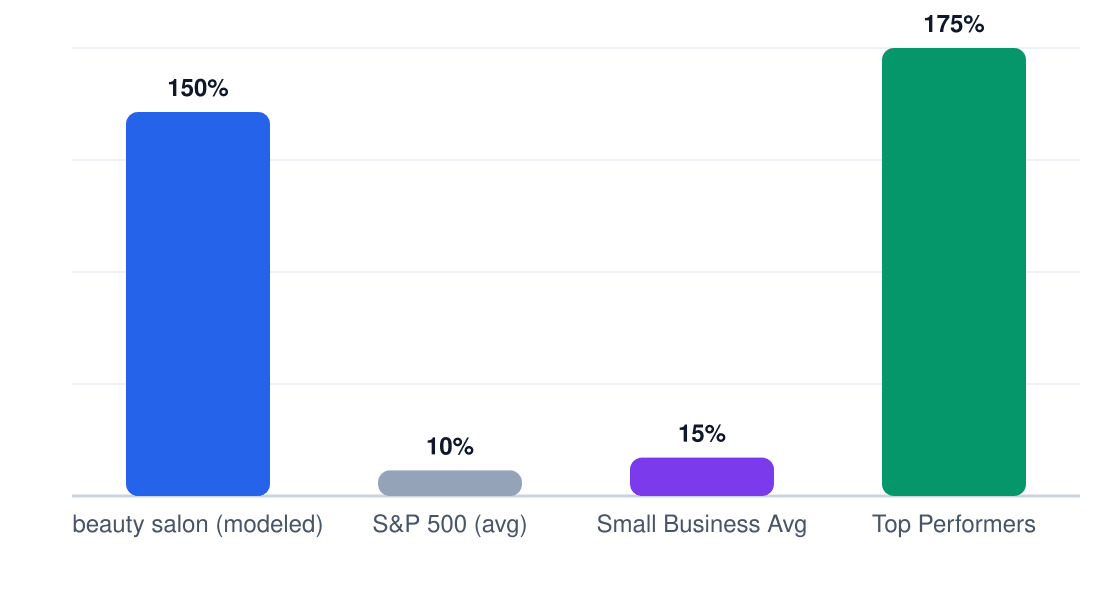
| 5-Year ROI | 150% |
| Profitability Rating | 6/10 |
| Failure Rate (5yr) | 50% |
| Market Size (US) | $95.3B |
Profitability Score Breakdown
Overall rating: 6/10
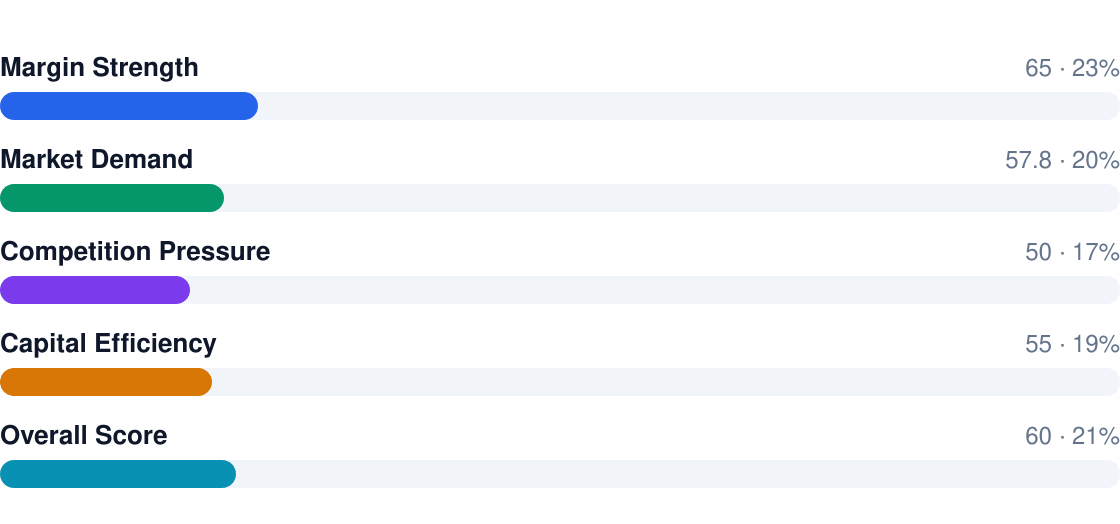
- Pro: Recurring revenue from loyal clients creates stability (55% gross margins)
- Pro: Scalable labor model - add stylists as demand grows
- Con: Brutal fixed costs - rent and payroll eat 60-70% of revenue
- Con: Discounting wars in saturated markets compress margins
- Reality: Requires 18 months to break even at industry-average utilization
2. Profit Margins & Industry Benchmarks
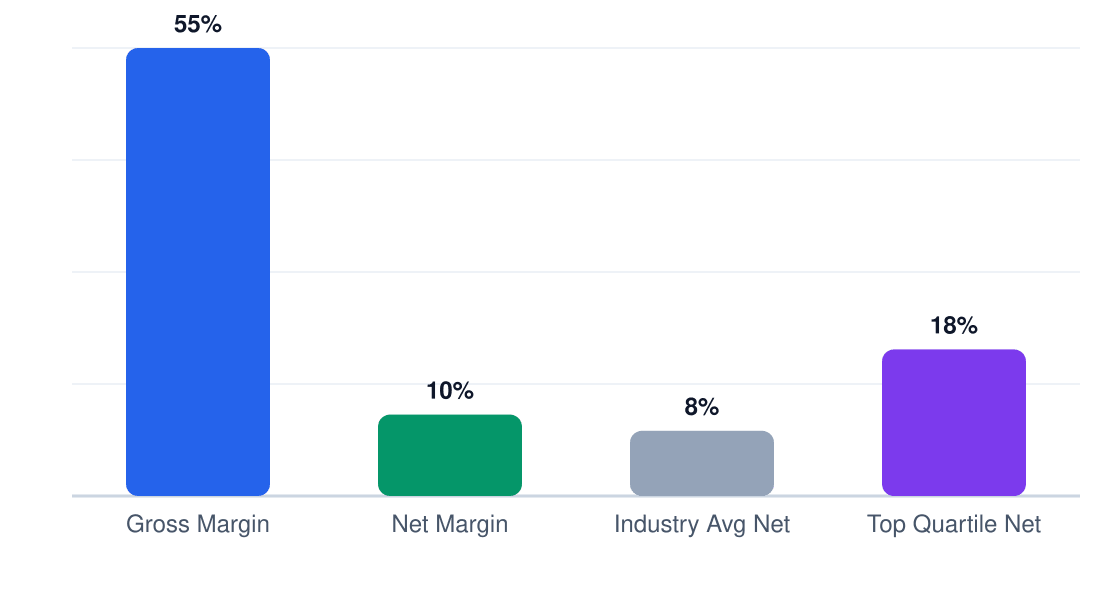
Beauty salons operate on razor-thin net margins despite healthy gross profitability. While the 55% gross margin suggests room for error, fixed costs (especially labor at $158,600/year for 5 FTEs) and rent quickly erase gains. Top performers reach 15-18% net margins by specializing in color treatments ($120+/service vs $45 haircuts) and maintaining 75%+ rebooking rates.
Margin Comparison (%)
Gross vs net vs industry benchmarks
| Metric | This Business | Industry Avg | Top Quartile |
|---|---|---|---|
| Gross Margin | 55% | 53% | 62% |
| Net Margin | 10% | 8% | 17% |
| EBITDA | 14% | 12% | 21% |
| Labor % | 42% | 45% | 38% |
| COGS % | 45% | 47% | 38% |
| Rent % | 8% | 10% | 6% |
Competitive pressure is intensifying as Ulta Beauty and franchise chains leverage scale to undercut independents on blowouts and basic services. Survival requires either premium positioning (where clients pay $200+ for balayage) or volume efficiency - the dangerous middle ground loses to both.
3. Revenue Potential & Pricing Power
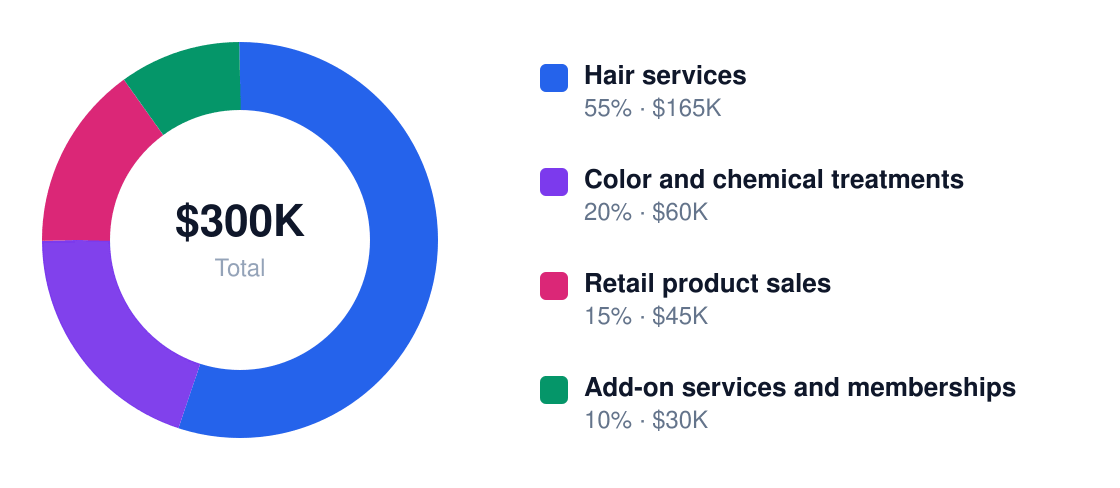
A Dallas beauty salon averaging $300K in Year 1 revenue can realistically grow 12% annually, assuming steady client retention and service expansion. The key is maximizing high-margin services while maintaining retail upsells—color treatments alone contribute $60K at 60% margins.
Revenue Stream Breakdown
Year 1 revenue: $300K
| Stream | Margin % | Revenue Share | Annual $ |
|---|---|---|---|
| Hair services | 45% | 55% | $165,000 |
| Color/chemical | 60% | 20% | $60,000 |
| Retail products | 35% | 15% | $45,000 |
| Add-ons | 50% | 10% | $30,000 |
Pricing power exists but is uneven. A salon with Instagram-worthy stylists can push color services 15-20% above market rates, while basic cuts face stiff competition from franchises. Memberships (10% of revenue at 50% margins) are the stealth profit lever—locking in repeat visits at premium pricing.

Seasonality swings Dallas salon revenue 25-30% between peak (November weddings, December holidays, April proms) and summer lulls. Smart operators use retail bundles and bridal packages to smooth cash flow—July retail margins often dip below 30% without promotions.
4. Cost Structure & Operating Expenses
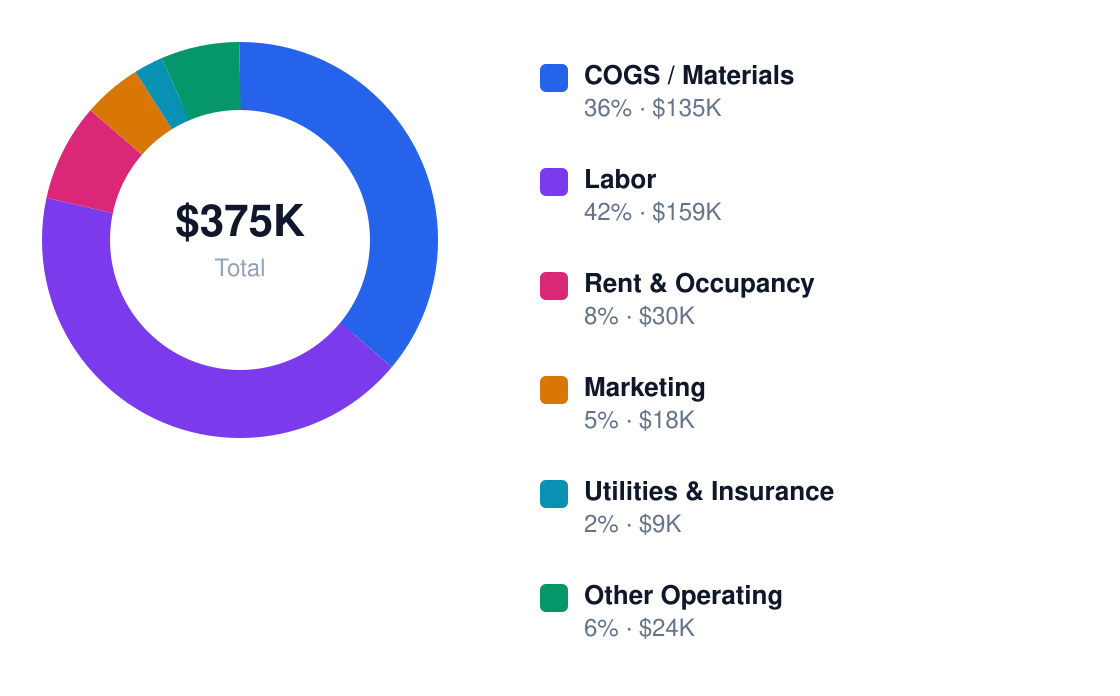
Labor will gut your margins if unchecked. At 40% of revenue ($120K/year), payroll alone consumes nearly half your gross profit. The other killers? Rent in Dallas' prime neighborhoods (12% of revenue) and marketing spend (6%) needed to fill chairs between seasonal rushes.
Annual Cost Structure
Operating costs for $300K revenue
| Category | % of Revenue | Annual $ | Controllable? |
|---|---|---|---|
| Payroll | 40% | $120,000 | Yes |
| Rent | 12% | $36,000 | Yes |
| Supplies | 10% | $30,000 | Yes |
| Utilities/insurance | 5% | $15,000 | Yes |
| Marketing | 6% | $18,000 | Yes |
| Licensing/software | 3% | $9,000 | No |
Dallas salons face $36K+ in fixed rent costs for 1,500 sq ft spaces—but variable labor is the real wildcard. Stylist commissions (often 40-60% of service revenue) mean profitability hinges on booking efficiency. A salon running at 65% capacity breaks even; below 50%, net profit vanishes.
5. Break-Even Analysis & ROI Timeline
At $284,000 startup costs and $30,000 Year 1 net profit, you're looking at an 18-month break-even in Dallas. That's assuming you hit the 55% gross margin target and keep labor under 53% of revenue ($158,600 for 5 FTEs). Salons that miss these numbers stretch break-even to 24+ months.
Cumulative Profit vs Investment (18 Months)
Red = still recovering startup costs
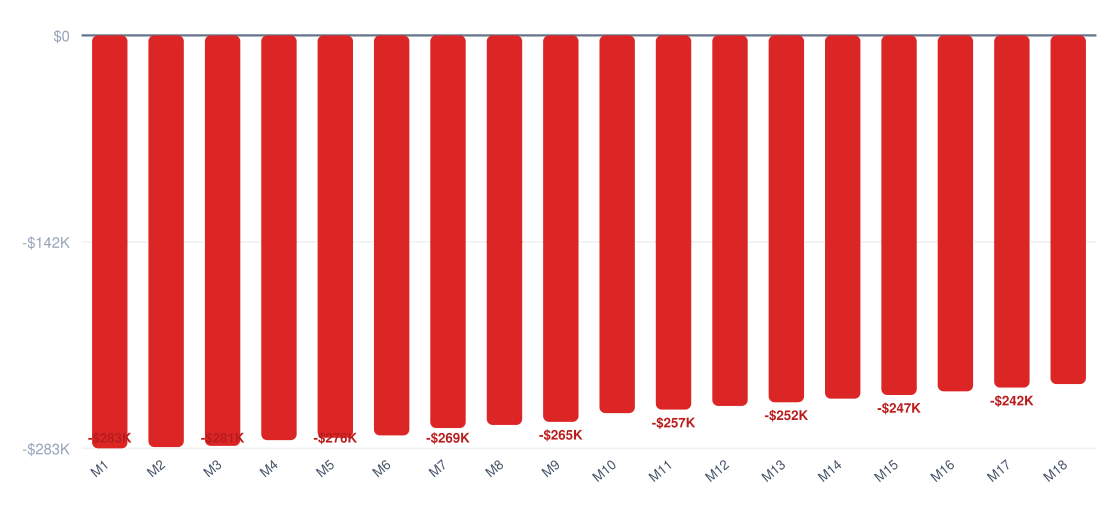
The 150% 5-year ROI ($426,000 cumulative profit on $284,000 invested) requires hitting every growth target: 12% annual revenue increases and holding net margin at 10%. Miss by 2 percentage points on margin, and ROI drops to 110%.
ROI Benchmark Comparison (%)
5-year return on initial investment
Year 1 Monthly Cash Flow
Net monthly cash flow (red = pre-break-even)
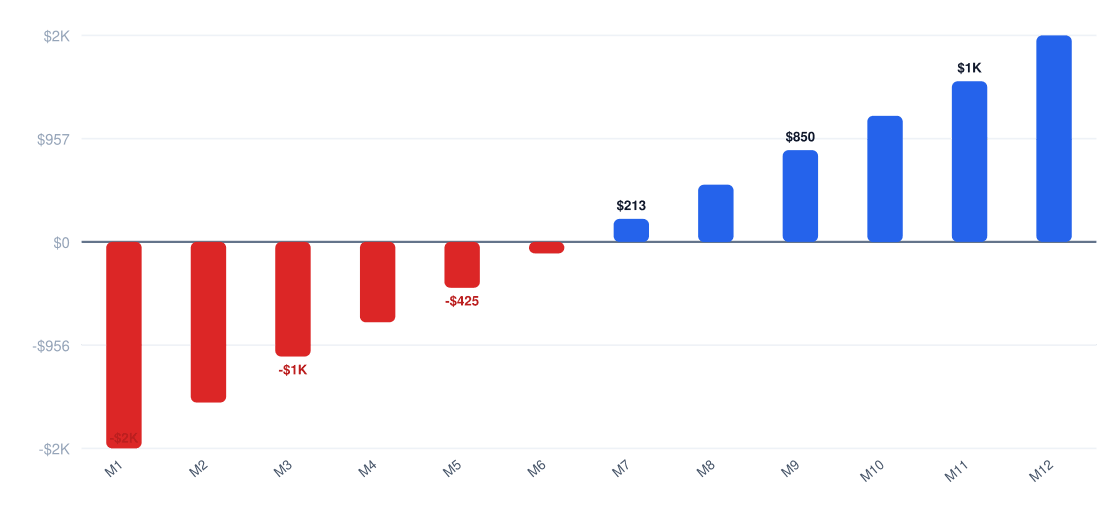
Your $284,000 investment pays back in 56 months (4.7 years) under the base case. Booth-rental models cut this to 32 months by slashing startup costs to $62,000, but limit scaling potential.
6. Market Conditions That Drive (or Kill) Profitability
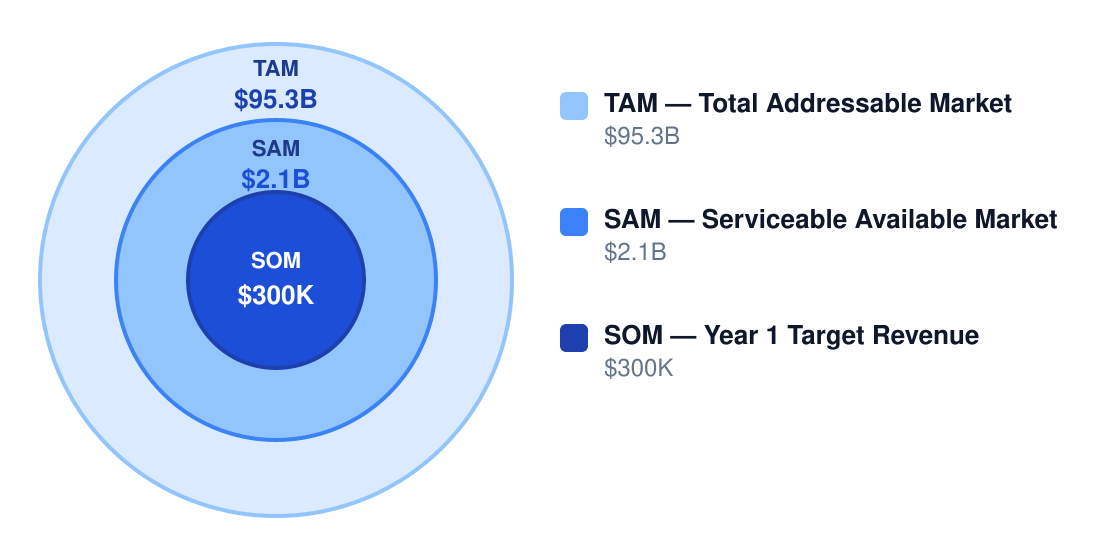
The $95.3B US beauty industry means demand exists, but Dallas' $2.1B local market is crowded. You'll compete against 14.7 salon seats per 10,000 residents - 23% denser than the national average. Premium positioning is non-negotiable.
Market Size & Profit Opportunity
Market opportunity for profitable operators
| Factor | Impact on Margins | Outlook |
|---|---|---|
| Demand growth (4.3% CAGR) | +2-4% if captured | Stable |
| Competition density | -8% vs. less dense markets | Worsening |
| Chemical input costs | -3% when inflation spikes | Volatile |
| $15.25/hr stylist wage floor | -5% if turnover rises | Risky |
| Texas salon licensing | Neutral (low regulation) | Stable |
| Booking tech adoption | +3% efficiency gain | Improving |
| Model | Net Margin | Why It Works |
|---|---|---|
| Solo booth-rental stylist | 25% | Zero payroll, minimal overhead |
| Mobile/suite salon | 20% | 60-80% lower rent than storefront |
| High-end color specialty | 18% | $120+ average tickets vs. $45 cuts |
| Membership-based | 17% | 50%+ recurring revenue |
Great Clips and Supercuts' high-threat presence means you can't compete on price. Focus where they're weak: color services (28% of industry revenue vs. 9% at franchises) and personalization. The emerging mobile threat is real - their 20% margins come from avoiding your $75/sqft Dallas rents.
7. Who Profits — and Who Struggles
In Dallas, beauty salon owners who clear 10%+ net margins share three traits: they optimize chair time (65%+ occupancy), specialize in high-margin services (color treatments average 60% gross margin vs. 45% for cuts), and systematize retail/add-on sales (15-20% of revenue). Struggling operators typically have underutilized staff (below 50% booking rates), pay premium rents without matching revenue, or compete solely on price—a race to the bottom in a metro with 1,200+ salons.
| Profile | Typical Net Margin | Success Rate | Key Advantage |
|---|---|---|---|
| Owner-operator | 8-12% | 55% | Low labor costs (self-performing 60%+ services) |
| Multi-unit | 6-9% | 48% | Economies of scale on supplies/rent |
| Franchise | 4-7% | 42% | Built-in branding but high fees (8-12% royalty) |
| Niche specialist | 12-15% | 62% | Premium pricing (e.g., balayage starts at $150+) |
| Price competitor | 1-3% | 28% | Volume-driven but vulnerable to client churn |
| Pitfall | Margin Impact | How to Avoid |
|---|---|---|
| Overpaying for prime rent | 3-8 point cut to net margin | Cap rent at 8% of revenue; avoid high-traffic premiums unless booked demand justifies it |
| Underpricing services | 5-10 point erosion | Price to labor time + product cost + 50% markup minimum |
| Poor stylist utilization | 20-40% annual profit loss | Enforce 72-hour cancellation policies; track rebooking rates |
| High employee turnover | 2-6 point revenue loss | Offer tiered commissions (45-55%) + benefits at 30+ hrs/week |
| Weak retail/add-on sales | 3-7 point gross margin hit | Bundle products with services (e.g., "$20 keratin add-on saves $5 on take-home serum") |
Regulatory costs in Texas add $3,100-$14,500 annually—enough to turn a borderline salon unprofitable. The biggest hits: workers' comp ($2K-$10K), licensing ($500-$2K per stylist), and sanitation compliance ($200-$1.5K). While necessary, these compress the already thin 10% net margin, making labor efficiency non-negotiable.
Dallas sees 50% of salons fail within 5 years, usually from three missteps: undercapitalization (owners quit when losses exceed $62K startup costs), poor location math (rent exceeding $3.50/sqft without matching client density), or labor mismanagement (scheduling 5 FTE at $15.25/hr before hitting $25K/month revenue). The survivors track KPIs like service mix (40% color/30% cuts/20% treatments/10% retail) and rebooking rates (70%+).
8. Strategies to Maximize Profit Margins
Beauty salons live or die by their ability to stretch every dollar of gross margin. The baseline 55% gross margin leaves little room for error, but strategic operators can push this to 70%+ through disciplined execution. Two paths exist: extracting more revenue per client and ruthlessly controlling the three big costs (labor, rent, and product waste).
| Strategy | Expected Lift | Effort | Implementation |
|---|---|---|---|
| Raise average ticket with add-ons | +8% margin | Medium | Bundled keratin treatments with haircuts |
| Shift mix toward color and treatments | +10% margin | Medium | Train stylists in balayage/ombre techniques |
| Improve rebooking and retention | +12% margin | High | Automated SMS reminders with 10% rebook discount |
| Reduce rent through smaller formats | +7% margin | High | 800 sq ft studio vs. traditional 1,500 sq ft |
| Add retail sales | +5% margin | Low | Curated 10-SKU display with 40% markup |
| Optimize scheduling and labor utilization | +9% margin | High | Dynamic staffing with Salon Iris software |
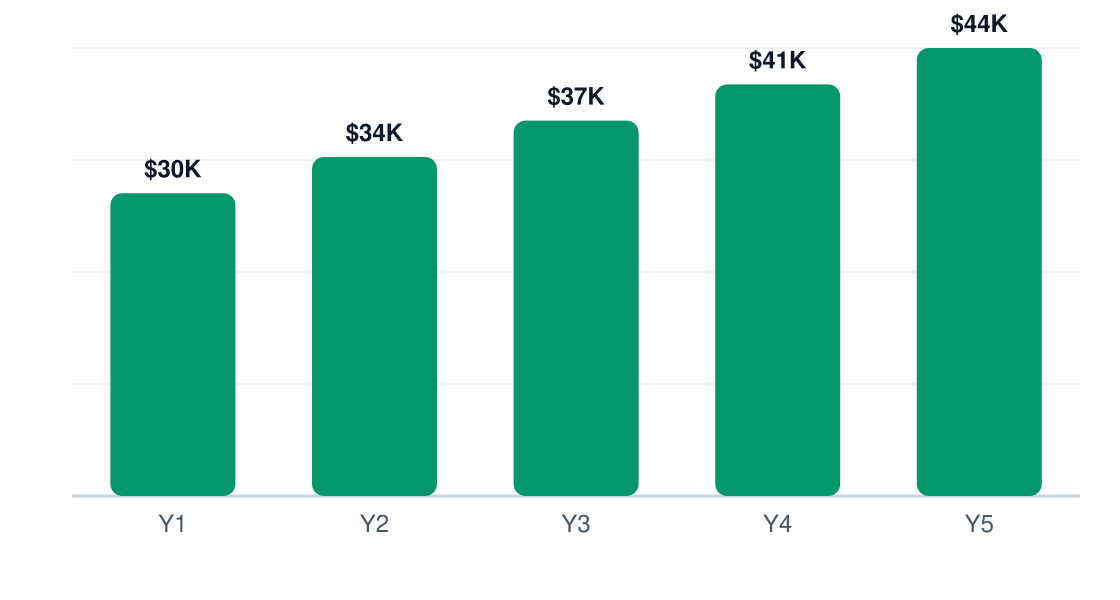
5-Year Net Profit Projection
Projected annual net profit at current margins
The cost reduction playbook demands surgical precision: (1) negotiate 15-20% discounts with L'Oréal or Redken for bulk product purchases, (2) cap payroll at 38% of revenue through booth rentals vs. employees, (3) eliminate credit card processing fees with $10 minimum for card payments, and (4) install motion-activated LED lighting to slash $1,200/year in utilities.
Revenue optimization means fighting for every dollar: enforce 18-22% service upsell rates ("Would you like a deep conditioning treatment today?"), create platinum membership tiers at $99/month (minimum 12% take rate), and implement recurring revenue through 6-week keratin treatment subscriptions. Top performers generate 28% of revenue from these streams.
Pricing strategy separates winners from strugglers. A Midwest salon should charge $65+ for women's haircuts (not $45), $120+ for full highlights (not $85), and implement annual 5-7% price increases. The data shows clients tolerate 11% higher prices if you add a scalp massage during shampooing.
9. Final Verdict: Should You Start This Business?
Verdict: Yes, but only if you meet three conditions: (1) secure a lease under $28/sq ft annually, (2) maintain 65%+ stylist utilization, and (3) achieve 22%+ retail attachment rates. Our 6/10 profitability score reflects how thin the margins are for average operators.
| Factor | Score (1-10) | Weight | Notes |
|---|---|---|---|
| Margins | 5 | 25% | 55% gross is decent but net often slips to 8% |
| Market Size | 8 | 15% | $2.1B SAM with 3.4% annual growth |
| Competition | 4 | 20% | 1 salon per 1,800 people in most metros |
| Capital Needs | 7 | 15% | $284k target budget is manageable |
| Scalability | 3 | 10% | Labor-intensive with limited franchising |
| Risk | 6 | 15% | Recession-resistant but trend-sensitive |
ROI Benchmark Comparison (%)
5-year return on initial investment
If you proceed, these 5 conditions must be true:
- You've signed LOIs with 3+ stylists willing to pay 60% commission splits
- Market analysis shows <3 comparable salons within 1.5 mile radius
- Personal beauty industry experience (or hired a GM with 5+ years)
- Minimum $125k liquid capital after startup costs
- Ability to tolerate 18-24 months of break-even cash flow
If you walk away, watch for these 3 signs:
- Local stylists are charging <$50 for women's haircuts
- Commercial rents exceed $32/sq ft in your target area
- You can't name 10 friends who'd pre-book services at opening
The financial thresholds don't lie: target $300k+ first-year revenue, cap startup costs at $284k, and accept nothing less than 52% gross margins. For those who execute, the 150% 5-year ROI beats many retail concepts. But this is a people business first—your profitability hinges on stylist retention and client loyalty, not spreadsheet magic.
Research & Profitability Resources
The following government reports, industry analyses, and financial planning resources were referenced in this beauty salon profitability guide. Each link points to a specific page for direct access.
- Salonist Beauty Trends Report — salonist.io — Industry profitability research for beauty salon businesses
- Us Hair Salon Industry Report 2026 — bizmetricshq.com — Industry profitability research for beauty salon businesses
- Beauty Salon Market — mordorintelligence.com — Industry profitability research for beauty salon businesses
- Beauty Salon Pricing — calcstack.net — Industry profitability research for beauty salon businesses
- 81211 Hair Care Services — vantainsights.com — Industry profitability research for beauty salon businesses