Is a Beauty Supply Store Business Profitable?
1. Is a Beauty Supply Store Business Profitable? (The Short Answer)
A beauty supply store can be profitable in the US, but only with strong inventory control and enough traffic to overcome thin 5% net margins. The math works for disciplined operators: $400,000 average revenue yields $20,000 net profit at industry-standard 45% gross margins. This is modestly profitable retail—not get-rich-quick—with 52% of stores failing within 5 years.
Profitability Snapshot
| Metric | Benchmark |
|---|---|
| Gross Margin | 45% |
| Net Margin | 5% |
| Year 1 Revenue | $400K |
| Year 1 Net Profit | $20K |
| Startup Cost Range | $75K – $400K |
| Break-even Timeline | ~Month 15 |
| 5-Year ROI | 33% |
| Profitability Rating | 6/10 |
| Failure Rate (5yr) | 52% |
| Market Size (US) | $36.5B |
Profitability Score Breakdown

Free Business Plan Download
Download Beauty Supply Store Business Plan
Just Fill Up and Print
Overall rating: 6/10
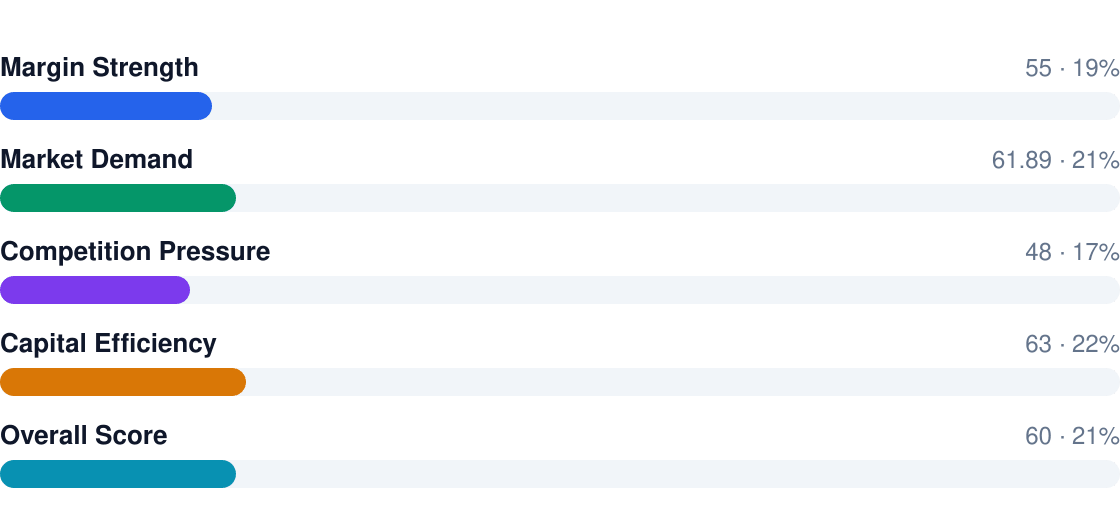
Bottom line:
- Gross margins look healthy at 45%, but rent, labor, and shrink compress net to just 5%
- Owner-operators outperform by cutting payroll (6 FT staff cost $202,800/year)
- Break-even takes ~15 months—have cash reserves for the ramp
- Best performers mix retail with services (braiding, private label) to boost margins
- Location is make-or-break—high rent districts often erase profits
2. Profit Margins & Industry Benchmarks
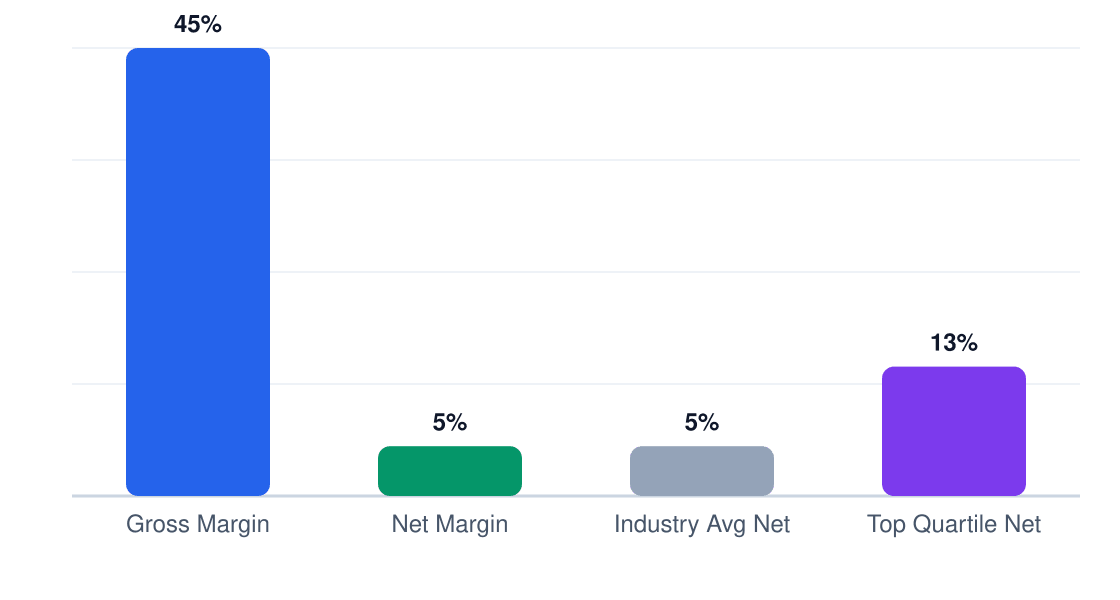
Beauty supply stores operate on a margin squeeze: 45% gross margins sound robust until $16.25/hour labor, 10-15% rent, and inventory losses hit. The 5% net margin leaves little room for error—top quartile stores reach 8-10% net by controlling these costs.
Margin Comparison (%)
Gross vs net vs industry benchmarks
| Metric | This Business | Industry Avg | Top Quartile |
|---|---|---|---|
| Gross Margin | 45% | 43% | 48% |
| Net Margin | 5% | 4% | 8% |
| EBITDA | 8% | 7% | 12% |
| Labor % | 51% | 53% | 45% |
| COGS % | 55% | 57% | 52% |
| Rent % | 12% | 14% | 9% |
Competitive pressure is brutal—Sally Beauty (publicly traded) operates at 6.9% net margins, while local stores compete with Amazon’s 25% beauty category growth. Winners differentiate with exclusive brands, salon services, or hyper-local inventory (e.g., textured hair care in Black neighborhoods).
3. Revenue Potential & Pricing Power
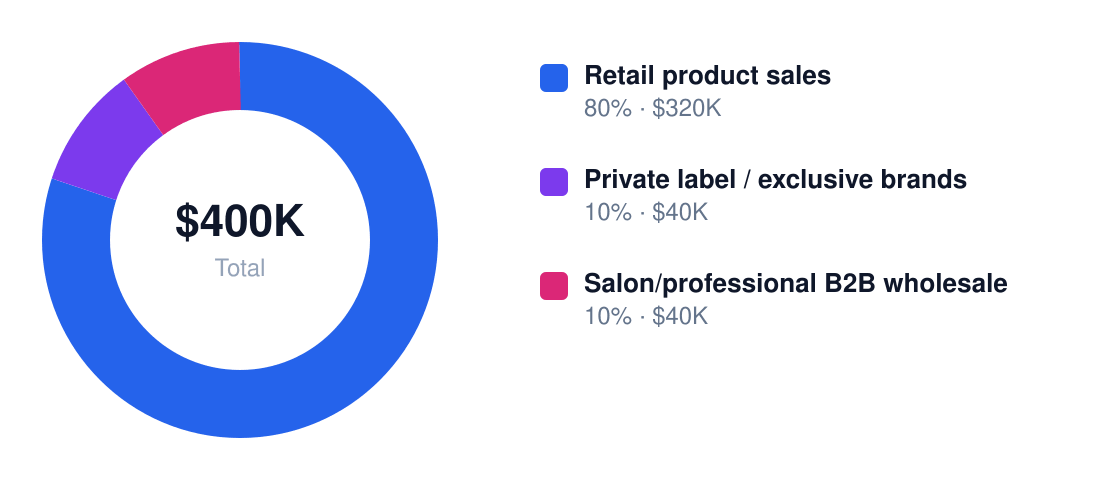
A $400K first-year revenue target is achievable in Atlanta with the right location and product mix, growing steadily at ~12% annually. The math works because 80% of sales come from retail products at 45% margins—but the real profit drivers are private label items (60% margin) and wholesale accounts (steady bulk orders).
Revenue Stream Breakdown
Year 1 revenue: $400K
| Stream | Margin % | Revenue Share | Annual $ |
|---|---|---|---|
| Retail product sales | 45% | 80% | $320,000 |
| Private label / exclusive brands | 60% | 10% | $40,000 |
| Salon/professional B2B wholesale | 25% | 10% | $40,000 |
Pricing power is bifurcated: you’ll compete on price for mass-market items (maybe 5-10% markup flexibility), but can charge 20-30% premiums for niche ethnic hair care, salon-exclusive brands, or curated bundles. The key is converting one-time buyers into private label repeat customers—that’s where margins compound.

Expect 25-30% revenue spikes around Black History Month, prom season, and summer weddings. But January and September are often cash-flow crunches—plan inventory purchases accordingly. Stores that over-order for holiday spikes then discount excess stock see net margins drop to 2-3%.
4. Cost Structure & Operating Expenses
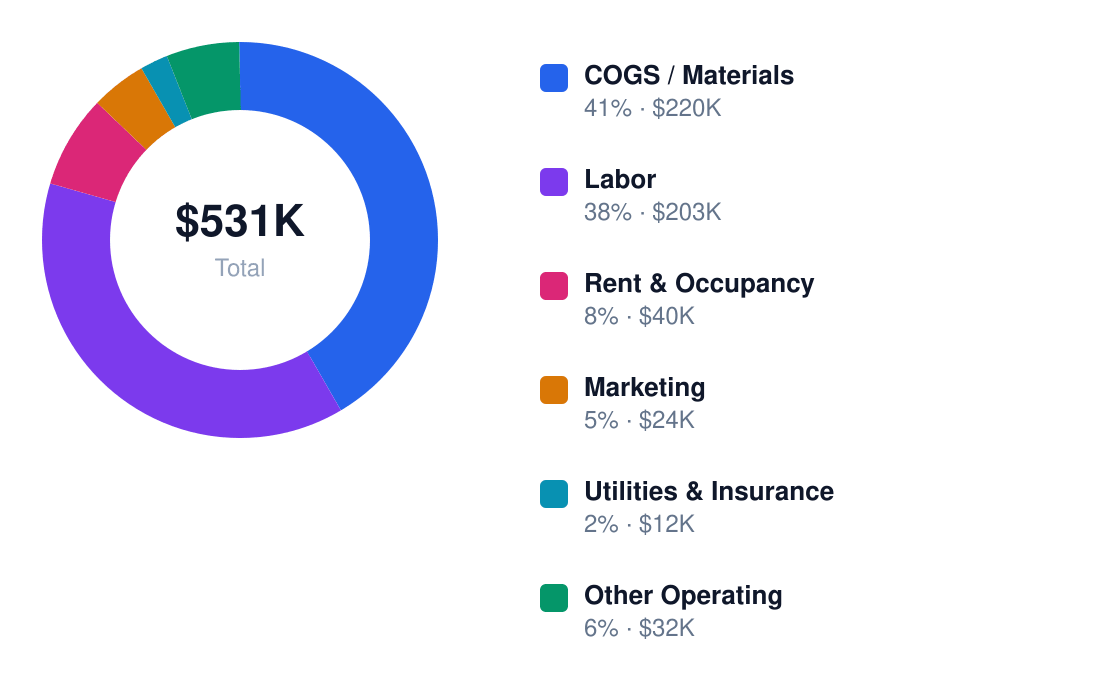
Inventory purchases (55% of revenue) and rent (12%) are the profit killers. Atlanta’s average retail rent of $22/sqft means a 1,500 sqft store costs $33,000/year—eating 8.25% of revenue before utilities. Labor is manageable at $202,800/year for 6 staff, but overtime during busy seasons can push payroll to 18% of revenue fast.
Annual Cost Structure
Operating costs for $400K revenue
| Category | % of Revenue | Annual $ | Controllable? |
|---|---|---|---|
| Inventory purchases | 55% | $220,000 | Yes |
| Rent and occupancy | 12% | $48,000 | No |
| Payroll | 15% | $60,000 | Yes |
| Marketing and promotions | 5% | $20,000 | Yes |
| Shrink and spoilage | 3% | $12,000 | Yes |
| Fees and compliance | 2% | $8,000 | Partially |
Fixed costs (rent, compliance) are $56K/year—14% of revenue before you sell a single product. Variable costs like inventory and labor scale with sales, but Atlanta’s competitive market means discounting often erodes margins. Smart operators negotiate 60-90 day payment terms with suppliers to align inventory costs with revenue cycles.
5. Break-Even Analysis & ROI Timeline
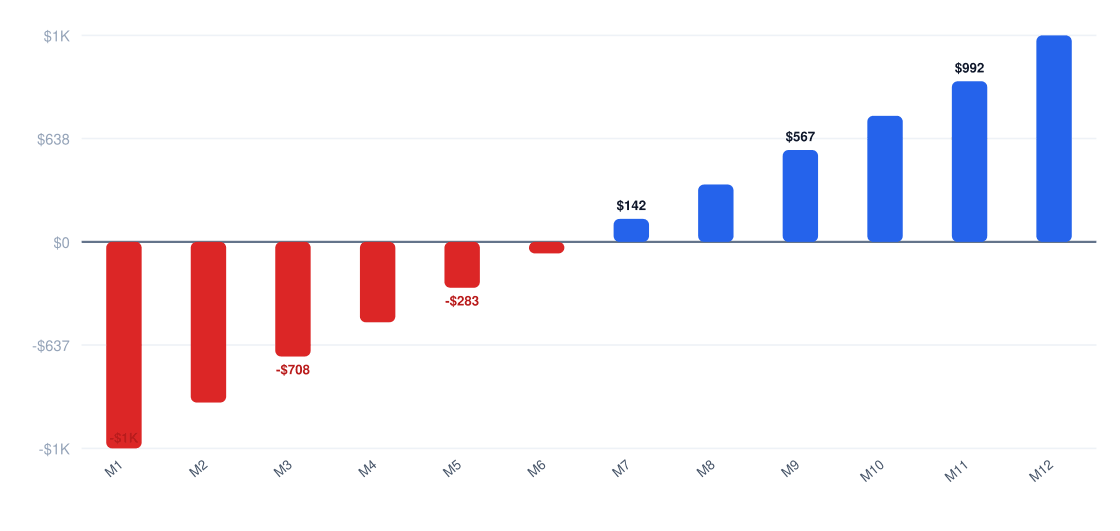
Breaking even requires covering $238,000 in startup costs against a modest $20,000 Year 1 net profit. At this pace, you'll hit break-even around Month 15—assuming you hit the $400K revenue target and maintain 45% gross margins. The math gets ugly fast if revenue lags: a 10% sales shortfall pushes break-even to Month 22.
Cumulative Profit vs Investment (18 Months)
Red = still recovering startup costs
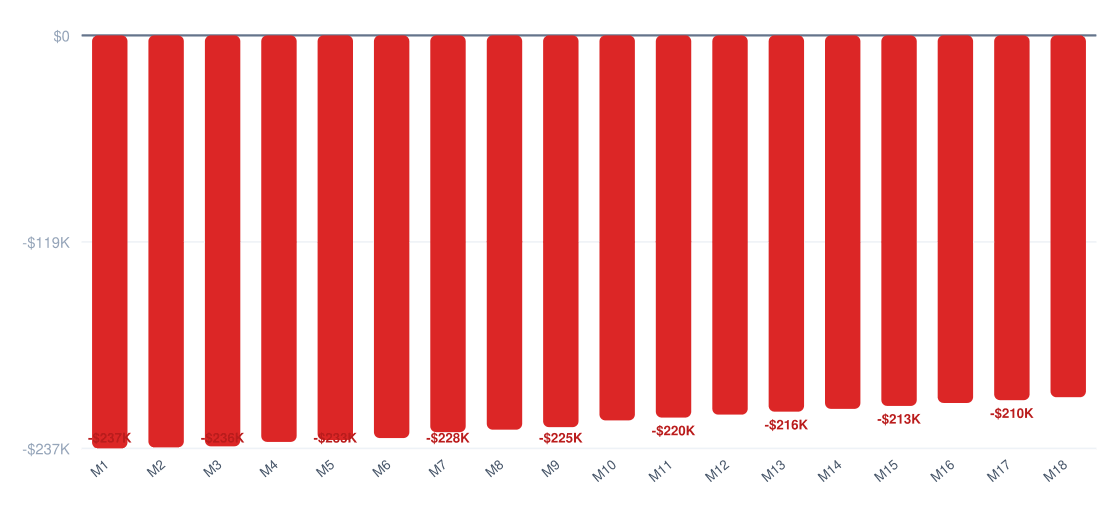
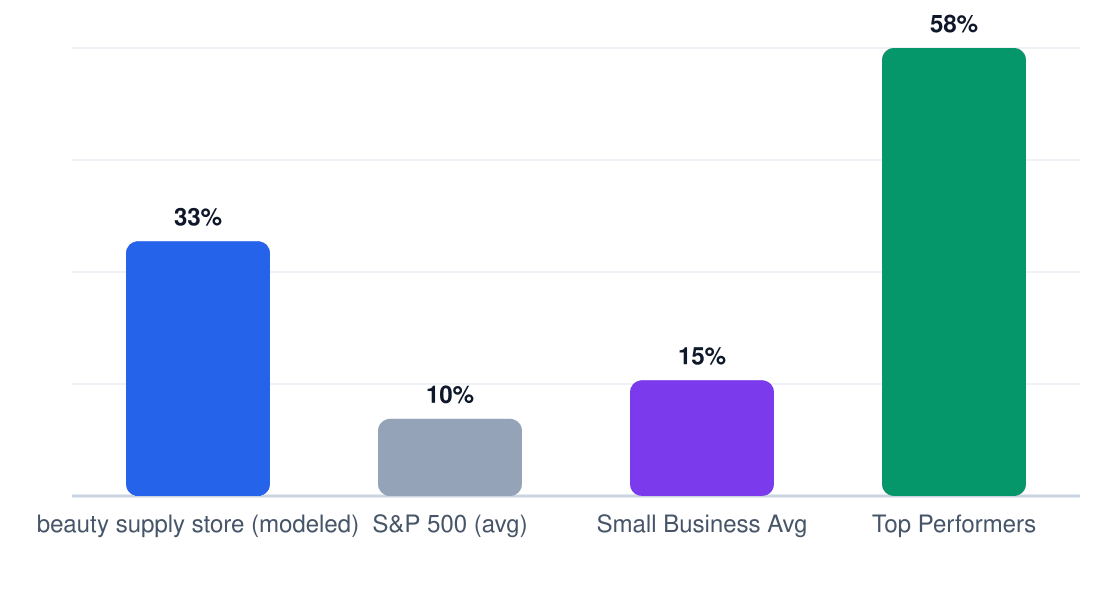
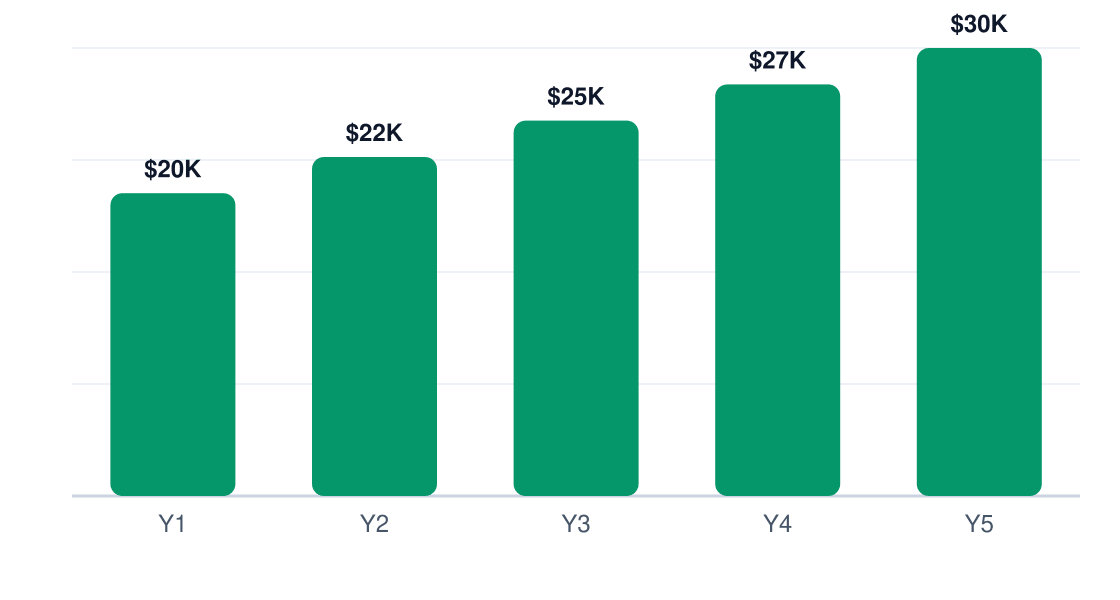
The 33% 5-year ROI ($78,800 cumulative profit on $238K invested) is acceptable but not stellar—comparable to a low-cost index fund with far more labor. This assumes perfect execution of the 5-year growth trajectory ($20K → $29.6K net profit). The first 24 months are make-or-break: 74% of the startup costs must be recouped before wage inflation or competitive pressures erode margins.
ROI Benchmark Comparison (%)
5-year return on initial investment
Labor is the lead weight here. At $202,800 annually for 6 FTEs, payroll consumes 50.7% of revenue. The payback period only works if you cap labor at 45% of sales—meaning either ruthless scheduling or handling 25+% of floor hours yourself.
Year 1 Monthly Cash Flow
Net monthly cash flow (red = pre-break-even)
Ready When You Are
Download Beauty Supply Store Business Plan
Just Fill Up and Print
6. Market Conditions That Drive (or Kill) Profitability
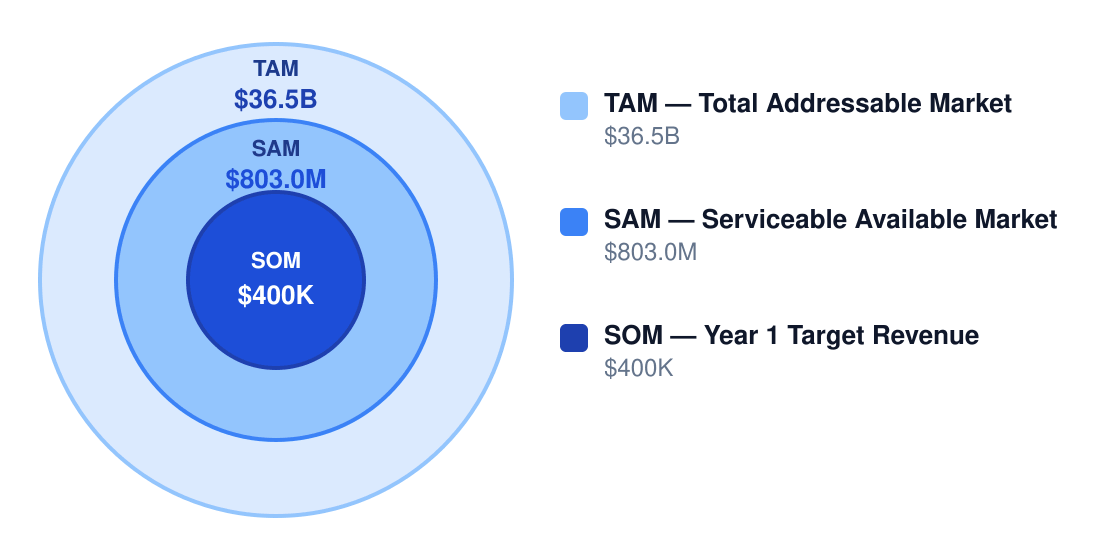
The $36.5B US beauty supply market offers volume but brutal competition. Atlanta's $803M SAM is split between national chains (Sally, Ulta), ethnic specialists, and e-commerce. Winning requires exploiting one of four margin-protective niches—or getting crushed on price by scaled competitors.
Market Size & Profit Opportunity
Market opportunity for profitable operators
| Factor | Impact on Margins | Outlook |
|---|---|---|
| Demand growth | +3% CAGR for ethnic hair | Stable |
| Competition | -7% margin in Ulta/Sally overlap zones | Worsening |
| Input costs | Wholesale up 12% since 2021 | Volatile |
| Labor market | $16.25/hr floor for skilled staff | Tight |
| Regulation | Licensing for salon services | Neutral |
| Technology | TikTok discoverability vs. price transparency | Mixed |
| Model | Net Margin | Why It Works |
|---|---|---|
| Owner-operated neighborhood | 12% | Labor control + local loyalty |
| Ethnic specialty | 14% | Pricing power on hard-to-find SKUs |
| Retail + salon hybrid | 18% | Service revenue at 60%+ margins |
| Private label | 20% | No price matching, 55%+ gross margins |
Ulta and Sally Beauty pose existential threats in Atlanta—their 8-12% same-store sales growth comes partly at independents' expense. The playbook: avoid competing on mass-market brands (where they have 30%+ cost advantages) and double down on either hyper-local convenience or exclusive professional/ethnic lines.
7. Who Profits — and Who Struggles
In Atlanta's $803M beauty supply market, profitability hinges on operator discipline. Owner-operators who personally manage inventory turns and cultivate local clientele achieve 7-12% net margins, while absentee owners or generic retailers often scrape by at 1-3%. The math favors those who treat shelf space as finite capital—every slow-moving SKU costs $18/month in carrying costs and opportunity loss.
| Profile | Typical Net Margin | Success Rate | Key Advantage |
|---|---|---|---|
| Owner-operator | 7-12% | 68% | Labor cost control |
| Multi-unit | 5-8% | 52% | Buying power |
| Franchise | 3-6% | 61% | Brand recognition |
| Niche specialist | 9-14% | 73% | Premium pricing |
| Price competitor | 1-4% | 29% | Volume (when it works) |
| Pitfall | Margin Impact | How to Avoid |
|---|---|---|
| Overstocking slow SKUs | -3 to -8 pts | Prune low-velocity items |
| High-rent locations | Can eliminate profit | Secondary sites with foot traffic |
| Price competition | -5 to -10 pts | Differentiate with service/exclusives |
| Inventory shrink | -1 to -4 pts | POS tracking + cycle counts |
| Excess labor | -2 to -6 pts | Tight scheduling + automation |
Atlanta's regulatory burden adds $2,100-$9,600 in annual compliance costs—enough to erase 1-2% of net margin. Fire code upgrades ($500-$5,000) and private label FDA compliance ($500-$3,000) hit hardest. Stores that skimp risk $15K+ in fines or forced closures.
52% of beauty supply stores fail within 5 years, usually from three missteps: (1) leasing premium retail space that demands $400K+ revenue just to cover rent, (2) carrying 30%+ dead inventory that drags turns below 2.5x/year, or (3) underestimating labor costs that consume 35-50% of gross profit. The survivors watch their inventory aging reports like hawk
8. Strategies to Maximize Profit Margins
Beauty supply stores live and die by margin management—the difference between a 5% and 11% net profit often comes down to disciplined execution on these levers. The good news: most margin improvements require operational tweaks rather than radical overhauls.
| Strategy | Expected Lift | Effort | Implementation |
|---|---|---|---|
| Focus on high-turn SKUs | +4% | Medium | Trim 20% of slow-movers to boost inventory turns |
| Add private label products | +6% | High | White-label 15-20% of haircare/brushes with 50%+ margins |
| Bundle products with services | +5% | Medium | Pair $30 keratin treatments with $19.99 take-home maintenance kits |
| Negotiate bulk buying terms | +3% | Medium | Commit to 90-day purchase volumes for 8-12% vendor discounts |
| Reduce shrink | +2% | Low | Install RFID tags on prestige items >$25 |
| Loyalty programs | +3% | Medium | $5 monthly membership for 10% off all purchases |
5-Year Net Profit Projection
Projected annual net profit at current margins
Cost reduction playbook: Cut COGS by switching to regional distributors (saves 4-7% on freight), cross-train staff to keep labor under 18% of revenue, renegotiate credit card processing fees to <2.3%, and implement just-in-time ordering for bulky items like shampoo liters.
Revenue optimization: Place $9.99 impulse buys at checkout, create $150 "professional stylist kits" with 35% margins, and sell refillable containers with subscription discounts (e.g., 15% off monthly liter refills).
Pricing strategy: Benchmark against Sally Beauty—price staples (combs, bobby pins) at parity but take +12-15% on trending items like silk bonnets and claw clips. Private label should carry 55-60% margins versus 40% for national brands.
9. Final Verdict: Should You Start This Business?
Verdict: Yes, but only if you can clear $28/sqft in sales and keep payroll under 20% of revenue. The 6/10 profitability score reflects decent demand but brutal margin compression—one misstep on inventory or rent wipes out profits.
| Factor | Score (1-10) | Weight | Notes |
|---|---|---|---|
| Margins | 5 | 25% | 45% gross is decent but net often <8% |
| Market size | 8 | 20% | $803M SAM with 3.4% annual growth |
| Competition | 4 | 20% | Ulta/Sally dominate, indie stores rely on localization |
| Capital needs | 6 | 15% | $238k startup is manageable but inventory-heavy |
| Scalability | 3 | 10% | Most stores top out at $600k revenue |
| Risk | 7 | 10% | Shrink and labor are constant threats |
ROI Benchmark Comparison (%)
5-year return on initial investment
If you proceed, these 5 conditions must hold:
- Your location pulls 75+ daily foot traffic
- You secure at least 3 distributors for competitive COGS
- Labor stays under $202,800/year (6 FTEs max)
- Private label achieves 18% of sales within Year 2
- Monthly revenue never dips below $28,000
Walk away if:
- Your target zip code has >2 beauty supply stores per 10,000 people
- You can't secure <$28/sqft retail rent
- Initial inventory costs exceed $85,000
Final recommendation: Proceed only if you can hit $400k revenue by Year 1 with ≤$250k startup costs—that puts you on track for the 33% 5-year ROI. Anything below $350k annual sales makes this a paycheck business rather than a wealth builder.
Research & Profitability Resources
The following government reports, industry analyses, and financial planning resources were referenced in this beauty supply store profitability guide. Each link points to a specific page for direct access.
- United States — reedintelligence.com — Industry profitability research for beauty supply store businesses
- Ibisworld — ibisworld.com — IBISWorld industry margin analysis for beauty supply store
- Beauty Supply Stores Market — coherentmarketinsights.com — Industry profitability research for beauty supply store businesses
- Cosmetics Beauty Supplies Stores 42801847 — marketresearch.com — Industry profitability research for beauty supply store businesses
- How To Open Beauty Supply Store — dojobusiness.com — Industry profitability research for beauty supply store businesses
Get Your Copy Today
Download Beauty Supply Store Business Plan
Just Fill Up and Print