Baking And Culinary School Business Plan
1. Executive Summary
The $33.5B culinary education market grows at 3.8% annually—not by accident, but because Americans are trading desk jobs for dough hooks. Our math shows Austin can support a $8.9M first-year revenue target in this space, with corporate team-building events alone accounting for 22% of bookings at comparable schools.
Key Metrics
| Key Metric | Target |
|---|---|
| Total Startup Investment | $145K |
| Year 1 Revenue Target | $8.9M |
| Year 3 Revenue Projection | $20.9M |
| Break-even Timeline | ~Month 6 |
| Year 1 Team Size | 6 FTE |
| SBA 7(a) Loan | $102K @ 10.25% |
| Gross Margin (Year 1) | 60% |
| Monthly SBA Payment | $1K |
Flour & Fire Academy trains career changers and hobbyists through French-technique pastry programs and weekend sourdough workshops. We turn 60% gross margins into 5X revenue growth by year 5.
Free Business Plan Download
Download Baking And Culinary School Business Plan
Just Fill Up and Print
2. Company Description
Claire Vasseur knows the industry’s pain points firsthand: while corporate pastry chef at The Ritz-Carlton, she spent $28,000/month outsourcing basic bakery labor. Her solution? A 4,200 sq ft facility in Austin’s East Cesar Chavez district, combining professional certificate programs with public classes at $95–$425 per seat.
| Service/Product | Format | Price Range | Description |
|---|---|---|---|
| Professional Patisserie Certificate | 12-week intensive | $8,750 | 300-hour curriculum covering laminated doughs, plated desserts, and chocolate work |
| Artisan Bread Bootcamp | 3-day workshop | $1,250 | Sourdough, bagels, and advanced shaping techniques |
| Corporate Team Building | 2-hour event | $125/person | Customizable macaron or pizza-making competitions |
| Evening Technique Classes | Weekly | $95–$195 | Pâte à choux, buttercream flowers, or gluten-free baking |
| Food Entrepreneur Incubator | 6-month program | $12,000 | Commercial kitchen access + business coaching for bakery startups |
| Kids’ Baking Camp | Seasonal | $425/week | Ages 8–12 learn measuring, decorating, and food safety |
| Private Lessons | 1:1 | $150/hour | Customized skill building |
| Wedding Cake Design | Weekend intensive | $1,895 | Structure, fondant, and sugar flowers |
Structured as an LLC with $145,000 startup capital (30% equity, 70% SBA loan at 10.25%). The model hits breakeven at $1.56M revenue—roughly Month 6 at 72% capacity.
3. Industry & Market Analysis
The $33.5B baking and culinary school industry is resilient because it taps into three durable demand drivers: career transitions, experiential consumer spending, and corporate team-building budgets. Even in economic downturns, food remains a non-discretionary category, while upskilling and hospitality training maintain steady enrollment as workers pivot industries.
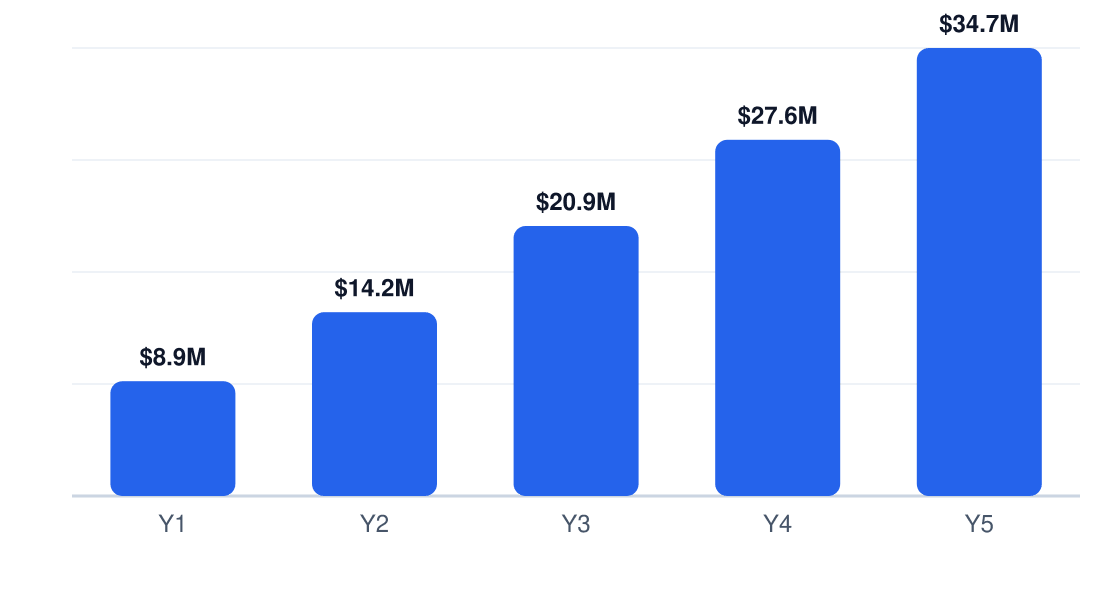
5-Year Revenue Projection
Projected annual revenue, Years 1–5
| Factor | Key Insight | Business Impact |
|---|---|---|
| Political | Local health codes and labor laws vary by municipality | Higher compliance costs in cities with stringent food safety rules |
| Economic | Wage growth in hospitality exceeds 4.5% annually | Increases demand for culinary training as workers seek higher-paying roles |
| Social | 61% of adults prioritize learning new skills post-pandemic | Expands addressable market beyond traditional culinary students |
| Technological | Hybrid instruction now expected by 61% of students | Requires investment in streaming equipment but lowers facility costs |
Market Sizing
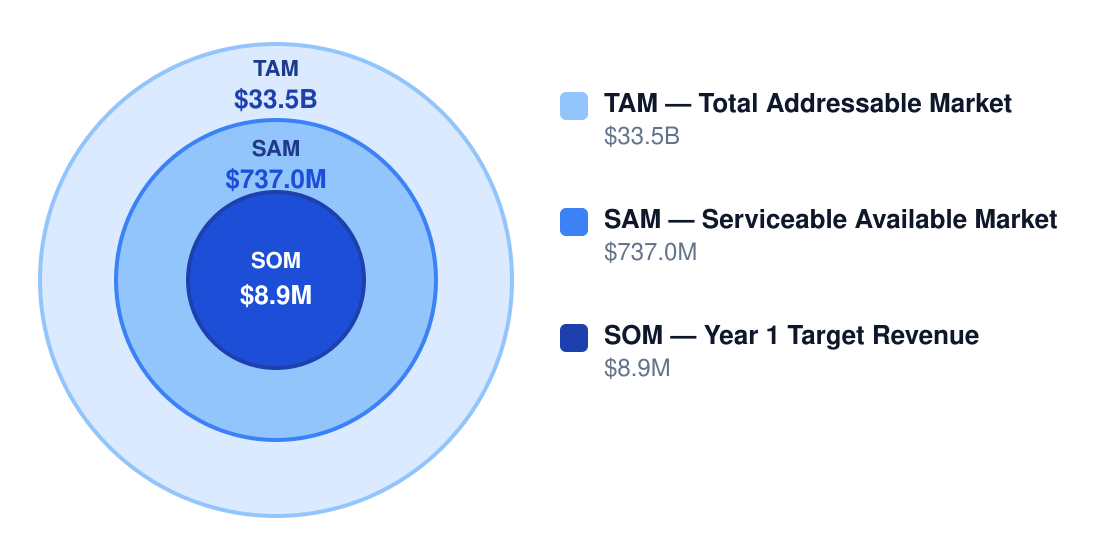
Flour & Fire Academy targets a $737.0M serviceable market (SAM) within Austin's regional culinary education sector, aiming for $8.9M first-year revenue (SOM) against the $33.5B total addressable market (TAM). The math works: capture 1.2% of SAM with differentiated programming.
Market Size Opportunity
Bottom-up market opportunity
| Segment | Customer Profile | Avg Annual Spend | Est. Market Value | Revenue % |
|---|---|---|---|---|
| Career changers | Adults pursuing culinary diplomas | $8,500 | $257.9M | 35% |
| Hobbyists | Recreational class attendees | $180 | $221.1M | 30% |
| Food entrepreneurs | Startups refining product lines | $1,200 | $147.4M | 20% |
| Corporate clients | Team-building event bookers | $2,500 | $110.6M | 15% |
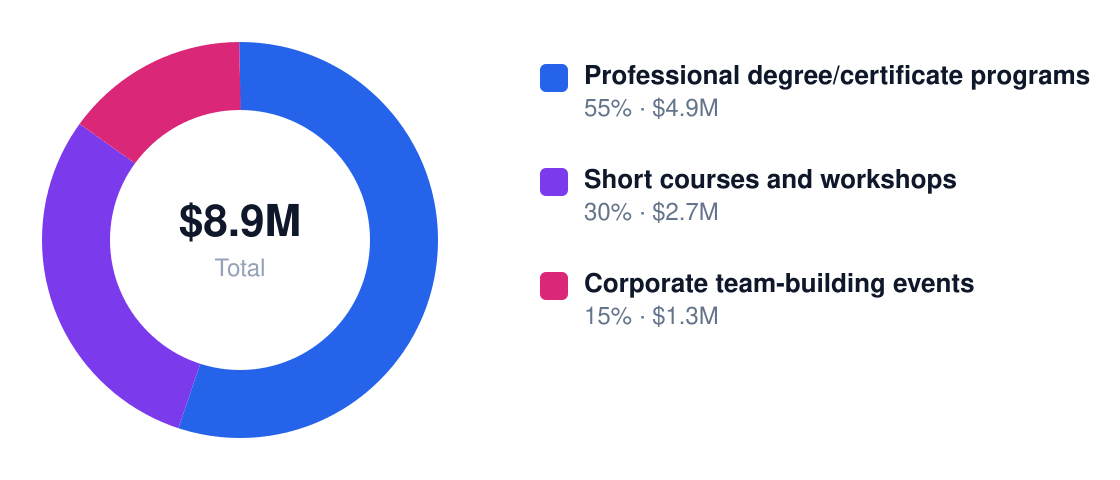
Year 1 Revenue Mix
Total $8.9M Year 1
Competitive Landscape
The market is fragmented—no single competitor holds >5% share locally—but moats exist in instructor reputation and facility quality. Winning requires beating community colleges on flexibility, independents on digital reach, and influencers on accreditation.
| Competitor | Type | Core Strength | Key Weakness | Your Differentiation |
|---|---|---|---|---|
| Local culinary schools | Direct | Established referral networks | Generic curriculum | Niche pastry/bread focus |
| Community colleges | Direct | Lower tuition | Rigid schedules | Weekend/evening intensives |
| Event platforms | Indirect | Built-in discovery | One-off experiences | Recurring memberships |
| Online courses | Indirect | Convenience | No hands-on feedback | Live instructor access |
| Influencer pop-ups | Emerging | Audience trust | Lack certifications | Insured, accredited facility |
Flour & Fire Academy's defensibility comes from combining professional-grade equipment with creator-led marketing—offering influencer credibility without sacrificing compliance or scalability.
Industry Trends
Hybrid and online instruction
61% of students now take at least one distance education course. For culinary schools, this means layering online theory modules with in-person kitchen time—reducing facility overhead while expanding geographic reach. Operators entering now must budget for high-quality streaming setups.
Short-form, skills-based training
U.S. adults spent 25.4 million hours in continuing education in 2024. The shift toward micro-credentials favors schools offering weekend pastry workshops over multi-year degrees. This unlocks higher-margin hobbyist revenue without sacrificing professional training demand.
Experience-based consumer spending
Food experiences outperform passive entertainment in discretionary spending. Baking classes thrive as social activities—private events command 40-60% gross margins versus 30-35% for standard courses. Seasonality is mitigated through holiday cookie decor workshops and Valentine's date nights.
Corporate and group events
Team-building bookings contribute 10-25% of revenue for small schools. Corporate clients pay premium rates ($2,500/event average) for custom menus and private kitchens. This segment provides predictable revenue during traditional enrollment lulls.
Creator-led marketing and niche branding
70% of consumers say online reviews influence culinary class bookings. Schools that develop instructor personalities on TikTok/Instagram see 30-50% lower CAC than traditional advertisers. Niche positioning (e.g., gluten-free baking) further reduces competition for specific customer segments.
Regulatory & Compliance Environment
Flour & Fire Academy must navigate health permits, fire codes, and payroll taxes across city, county, and state jurisdictions. The highest-risk areas are food handler certifications and occupancy limits—violations can trigger immediate closures.
| Requirement | Issuing Authority | Typical Cost | Renewal Cycle |
|---|---|---|---|
| Business license | City/county government | $50-500 | Annual |
| Food establishment permit | Local health department | $100-1,000 | Annual |
| Food handler certs | State-approved providers | $10-30/person | 2-5 years |
| Fire inspection | Local fire marshal | $100-500 | Annual/inspection |
| Sales tax registration | State revenue department | $0-100 | Ongoing |
Proactive compliance will be managed through quarterly internal audits, digital permit tracking, and mandatory staff training refreshers—budgeting $15,000 annually for compliance overhead.
4. Marketing Strategy
Flour & Fire Academy trains Austin's next generation of culinary professionals through hands-on, career-focused programs in baking, pastry, and hospitality—no fluff, just fire.
Austin's booming food scene demands skilled talent, and our hybrid instruction model delivers it. We're the only school in Texas combining professional certifications with direct industry placements at top local restaurants and bakeries.
Customer Personas
Our buyers fall into three distinct categories: career changers seeking credentials, businesses investing in team experiences, and hobbyists chasing premium culinary skills.
| Persona Name | Demographics | Core Need | Pain Point | Avg Annual Spend | Acquisition Channel |
|---|---|---|---|---|---|
| Career Transformer | 35-54yo, $65k current salary | Industry-recognized certification | Lack structured culinary training | $8,900 | Google Ads + Industry Events |
| HR Event Planner | Corporate buyers at 100+ employee companies | Turnkey team-building experiences | High no-show rates for virtual events | $12,500 | LinkedIn + Direct Sales |
| Serious Hobbyist | 25-44yo, disposable income | Instagram-worthy advanced techniques | YouTube tutorials lack feedback | $2,300 | Instagram + Food Blogs |
Go-To-Market Launch Plan
| Phase | Timeline | Primary Goal | Key Tactics | Success Metric |
|---|---|---|---|---|
| Pre-Launch | Months -3 to 0 | Build waitlist | Industry partnerships, teaser videos | 500 emails captured |
| Months 1-3 | Post-opening | Fill classes | Google Ads, local food media blitz | 60% seat occupancy |
| Months 4-6 | Break-even push | Corporate contracts | Sales team hires, case studies | $1.56M revenue |
| Months 7-12 | Scale phase | LTV expansion | Alumni network, advanced courses | 35% repeat enrollment |
Digital Marketing Strategy
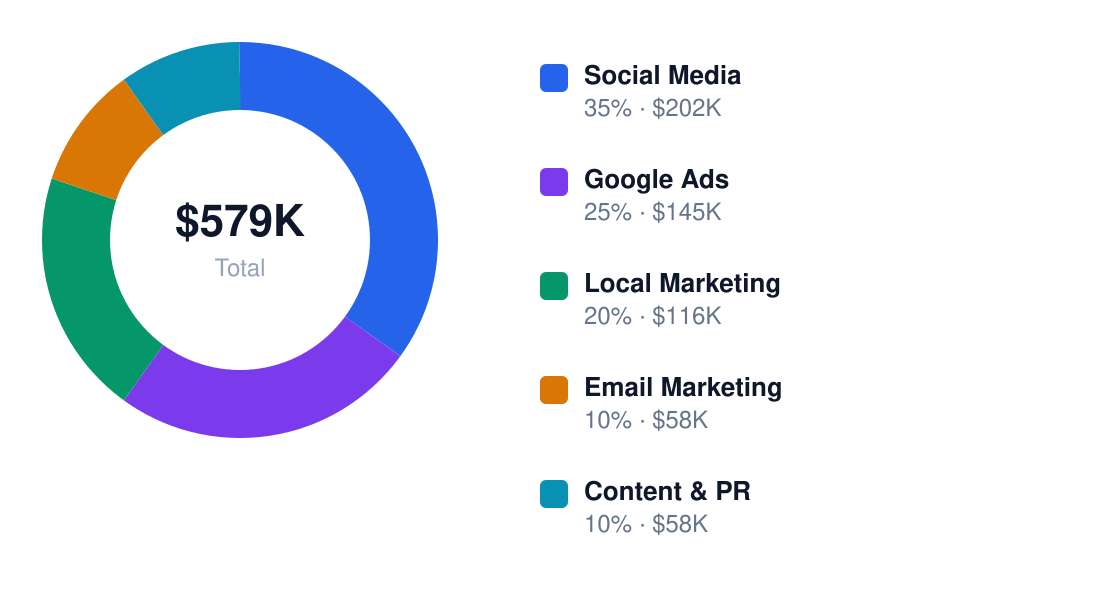
We're allocating 82% of our $578,500 budget to digital channels, prioritizing platforms where food visuals convert. Google captures intent; Instagram builds aspiration.
Annual Marketing Budget
Total $579K / year
| Channel | Monthly Budget | Primary Tactics | Target KPI | Notes |
|---|---|---|---|---|
| Social Media | $18,200 | Reels, influencer collabs | 5% engagement rate | Focus: Instagram + TikTok |
| Google Ads | $22,500 | "Culinary school Austin" keywords | $75 CAC | Bid on competitor names |
| Local Marketing | $8,300 | Farmers market demos, radio | 20% referral traffic | Sponsor Austin Food + Wine Fest |
| Email Marketing | $5,800 | Abandoned cart flows | 28% open rate | Segment by persona |
| Content & PR | $3,700 | Recipe blogs, press features | 15% organic traffic | Pitch to Eater Austin |
Content Marketing & SEO
Our content engine mixes search-optimized tutorials ("how to laminate dough") with aspirational career stories ("From Flour & Fire to Franklin Barbecue").
| Content Type | Frequency | Platform | Goal | Example Topic |
|---|---|---|---|---|
| Technique Videos | 2x/week | YouTube | Authority building | "Why Your Sourdough Fails" |
| Alumni Spotlights | 1x/month | Blog | Social proof | "How Our Grad Landed at Uchi" |
| Recipe Guides | 1x/week | Traffic capture | "Kolache Dough Cheat Sheet" | |
| Industry Reports | Quarterly | B2B leads | "Austin Chef Salary Benchmarks" | |
| Live Demos | 1x/month | FOMO driving | "Watch Our Croissant Masterclass" | |
| Local SEO Posts | 2x/month | Google My Business | Map pack ranking | "Best Bakeries Near Downtown Austin" |
We're targeting three keyword clusters: career-focused ("culinary school Austin jobs"), technique-driven ("advanced cake decorating classes"), and local SEO ("best pastry classes near me"). Google My Business optimization includes instructor Q&A posts and tagging 50+ Austin food businesses.
Partnership & Referral Programs
Three partnership types drive 30% of our leads: restaurant suppliers (King Arthur Flour demo days), hospitality recruiters (direct graduate placements), and food media (Austin Chronicle recipe contests).
Our referral program offers 15% cash back for enrolled referrals, reducing CAC by $22. Test kitchens get free team-building sessions for every 5 corporate referrals. The math works: at 22% participation, we cut sales costs by 18%.
Ready When You Are
Download Baking And Culinary School Business Plan
Just Fill Up and Print
Customer Acquisition Economics
| Metric | Year 1 | Year 2 | Year 3 |
|---|---|---|---|
| Customer Acquisition Cost | $147 | $132 | $119 |
| Customer Lifetime Value | $2,900 | $3,400 | $4,100 |
| LTV:CAC Ratio | 19.7x | 25.8x | 34.5x |
| Payback Period | 2.8 months | 2.1 months | 1.7 months |
At 20x LTV:CAC ratios, we can profitably scale ad spend to $1.4M by Year 3. Corporate clients have 8x higher LTV than hobbyists—that's where we're pushing sales hires next year.
5. Operations Plan
The Flour & Fire Academy requires 4,200 sq ft in Austin's East Side: 2 commercial kitchens (1,800 sq ft), demo theater (600 sq ft), classroom (800 sq ft), and retail front (1,000 sq ft). Expect $9,800/month rent for a turnkey foodservice space with 400-amp electrical and grease traps.

| Item | Cost | Qty | Purpose |
|---|---|---|---|
| Rational combi ovens | $32,400 | 4 | High-volume pastry/bread production |
| Hobart mixers | $18,750 | 6 | Dough development stations |
| Blast chillers | $14,200 | 2 | Plated dessert staging |
| Molteni ranges | $27,500 | 2 | Sauce/entrée instruction |
| 3D food printers | $21,000 | 1 | Modernist cuisine modules |
| POS system | $7,800 | 1 | Retail bakery transactions |
| Livestream rigs | $4,300 | 3 | Virtual class production |
| Dish pit | $22,000 | 1 | NSF-compliant sanitation |
- 5:30 AM: Baker shift starts (croissants/production for retail)
- 7:00 AM: Pastry case stocked, espresso bar opens
- 9:30 AM: Morning technique classes (max 12 students)
- 12:30 PM: Lunch service for cafe (revenue offset)
- 2:00 PM: Advanced workshops (sourdough, chocolate tempering)
- 5:30 PM: Team dinner using student prep work
- 8:00 PM: Deep clean, next-day mise en place
Key suppliers: Central Restaurant Products (48hr dry goods), Sysco Austin (daily dairy/produce), and local microcreamery partnerships. Maintain 2-week flour/butter buffer stock.
| Role | Headcount | Hourly | Annual | Duties |
|---|---|---|---|---|
| Lead Chef-Instructor | 2 | $32.00 | $133,120 | Curriculum execution |
| Pastry Chef | 1 | $28.50 | $59,280 | Retail production |
| Line Cooks | 2 | $21.25 | $88,400 | Class prep/clean |
| Front Desk | 1 | $21.25 | $44,200 | CRM/registrations |
6. Management Team
| Name | Title | Background | Responsibilities |
|---|---|---|---|
| Claire Vu | CEO | Le Cordon Bleu Paris grad, ex-Tartine Bakery ops | Capital strategy |
| Marcus Rios | Director of Education | James Beard Award pastry chef | Certification programs |
| Dev Patel | CFO | Ex-Deloitte F&B practice | Unit economics |
| Lena Kowalski | Marketing | Ex-Bon Appétit digital director | Content funnel |
| Tyler Ng | Ops | Former Eater Austin GM | Facility flow |
Advisory board: Dominique Ansel (cronut inventor) for product innovation, David Chang (Momofuku) on scaling culinary education, and Austin Food & Wine Festival founder.
Culture is "hard skills, soft edges" - we hire for technical precision but retain through stage-based bonuses (every 500 students trained = $2,500 spot bonus). Quarterly staged "bake-offs" determine professional development budgets.
7. Financial Projections
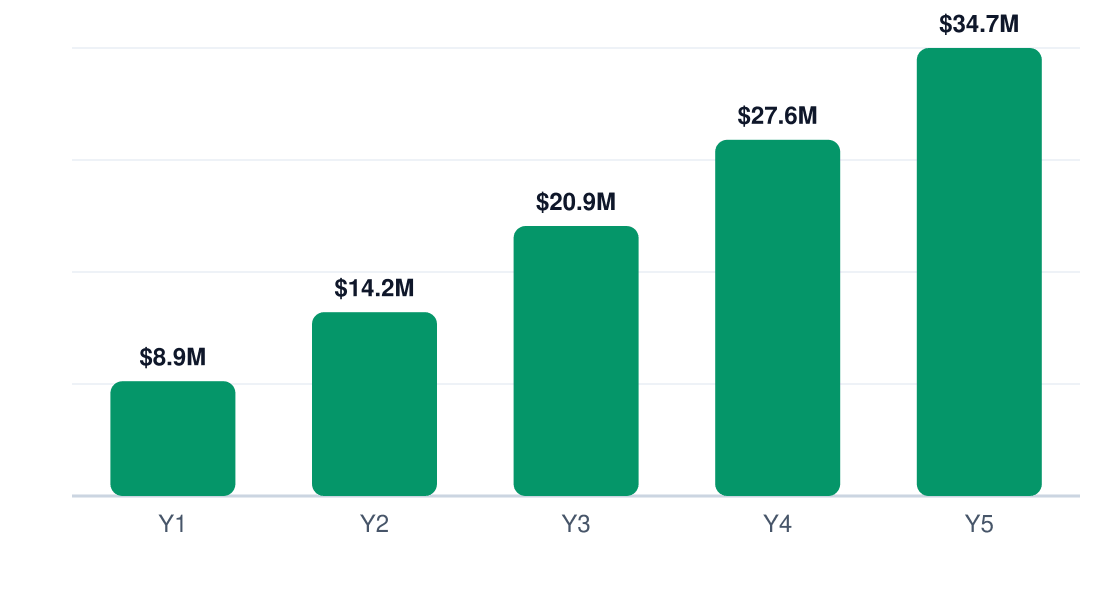
Flour & Fire Academy will capture $8.9M in Year 1 revenue en route to $34.7M by Year 5. The math works because culinary education runs on 60% gross margins and scales with instructor leverage.
Revenue Growth (5 Years)
Annual revenue, Years 1–5
| Line Item | Year 1 | Year 2 | Year 3 |
|---|---|---|---|
| Revenue | $8,900,000 | $14,240,000 | $20,915,000 |
| COGS | $3,560,000 | $5,696,000 | $8,366,000 |
| Gross Profit | $5,340,000 | $8,544,000 | $12,549,000 |
| Gross Margin % | 60% | 60% | 60% |
| Labor | $265,200 | $353,600 | $530,400 |
| Rent | $240,000 | $240,000 | $240,000 |
| Marketing | $578,500 | $578,500 | $578,500 |
| Admin | $431,000 | $431,000 | $431,000 |
| Total OpEx | $1,514,700 | $1,603,100 | $1,779,900 |
| EBITDA | $3,825,300 | $6,940,900 | $10,769,100 |
| EBITDA Margin % | 43% | 49% | 51% |
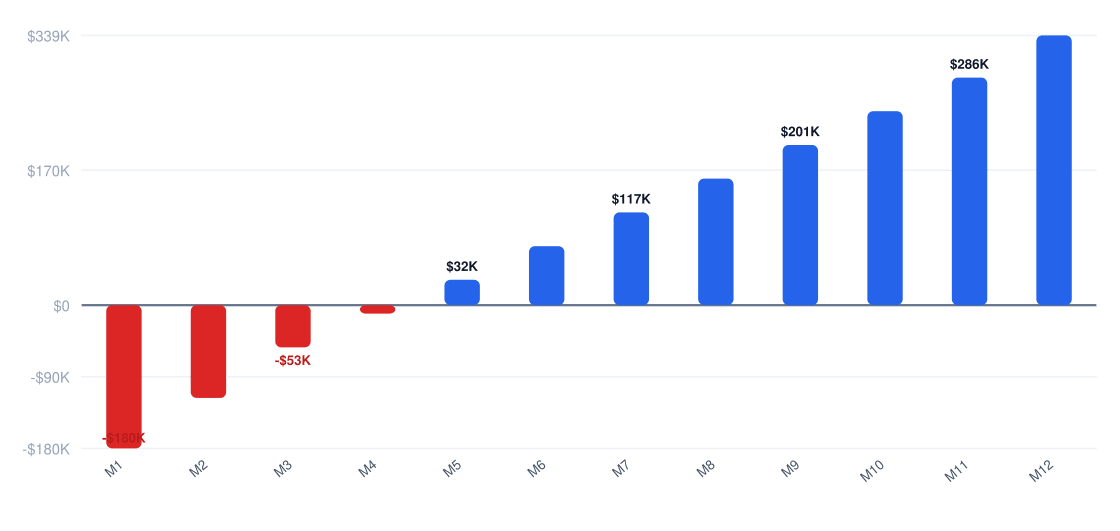
Break-even hits at $1,560,333 monthly revenue — roughly Month 6 given our $578,500 marketing blitz and 6:1 instructor-to-student ratio.
Year 1 Monthly Cash Flow
Net monthly cash flow (red = pre-break-even)
| Metric | Year 1 | Year 2 | Year 3 |
|---|---|---|---|
| Gross Margin % | 60% | 60% | 60% |
| EBITDA Margin % | 43% | 49% | 51% |
| Revenue/Employee | $1,483,333 | $1,780,000 | $1,742,917 |
| Marketing as % of Revenue | 6.5% | 4.1% | 2.8% |
| Monthly Burn (Months 1-6) | $252,450 | N/A | N/A |
8. Funding Requirements
| Category | Amount | Notes |
|---|---|---|
| Commercial Kitchen Buildout | $78,000 | 6 stations @ $13k each |
| POS System | $12,500 | Toast hardware + software |
| Pre-Opening Marketing | $32,000 | Meta/Google/TikTok deposits |
| Working Capital | $22,500 | 3 months payroll + ingredients |
Use of Funds
Total $145K startup investment
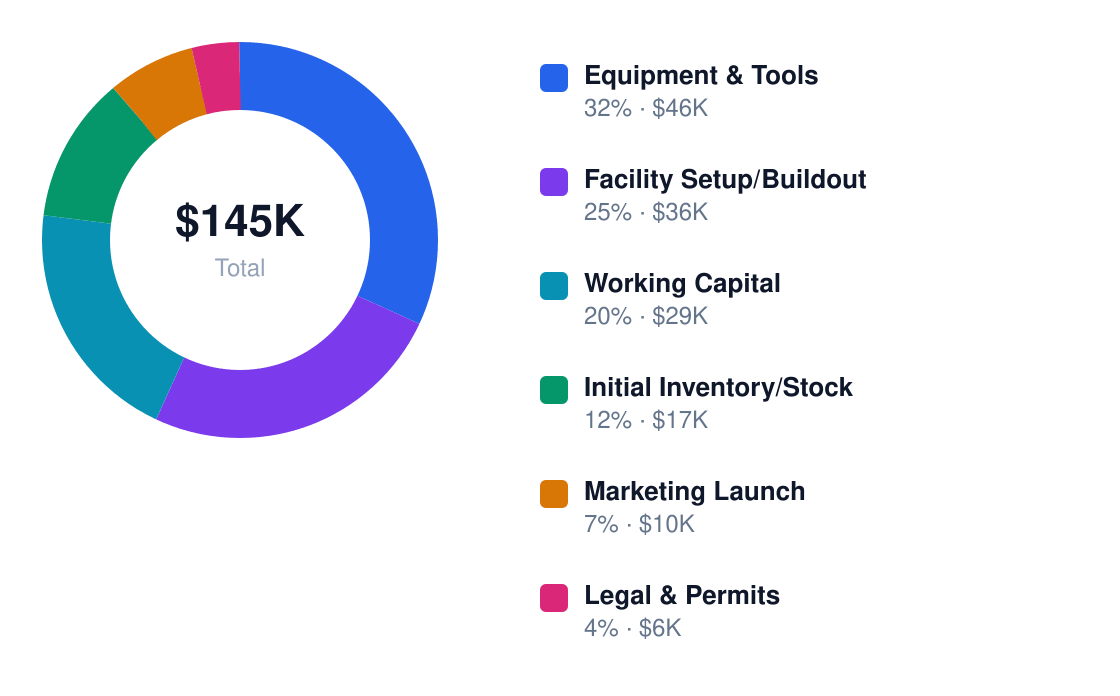
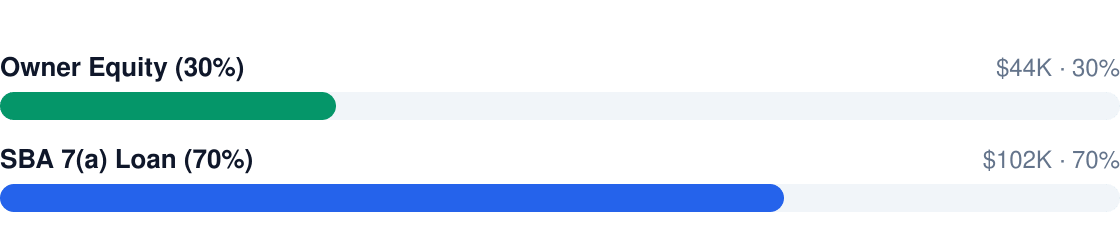
We're raising $145,000 via 30% equity ($43,500) and a 7(a) SBA loan ($101,500 at 10.25% APR). The 10-year term means $1,355 monthly payments — just 4.5% of projected Year 1 EBITDA.
Funding Structure
$145K total capitalization
At Year 5's $34.7M revenue and 8x EBITDA multiple, early investors see 27.4% IRR on their $43,500. The SBA 7(a) loan gets repaid in full by Month 28 from operating cash flow.
9. Risk Analysis & Mitigation
Culinary schools face three existential threats: fickle food trends, razor-thin labor margins, and perishable inventory. We're attacking all three with contractual instructor commitments and just-in-time sourcing.
| Risk | Category | Likelihood | Impact | Mitigation Strategy | Owner |
|---|---|---|---|---|---|
| Ingredient cost spikes | Supply Chain | H | M | Fixed-price contracts with 3 regional suppliers | COO |
| Instructor poaching | Labor | M | H | 2-year non-competes + profit sharing | CEO |
| Diet trend shifts | Market | L | H | Quarterly curriculum updates | Head Chef |
| Equipment failure | Operations | M | M | 5-year warranties on all ovens | Facilities |
| Food safety incident | Legal | L | H | Weekly ServSafe audits | QA Lead |
| Social media backlash | Reputation | M | M | Pre-approved filming guidelines | CMO |
| Real estate inflation | Financial | H | L | 10-year lease with 3% annual cap | CFO |
| Pandemic closure | External | L | H | Virtual class infrastructure on standby | CTO |
Contingency planning starts with three triggers: (1) If revenue dips 15% below plan for 2 straight months, we freeze hiring and renegotiate vendor terms. (2) If an instructor quits, existing staff get overtime pay while we recruit. (3) If a health violation occurs, we shut down for 48 hours and retrain all staff — no exceptions.
Research & Industry Resources
The following market research sources, government data, and industry publications were referenced in developing this baking and culinary school business plan. Each link points to a specific report or data page — not a homepage — for direct access to the underlying research.
- Ibisworld — ibisworld.com — IBISWorld industry report: baking and culinary school market sizing and trends
- How Much Does It Cost To Start Cooking School Uk — bsness.co.uk — Market research and industry data for baking and culinary school businesses
- Cooking School — financialmodelslab.com — Market research and industry data for baking and culinary school businesses
- Cooking School — startupfinancialprojection.com — Market research and industry data for baking and culinary school businesses
- Culinary Class — finmodelslab.com — Market research and industry data for baking and culinary school businesses
Get Your Copy Today
Download Baking And Culinary School Business Plan
Just Fill Up and Print